


How two research teams and a London based quantum hardware company are betting nanoscale gold can crack the stability-scalability problem that has stalled every other qubit platform.
Insider Brief
- Delta Gold Technologies is betting on nanoscale gold as a new qubit platform, running two parallel research programs — with Penn State and the University of Toronto — that target quantum computing’s long-standing trade-off between qubit stability and scalability.
- Penn State’s optical approach, led by Professor Kenneth Knappenberger, has recorded roughly 40% spin-polarised photon emission in gold nanoclusters — the highest such figure reported in any condensed-phase quantum material — alongside gram-scale synthesis achievable under standard lab conditions.
- Toronto’s electrical approach, led by Professor Harry Ruda, builds atomically precise planar gold structures via Molecular Beam Epitaxy; Penn State has filed three full patent applications and Toronto a provisional patent, giving Delta Gold a foundational IP position ahead of either program producing a finished device.
Quantum computing’s race for a stable, scalable qubit has never lacked contenders. Trapped ions, superconducting circuits, photonic systems, neutral atoms, silicon spin — each modality stakes its claim on the same unsolved problem: how to build a qubit that is stable enough to hold a quantum state and scalable enough to manufacture in bulk. So far, every platform has had to trade one for the other.

Now, an unlikely candidate has stepped into this crowded arena: gold. Not gold as bullion or jewellery, but gold reduced to nanoclusters and atomically thin layers, engineered to display tunable quantum-mechanical spin properties. Delta Gold Technologies, working with research teams at Penn State University and the University of Toronto, believes it has found a genuinely new route into the field.
Two Streams, One Thesis
The idea did not begin with quantum computing in mind. Delta Gold CEO Mike Jones recalls the conversation started with a much narrower question about catalysis, which he put to Professor Harry Ruda of the University of Toronto.
Ruda took the question further than expected.
“Pardon the pun — it catalysed the question about gold, and working in quantum,” he said, describing how an initial dead end around superconductivity gave way, weeks later, to a different insight entirely. That reframing produced two parallel research streams, unified under Delta Gold’s sponsorship but distinct in method.
At Penn State, Professor Kenneth Knappenberger’s group works with gold optically: Quantum information is encoded in the spin of gold nanoclusters and read out through polarised light emission. Meanwhile, at the University of Toronto, Ruda’s group works with gold electrically, using Molecular Beam Epitaxy — a technique for growing ultra-pure crystalline films one atomic layer at a time — to build atomically precise planar gold structures and address spin states through circuitry rather than photons.
Different instruments, different signatures, but the same underlying material and the same wager: Gold’s electronic structure can be tailored into a platform other modalities simply cannot match.
What a Qubit Actually Needs
A classical bit is settled: a one or a zero, up or down, with no state in between.
A qubit is not settled in this way.
It can exist as a superposition of both states at once, weighted with different probabilities. A means to visualize this would be to consider the surface of a sphere where the two classical states are sitting at the poles, and every other point represents a distinct mixture between them.
A quantum computer’s power comes from manipulating that position on the sphere directly, rather than checking one fixed value at a time. Entangle multiple qubits together and the number of states a system can represent simultaneously grows exponentially, which is what allows quantum machines to explore vast combinations of possibilities in parallel rather than sequentially.
Building a working qubit out of that idea means satisfying two requirements that tend to work against one another.
- The first is stability: the superposition has to hold its position on the sphere long enough to be read out and operated on, without being knocked off course by heat, vibration, or stray electromagnetic noise.
- The second is scalability: a useful computer needs not one or ten qubits but thousands, produced reliably and cheaply enough to be wired into a real device.
The physics that gives a system its stability tends to be the same physics that makes it hard to scale. Isolated particles, held in near-perfect vacuum and cut off from their surroundings, preserve a quantum state for a long time precisely because they are so isolated. Unfortunately, that isolation also makes them difficult to pack together densely. In contrast, materials that are easy to manufacture in bulk sit close together in a solid, and that proximity introduces the very interactions that degrade coherence.
Every existing modality sits somewhere on this spectrum, and none has resolved the trade-off outright:
- Trapped-ion systems illustrate one end of that spectrum. Individual ions, suspended and manipulated with lasers, offer some of the best coherence times and highest-fidelity operations of any current platform. But, each ion has to be addressed one at a time, which puts a hard ceiling on how far the approach can scale.
- Diamond nitrogen-vacancy centres illustrate a different failure mode. The qubit here is not the diamond itself but a rare atomic-scale defect within it, occurring at a low enough probability that only a small fraction of the material created ends up with the properties needed. This leaves even a successful lab demonstration facing a serious supply-chain problem at any real scale.
- Superconducting circuits and neutral atoms fare better on scalability, but generally at the cost of very short coherence times, measured in microseconds. Across the field, the pattern repeats: whichever axis a platform gains on, it tends to lose on the other.
Why Gold Is Different
Gold nanoclusters are potentially a way out of that bind, because they are designed rather than discovered.
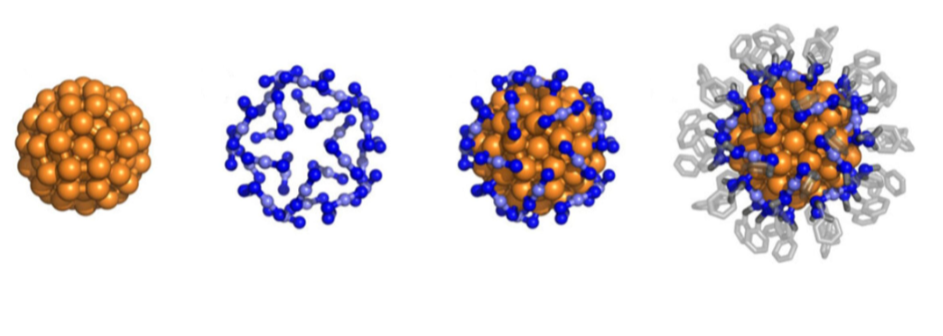
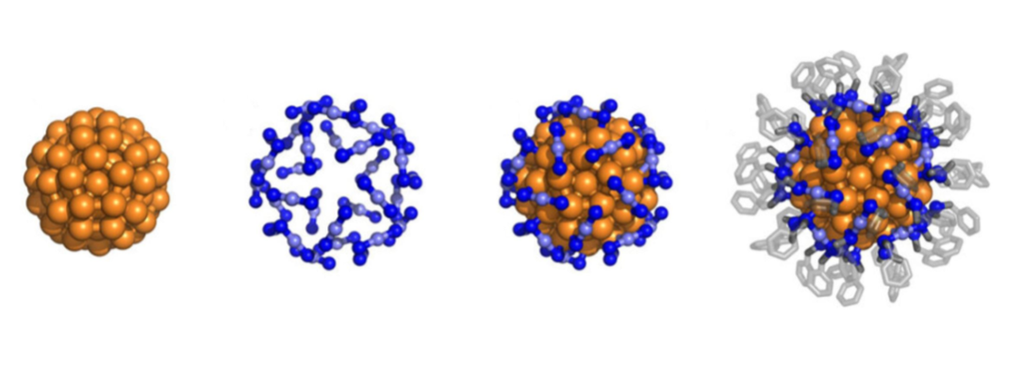
Where a diamond defect either occurs or does not, a gold nanocluster’s structure, characterized by its size, its surface chemistry, and the ligands attached to it, can be deliberately built to produce a specific desired property in every unit synthesised, rather than relying on a low-probability accident of nature.
This remarkable tunability is a manufacturing advantage as much as a physics one: it points toward a route where quality is engineered in from the outset instead of sorted for after the fact.

“There’s actually something really interesting about the electronic structure in gold, and I think we could use it to do quite a different approach to information.” — Professor Harry Ruda, University of Toronto
The field of quantum information science has so far been built largely by physicists and materials scientists, working with whatever a given material happens to offer. Knappenberger and Ruda’s argument is that chemistry, the discipline of building and adjusting molecular and nanoscale structures on purpose, has barely been applied to the problem.
In gold’s case, it is an unusually good candidate for the test. Why? Its intrinsic electronic structure already resembles the properties that make isolated ions stable. Even more so, unlike an ion, a gold cluster can be modified or retuned to emit and absorb at different frequencies, depending on what a given application demands.
Turning the Idea into Devices
The two research streams at Penn State and University of Toronto have already produced measurable results consistent with that thesis.
At Penn State, gold nanoclusters have shown roughly 40% spin-polarised photon emission. This is the highest figure the research team is aware of in any condensed-phase quantum material and at a physical size roughly an order of magnitude smaller than conventional microelectronics. Furthermore, gram-quantity synthesis has already been demonstrated under standard laboratory conditions, establishing a manufacturable baseline that trapped-ion and most superconducting approaches lack.

“The approximately 40% spin-polarised emission we have recorded has not been achieved in any other material system I am aware of.” — Professor Kenneth Knappenberger, Penn State University
At the University of Toronto, the approach is structurally different but philosophically aligned. Rather than free-standing clusters, the team works with gold in planar, atomically thin layers, grown one layer at a time and addressed electronically instead of optically.
Because the underlying patent applications are still being filed, the specific mechanisms cannot yet be disclosed in detail but early experimental results are described by the team as consistent with their theoretical models, and encouraging enough to support an expanded, multi-year research programme.
Three full patent applications have already been filed by Penn State, with a provisional patent filed by the University of Toronto and specific applications targeted for 2027, giving Delta Gold a foundational IP position at both institutions before either research programme has produced a finished device.
From Laboratory to Licensable Platform
Delta Gold’s commercial logic follows the two research streams directly, with separate near-term, mid-term, and long-term milestones for each.
Penn State’s optical route is building toward a first product in an optical quantum sensor, en route to a longer-term networked cluster device. The University of Toronto’s electrical route is building toward a topological quantum spin sensor, en route to a scalable topological system.
Internally, the company refers to the point at which these two paths are meant to converge as “Project Hurricane”: a single hybrid gold platform combining stable, scalable computation with networking capability built into the same material, rather than bolted on afterward.
The patents already filed at both institutions are intended as the foundation layer beneath that roadmap and positioning Delta Gold to license it onto a quantum computing and sensing market with an estimated worth well over a trillion dollars in economic value across industries by 2035.
The Case Still to Be Made
Gold’s candidacy remains, by its own backers’ admission, at the research stage rather than the device stage: a set of patents, published results, and early prototypes rather than a finished, commercially deployed qubit.
Nevertheless, the underlying case is coherent. Gold is a material that can be chemically tailored rather than merely discovered, pursued in parallel through two genuinely different physical approaches, with encouraging results in both.
It is too early to say that nanoscale gold structures have solved the problem of stability and scale. But these structures now clearly belong in the conversation about quantum modalities. On the evidence assembled so far, they are a contender the field will find increasingly hard to overlook.