
Guest Post by Dr. Kris Naudts, Zeynep Koruturk and Donald Harmitt @ Firgun Ventures.
Firgun Ventures is a VC firm investing in Series A/B quantum scale-ups globally.
CERN occupies a monumental position in European science and particle physics. The laboratory near Geneva operates the Large Hadron Collider, the world’s largest and most powerful accelerator, and confirmed the Higgs boson, the particle linked to how other particles gain mass. It also gave the world the web in 1989, through the British scientist Tim Berners-Lee and his Belgian collaborator Robert Cailliau, creating a natural expectation that it should anchor Europe’s quantum ambitions.
The laboratory holds ground that rival quantum vendors and European policymakers alike treat as neutral, underwritten by a funding structure few national programmes can match. From that position it is drawing quantum sensing towards its detectors, quantum networks towards its timing systems, and quantum processors onto its benchmarks. The common thread is that CERN’s influence comes from testing other people’s quantum hardware and supplying the specialist engineering that hardware depends on.

CERN’s Neutral Ground is its Most Unique and Most Influential Quantum Asset
CERN’s Quantum Technology Initiative (QTI) calls the laboratory an “honest broker” among member states. Neutral ground carries a specific meaning in a market where almost every performance claim comes from the company selling the machine. Benchmarks decide which machine looks fastest and whose architecture everyone else must accommodate, so a comparison run by one vendor reads as a commercial move and rivals decline to take part. CERN sells nothing, competes for no quantum customers, and publishes what it finds, which is why competitors will put equipment into its laboratories and rely on the numbers that come out.
The Open Quantum Institute, incubated through the Geneva Science and Diplomacy Anticipator (GESDA), began its CERN-hosted pilot in March 2024 with UBS as lead partner, steering quantum computing towards the UN Sustainable Development Goals. CERN is an associate member of the European Quantum Industry Consortium (QuIC) and hosted its Quantum Business Community Summit in November 2025.
The position gains value as European infrastructure fills out, with the Commission’s Quantum Europe Strategy of July 2025 tying quantum to competitiveness and sovereignty, and EuroHPC, the joint EU and member state body funding Europe’s supercomputing, opening pilot access to four of its six quantum computers in June 2026. Nothing in CERN’s strategy suggests an ambition to build a general-purpose machine in competition with IBM, Pasqal, Quantinuum or IQM, nor to run national systems such as Jülich, Germany’s national research and supercomputing centre, or CINECA, Italy’s national supercomputing consortium. Having no horse in the race leaves it free to assess scientific findings without a clear bias.
CERN’s Quantum Programme’s Funding Model Widened
CERN’s quantum story has three beginnings, the earliest in 2009, when the laboratory joined SwissQuantum, a Geneva-area prototype quantum key distribution network. This was then followed by a CERN openlab workshop in November 2018 that opened deliberate work on quantum computing, and then the institutional turning point of September 2020 with the launch of QTI. A formal strategy and roadmap followed in 2021, the year CERN became an IBM Quantum Network hub. Alberto Di Meglio, who leads QTI and CERN openlab, set out the ambition a year later, stating “CERN is well positioned to make significant contributions to the quantum revolution“. The programme has since run in two phases:
- Phase 1 (2020-2023) casts a wide net of more than 20 short-term projects across the three technology families, touching themes covered earlier in Firgun Ventures’ Insights pieces from quantum error correction to the quantum internet.
- Phase 2 (2024-onwards) focused the initiative onto four Centres of Competence:
- Hybrid quantum computing infrastructure and algorithms
- CERN technologies as quantum platform demonstrators
- Quantum network hub
- Collaboration for impact
Underwriting the narrowed programme is a funding structure that resembles the EU’s but works differently. CERN was created by treaty in 1954, and its 25 member states pay contributions tied proportionally to national income, each holding a single Council vote whatever it pays. Membership crosses the EU boundary, since the United Kingdom stayed after Brexit under CERN’s own convention. Switzerland, Norway, and Israel also sit at the same table, and the EU attends as an observer without a vote. Brussels can steer European quantum infrastructure through EuroHPC procurement and sovereignty rules, but it cannot steer CERN.
December 2025 added a layer, when private and philanthropic donors pledged up to $1 billion (860 million euros) towards the proposed Future Circular Collider (FCC), a successor to the current accelerator. This is the first time CERN has taken private money on this scale for a flagship research project. Donors include the fund of Eric Schmidt, the former Google chief executive, which already backs CERN’s $48 million Next Generation Triggers project. Other donors include the French telecoms founder Xavier Niel, John Elkann of Exor, the Italian holding company behind Ferrari and Stellantis, and the Breakthrough Prize Foundation. Scarcity gives that money weight, since the United States has not run an energy-frontier collider since Fermilab’s Tevatron, one of its national labs, closed in 2011, and China’s proposed Circular Electron Positron Collider missed Beijing’s latest five-year plan.
Whether private billions compromise that independence is a fair question, and the answer rests on scale and governance rather than donor intent. The pledge covers under a tenth of the CHF 15 billion ($17 billion) first stage, which member states must still approve, with a decision expected around 2028. No donation carries a vote in a Council where the smallest contributor has the same one as the largest. Those safeguards remain firm while private money stays a minority share of a project member states have chosen on scientific grounds, and the day it becomes the reason a project proceeds is the day neutrality weakens.
Quantum Computing Trails while CERN’s Sensing and Engineering Capabilities Advance Faster
CERN’s quantum computing progress comes from event classification, the work of sorting collision debris into signal and background. A flagship study of 2021 ran a quantum version of a standard machine learning classifier on Higgs production alongside top quarks. The study tested roughly 100 events on a 15-qubit IBM device, matching well-tuned classical methods rather than beating them. The accelerator controller that entered operation in March 2025 used conventional neural networks rather than quantum. Classical methods still set the standard, and publishing parity results rather than burying them is how a benchmark gets built, which QTI Phase 2 formalised by adopting quantum processors where controlled evidence justifies them.
One of the most useful things CERN has brought to quantum so far was not built for quantum. White Rabbit, designed to keep accelerator hardware synchronised to within fractions of a billionth of a second, first ran in 2012. Later, it entered the IEEE precision timing standard. It is now being tested in a quantum network laboratory opened in 2025, to see whether one fibre can carry both timing signals and the entangled photons quantum networks rely on. Quantum networks need a shared clock before they need more qubits. A similar pattern is seen across cryogenics, vacuum systems, and detector materials, which is how a laboratory whose computing results only match classical methods today can still be indispensable to the industry.
Where the Quantum Value will Materialise First for CERN
The trailing computing results and the promise of computing answer two different questions. What CERN offers quantum today is testing, timing, and materials, and what quantum offers CERN eventually is computing, in a laboratory whose simulation demands outgrow classical hardware. Sensing is likely to reach practical value first, meaning a device that moves out of the workshop into a live experiment without waiting for a market to form, in conditions far more stringent than any sales demonstration. The performance record it generates, published openly, tells the industry which designs hold up, while communications follows as the network laboratory matures and computing will likely follow because displacing mature classical workflows is difficult.
The window for proving that prediction is defined. The LHC has been in Long Shutdown 3 since June 2026, the rebuild that takes it offline for upgrades. Its successor, the High Luminosity machine, is scheduled to switch on around June 2030, running collisions at roughly 10 times the rate. Quantum methods therefore have the rest of this decade to show a convincing performance, accuracy, or energy advantage before that data surge. Which companies CERN lets through its doors over those years will be a credible signal, and EU governments choosing between going it alone and working together have a template in a body older than the EU. As China’s FCC decision nears in 2028 and Europe’s public quantum systems progress towards fault-tolerance quantum computing, CERN could shape the quantum race as it once shaped classical computing: pushing companies to improve, testing their technology on hard problems, and helping set common standards.
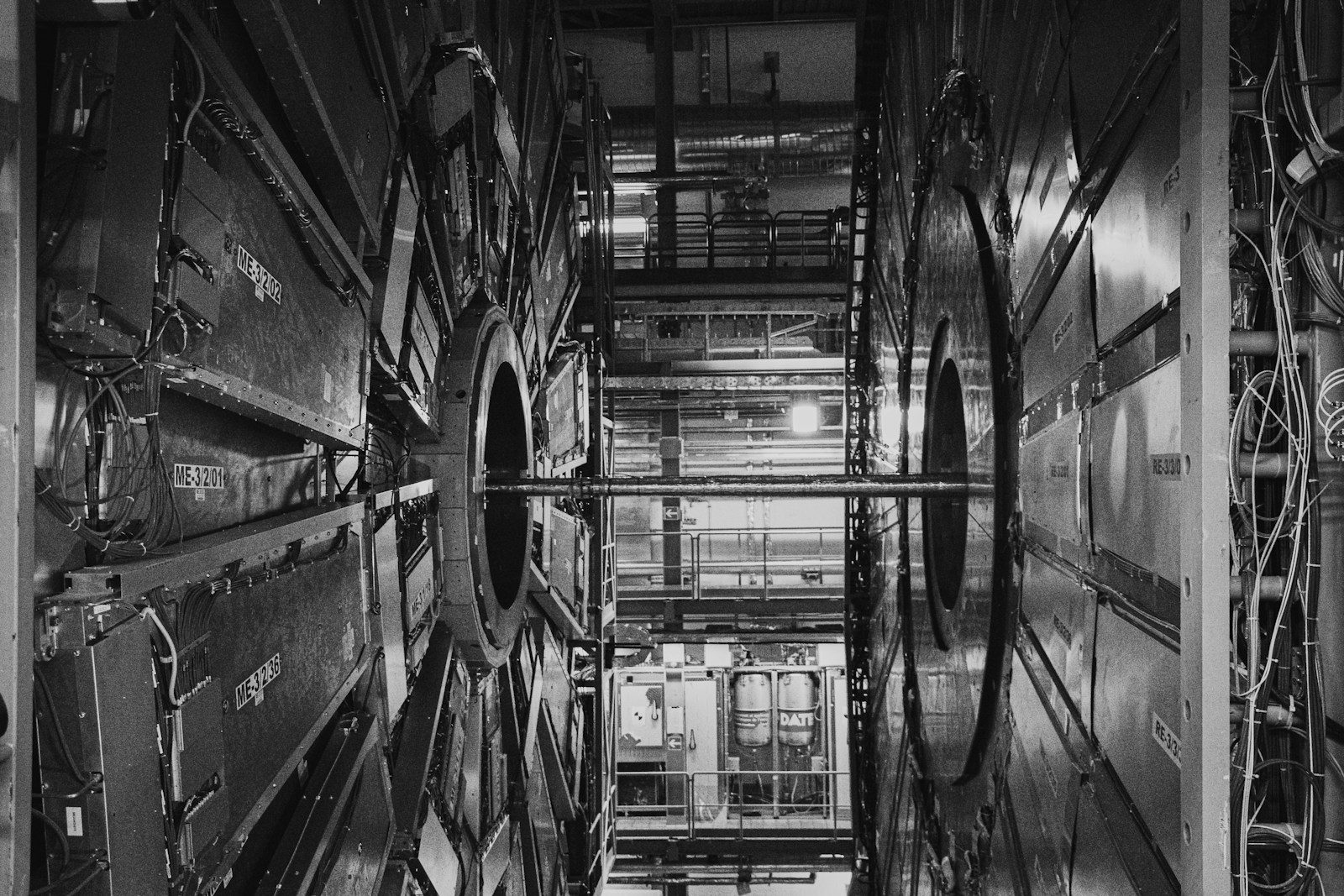
Image: Photo by Antonio Vivace on Unsplash