Quantum Keys Travel 18 Kilometers Across Hybrid Air-and-Fiber Network


Insider Brief
- Researchers demonstrated quantum key distribution across an 18-kilometer free-space link connected to conventional fiber infrastructure using adaptive optics.
- The system generated secret keys at about 1,000 bits per second with superconducting detectors and 200 bits per second with room-temperature detectors.
- Faster adaptive optics and automated fiber alignment could improve performance under strong turbulence and support future terrestrial and satellite quantum networks.
Researchers demonstrated quantum key distribution across an 18-kilometer free-space link by using adaptive optics to counter atmospheric turbulence and connect the signal to conventional fiber infrastructure.
The field trial in northeastern Italy generated secret encryption keys at an average rate of about 1,000 bits per second with high-efficiency superconducting detectors and 200 bits per second with compact detectors operating at room temperature. The results suggest that quantum communication equipment built for fiber networks could also support longer free-space and satellite links without extensive changes.
The study, published in npj Quantum Information, addressed a basic problem facing future quantum networks. Such networks will likely need to move quantum signals between fiber-optic cables, open-air links and satellites. Each transmission medium has different technical demands, making it difficult to connect them without losing the fragile quantum states that carry information.

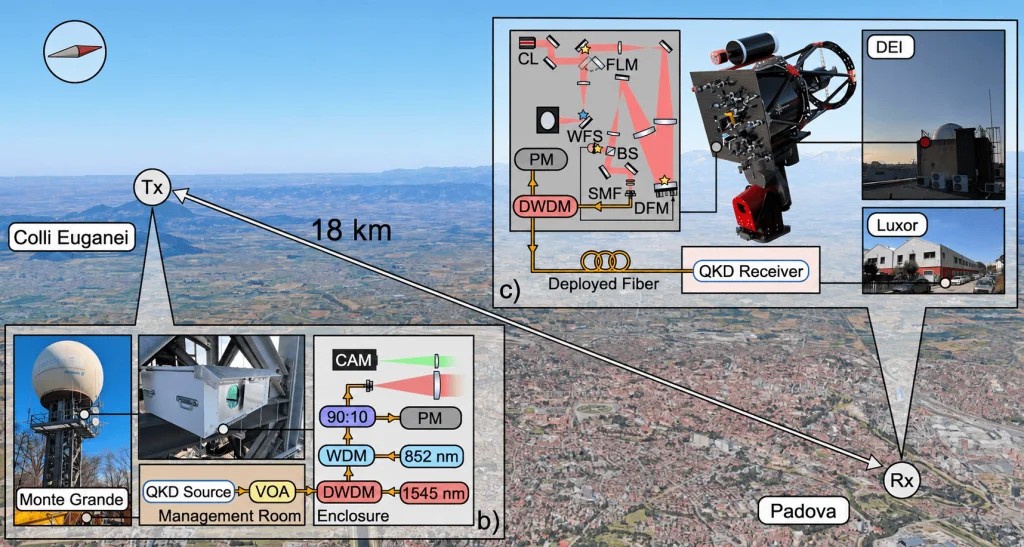
The researchers tested what they describe as an intermodal system, meaning the quantum signal traveled through both free space and installed optical fiber. A transmitter on Monte Grande in Italy’s Colli Euganei region sent the signal across 18 kilometers of open air to an optical ground station at the University of Padua. The signal was then placed into a standard single-mode fiber and carried about half a kilometer to a separate quantum key distribution receiver.
The system sustained secure key generation despite total channel losses of roughly 30 decibels, meaning only about one-thousandth of the original signal remained by the time it reached the receiver.
That level of loss approaches the operating limits of some commercial quantum key distribution systems originally designed for fiber connections. The experiment therefore provides evidence that adaptive optics can help extend existing equipment into hybrid networks that include free-space segments.
Quantum Keys Across Air and Fiber
Quantum key distribution, or QKD, uses properties of quantum physics to allow two parties to establish a shared encryption key. Measurements disturb quantum states, providing a way to detect certain attempts to intercept the key during transmission.
One way to think of how quantum key distribution works is it is somewhat like sending a series of tamper-evident coins whose condition changes when someone inspects them. The sender and receiver use matching measurements to turn the successfully delivered photons into a shared encryption key, while an unusually high error rate can reveal possible interception.
It’s important to note that the technology does not transmit ordinary data by itself. Instead, those secret keys can be used with conventional encryption systems. QKD is one of the more mature applications of quantum communications, but its deployment has largely centered on fiber networks or specialized free-space demonstrations.
Fiber is well suited to city and regional networks, while free-space transmission can reach locations without direct cable connections. It is also required for communication between satellites and ground stations. A practical quantum network may need to combine all three.
The Italian experiment used commercial polarization-based QKD equipment supplied by ThinkQuantum. Polarization refers to the orientation of a light wave and can be used to encode quantum information in extremely weak optical pulses.
The equipment implemented a version of the BB84 protocol, a widely studied QKD method. The transmitter prepared photons in three polarization states across two measurement settings. One setting generated the key, while the other helped the system check for errors and assess security.
The quantum signal operated at a telecommunications wavelength of 1,565.50 nanometers — about 50 times thinner than a human hair — and placing it within a spectral range commonly used by fiber networks. That compatibility allowed the team to route the signal into standard telecom fiber after the free-space portion of the journey.
Researchers treated the full path, including the transmitter fiber, free-space channel, receiving optics and final fiber segment, as one changing optical channel. The QKD system automatically adjusted for slow changes in polarization as the signal traveled through the hybrid link.
Correcting the Atmosphere
Atmospheric turbulence — the shifting pockets of air created by changes in temperature and wind — posed the experiment’s main technical obstacle. Changes in air temperature and density distort an optical wavefront as it moves through the atmosphere. The effect resembles the shimmering seen above a hot road, although the changes can be too small or rapid for the eye to detect.
Those distortions make it harder to focus arriving light into the narrow core of a single-mode optical fiber. Single-mode fiber is important because it filters unwanted light, supports precise wavelength filtering and connects directly to deployed telecom infrastructure.
Basic tracking systems can correct motion that shifts a beam from side to side. Over longer, low-altitude paths, however, turbulence also bends and warps the wavefront in more complex ways.
The University of Padua ground station used a telescope with a 41-centimeter aperture to collect the incoming signal. A Shack-Hartmann wavefront sensor measured the shape of the arriving light, while a deformable mirror with 64 actuators changed its surface to counter the distortions.
This high-order correction went beyond simple tip-and-tilt stabilization. The adaptive optics system operated in a feedback loop, repeatedly measuring the wavefront and adjusting the mirror before directing the quantum signal into the fiber.
An additional laser at a nearby telecom wavelength provided the adaptive optics system with a stronger reference beam. A separate beacon at 852 nanometers helped with coarse alignment between the transmitter and receiver.
After correction, the system coupled an average of about 12% of the available light into the fiber during a representative measurement. A model based on wavefront-sensor data predicted a coupling efficiency of about 19%. The researchers attributed much of the difference to manual fiber alignment and optical distortions that the deformable mirror could not correct.
The measured result was competitive with earlier free-space quantum communication tests over comparable distances, according to the study. Direct comparisons are difficult because experiments use different telescope designs, channel geometries, atmospheric conditions and correction systems.
Room-Temperature Detectors
The team conducted QKD runs on three occasions in April 2025. One trial used superconducting nanowire single-photon detectors with an efficiency of 80%. Another used indium gallium arsenide single-photon avalanche diodes operating at room temperature with 15% efficiency. A third room-temperature trial tested the repeatability of the setup.
The superconducting detectors produced an average signal rate of about 20,400 detections per second and an average secret key rate near 1,000 bits per second. The room-temperature detectors produced about 3,400 signal detections per second and a secret key rate near 200 bits per second.
The quantum bit error rate was below 1% with the superconducting detectors and about 2% with the room-temperature devices. That measure tracks how often transmitted quantum bits are recorded incorrectly. Excessive errors can prevent a QKD system from producing a secure key.
The lower rate from the room-temperature detectors was expected because they captured a smaller share of the arriving photons. They also contributed more detector noise to the measurement. Their successful operation is still significant because superconducting detectors require cryogenic cooling, adding cost, power demands and operational complexity.
Room-temperature detectors could support smaller and less expensive receiving terminals, although the trade-off would be lower performance. The experiment produced only hundreds of secret bits per second with those detectors, enough for some key-refresh operations but far below ordinary network data rates.
The researchers also found that the commercial QKD platform worked across the combined free-space and fiber channel without functional changes. Adaptive optics handled the atmospheric disruption before the signal entered the fiber, allowing the QKD equipment to operate much as it would on a conventional optical connection.
Limits and Future Work
The experiment was conducted over a fixed, horizontal ground link and under weak-to-moderate turbulence. It did not demonstrate transmission to, for example, a moving satellite, continuous daytime operation or performance during severe weather.
Strong turbulence, particularly during daytime over long distances, can change faster than the current adaptive optics system can respond. The researchers identified the system’s control bandwidth as a central limitation.
The experimental controller had an effective correction bandwidth of about 10 hertz, below its estimated theoretical bandwidth of roughly 24 hertz. Communication delays, sensor noise, fluctuations in received light and the general-purpose computer environment reduced its real-world speed.
Dedicated real-time controllers could raise the correction bandwidth above 100 hertz, according to the study. Faster sensing and mirror control would allow the system to follow more rapid atmospheric changes and could make long-distance daytime QKD more practical.
Automating the fiber-alignment stage could also improve coupling efficiency, the team suggested. The experiment relied on a manually positioned fiber, leaving room for small alignment errors. A motorized three-axis positioning system could maintain more precise coupling as conditions change.
The researchers said the architecture could apply beyond QKD because the adaptive optics and fiber-coupling system does not depend on a specific quantum communication protocol. Potential uses include distributing entangled quantum states for networked computing, remote sensing and other communication tasks.
The ground station also acted as a transparent relay rather than a trusted node. It corrected and transferred the signal into fiber without measuring the quantum information. That design could allow one ground station to serve several users while reducing the number of locations that must be physically secured and trusted.
The work may also inform satellite quantum communication programs, including the European Space Agency’s Eagle-1 and SAGA initiatives. Satellite links face different conditions from horizontal ground channels, but both require reliable collection of distorted optical signals and efficient transfer into fiber-based equipment.
The research team included scientists from the University of Padua’s Department of Information Engineering and Padua Quantum Technologies Research Center, ThinkQuantum, and the Institute of Photonics and Nanotechnology at Italy’s National Research Council.

Keep track of everything going on in the Quantum Technology Market. In one place.
Matt Swayne
With a several-decades long background in journalism and communications, Matt Swayne has worked as a science communicator for an R1 university for more than 12 years, specializing in translating high tech and deep tech for the general audience. He has served as a writer, editor and analyst at The Quantum Insider since its inception. In addition to his service as a science communicator, Matt also develops courses to improve the media and communications skills of scientists and has taught courses.
[email protected]

Stay Ahead of Quantum
Get the latest research, company news, and market intelligence every week.
MENTIONED IN THE ARTICLE

ThinkQuantum
ThinkQuantum, founded in 2021, is an innovative Italian spin-off of the University of Padua that develops cutting-edge hardware for quantum cybersecurity. Backed by aerospace firm Officina Stellare, the company engineers satellite-based Quantum Key Distribution and Quantum Random Number Generation systems for the New Space Economy.
→

Università degli Studi di Padova
The University of Padua, established in 1222, is a historic Italian state university and one of the world's oldest. It serves as an example of a medieval university formed by students migrating from a previous university site. The university includes a high school, the Scuola Galileiana di Studi Superiori, and a network of libraries and museums.
→
European Space Agency
The European Space Agency (ESA) is an intergovernmental organization established in 1975 to shape European space capabilities, focusing on exploration, research, and technology development. The ESA Convention was signed in 1975, with the agency fully established by 1980, merging ELDO (launchers) and ESRO (research). Headquartered in Paris, it serves as Europe's gateway to space, uniting 22 member states to develop launchers, satellites, and robotic missions, collaborating frequently with NASA.
→