Japan’s Full-Stack Neutral-Atom Quantum Computer is Operational


Insider Brief
- Japan’s Institute for Molecular Science has begun operating Shunkai, the country’s first full-stack neutral-atom quantum computer, integrating hardware and software in a system initially using about 50 qubits.
- Developed with Hitachi and Infleqtion under Japan’s Moonshot R&D Program, Shunkai uses laser-controlled neutral atoms as qubits and is expected to scale to about 500 qubits while supporting external research and quantum error-correction development.
- The project aims to expand the platform to 10,000 physical qubits with quantum error detection and correction capabilities by March 2031, with plans to make the system available to outside users.
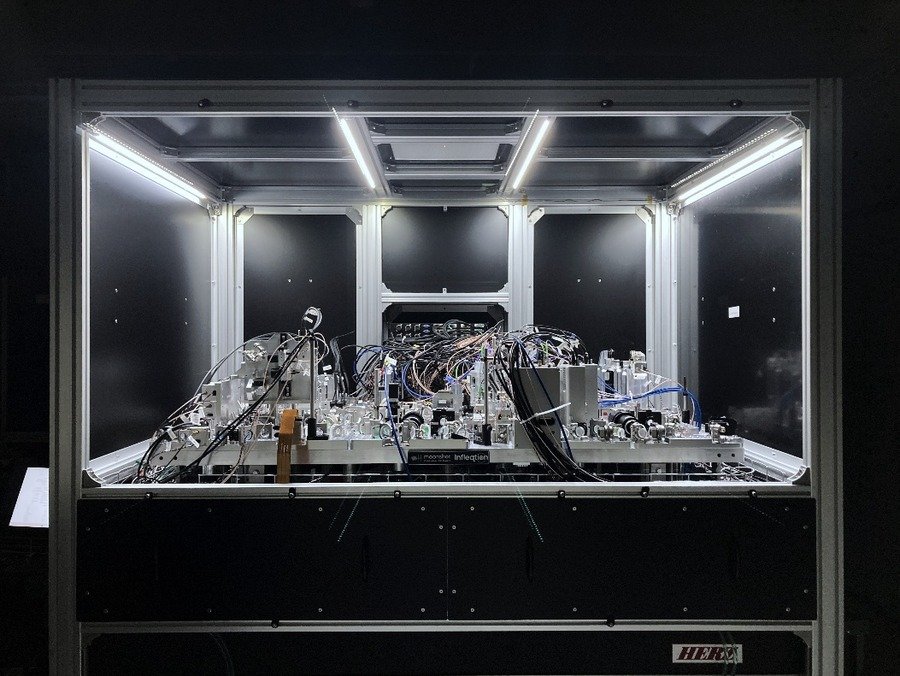
- Image: Japan’s first full-stack neutral-atom quantum computer “Shunkai”. (Photo: Takafumi Tomita)
PRESS RELEASE — Institute for Molecular Science (IMS), National Institutes of Natural Sciences, announced on Aug. 24 that Japan’s first full-stack neutral-atom quantum computer “Shunkai,” developed by a research team led by Professor Kenji Ohmori, is now operational.
Quantum computers are being developed in various modalities worldwide. However, there remain challenges to address for their practical applications, such as scalability and error correction during computation.
Anticipated to overcome those challenges, neutral-atom quantum computing has been rapidly attracting attention from industry, academia, and governments worldwide, as a groundbreaking new modality. Neutral-atom quantum computing uses a single atom as a qubit and has exceptional features, including:

- Room-temperature operation without the need for a refrigerator.
- Achieve quantum entanglement (the source of quantum speedup) between arbitrary qubits by moving the atoms (qubits) during computations.
- Flexibly optimize qubit configuration for each algorithm.
- Relatively easy increase in the number of qubits.
- Long lifetime of quantum information in each qubit.
Professor Kenji Ohmori, at the IMS, is the project manager leading the neutral-atom quantum computing research and development team for the project Large-scale and high-coherence fault-tolerant quantum computer with dynamical atom arrays under the Cabinet Office/JST Moonshot Research and Development
Program Goal 6, Realization of a fault-tolerant universal quantum computer. Aiming at practical quantum computers, the team has developed Japan’s first full-stack neutral-atom quantum computer named “Shunkai”.
Shunkai
It is named after Harumi Shibukawa, where his given name “Harumi” is also pronounced as “Shunkai,” an Edo-period (1603-1867) astronomer who established the first original calendar system in Japan. Calculations of celestial motion on the celestial sphere evoke the precise control of quantum states on the “Bloch sphere,” which represents the state of a qubit in the physics expert community. With highest respect to Shibukawa who developed Japan’s first indigenous calendar based on precise calculations, this system “Shunkai” has been named in the hope that Japan’s first full-stack neutral-atom quantum computer will perform precise quantum computations.
(Takafumi Tomita, Assistant Professor, Institute for Molecular Science, National Institutes of Natural Sciences)
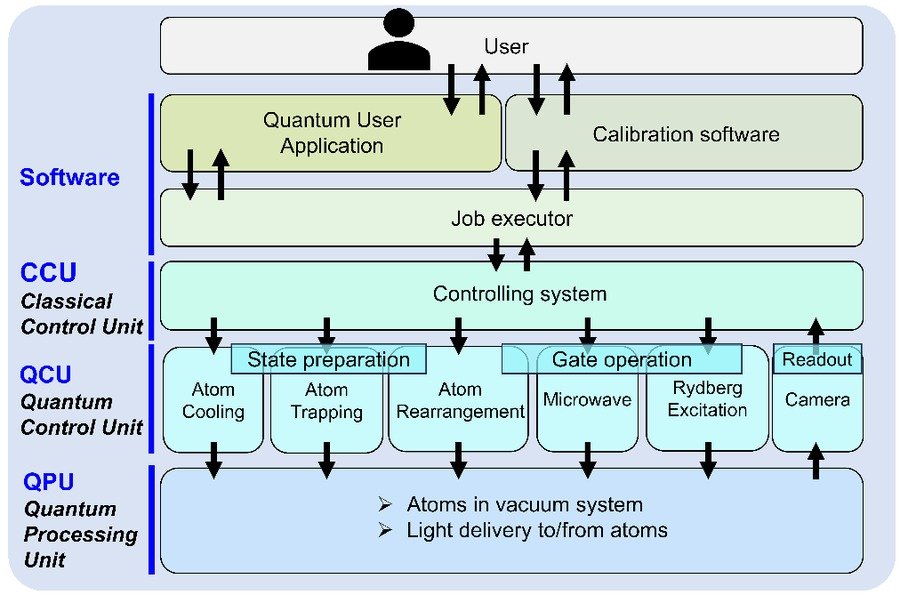
A “full-stack” system, as shown in Fig. 2, refers to a system that integrates multiple layers (stacks) necessary for converting user inputs into drive signals for the computing device to execute computational output as its result. Personal computers and supercomputers are examples of full-stack systems. Inside Shunkai, atomic qubits are captured in an array using “optical tweezers*3” generated by tightly focusing laser light with an objective lens. Quantum calculations are performed by irradiating the atoms with microwaves or laser light. The computational results are interpreted by observing the fluorescence from each individual atom with a camera. The IMS has taken the lead developing this full-stack quantum computer, leveraging a strong industry-academia collaboration within the Ohmori Moonshot Project with Hitachi, Ltd. for the software stack and with Infleqtion, Inc. for the Quantum Processing Unit (QPU) stack.
Shunkai will use approximately 50 qubits in its early stage, and will expand its scale to approximately 500 qubits. The system will be partially open to external users for the development of its applications and the demonstration and improvement of quantum error correction*4). Plans also include collaboration with Yaqumo Inc., where Professor Ohmori serves as a founder and executive advisor, from the viewpoint of the social implementation and upgrade of the quantum computer.
Future Developments
In the second stage of the Ohmori Moonshot Project Neutral atom-based fault-tolerant quantum computer that has just started in April 2026, the team will operate this full-stack quantum computer to further develop and improve the integration and control technologies, upgrade the system toward fault tolerance and larger scales, and enable high stability and high-fidelity quantum computation for extended periods of time. By March 2031, at the end of the second stage, the goal is to realize a large-scale, high-performance neutral-atom fault-tolerant quantum computer, with 10,000 physical qubits and quantum error detection and correction capabilities, available to external users.
Message from Professor Kenji Ohmori, Institute for Molecular Science
“Neutral atom-based quantum computers have recently been rapidly attracting attention around the world as a new modality that could exceed the limits of the superconducting modality, which started its development earlier. I think it is extremely significant that now we have developed Japan’s first full-stack quantum computer in this cutting-edge modality and started its operation. We expect that the external use of our full-stack machine Shunkai, for example, by the theory and software researchers for the development of error-correction technologies, and by the corporate researchers toward practical applications would lead to ripple effects on various fields in industry, academia, andgovernment around the world. It is also expected that Shunkai will be integrated with the existing shared supercomputer facility at the IMS to develop into a quantum-GPU hybrid computing center.”

Keep track of everything going on in the Quantum Technology Market. In one place.
Topics

Matt Swayne
With a several-decades long background in journalism and communications, Matt Swayne has worked as a science communicator for an R1 university for more than 12 years, specializing in translating high tech and deep tech for the general audience. He has served as a writer, editor and analyst at The Quantum Insider since its inception. In addition to his service as a science communicator, Matt also develops courses to improve the media and communications skills of scientists and has taught courses.
[email protected]

Stay Ahead of Quantum
Get the latest research, company news, and market intelligence every week.
MENTIONED IN THE ARTICLE

Hitachi
Hitachi is a Japanese multinational conglomerate established in 1910 and based in Chiyoda, Tokyo, operates across diverse industries. The company's activities span digital systems, power and renewable energy solutions, railway systems, healthcare products, and financial systems.
→

Infleqtion
Infleqtion, founded in 2007 at the University of Colorado Boulder, specializes in neutral atom quantum technology for the aerospace and defense sectors. The company is heavily involved in orbital infrastructure, notably supplying atomic clocks and contributing quantum sensors to NASA's Cold Atom Lab and the Quantum Gravity Gradiometer Pathfinder mission to enhance space navigation, timing, and Earth observation capabilities.
→
IF
Institute for Molecular Science (Japan)
The Institute for Molecular Science (IMS), founded in 1975 in Okazaki, Japan, is a leading research institute dedicated to advancing molecular sciences through theoretical and experimental studies. Operating under the National Institutes of Natural Sciences, it fosters collaboration among researchers both nationally and internationally, supporting joint programs and shared use of advanced facilities.
→