


Insider Brief
- Quantum Computing Inc. reported $5.6 million in second-quarter revenue, largely driven by acquired businesses, as it continued to expand its quantum, photonics and semiconductor operations.
- The company posted a $23 million operating loss and a $1.2 million gross loss, while its $1.3 billion in cash and investments generated nearly $13 million in interest and other income.
- QCi reported new commercial activity involving Dirac-3 and NeuraWave systems, while also disclosing material weaknesses in its financial reporting controls that it aims to remediate by the end of 2026.
Quantum Computing Inc. reported a sharp increase in second-quarter revenue as acquisitions and photonics sales expanded its business, while higher spending and continued operating losses showed the cost of building out the company’s broader quantum and semiconductor strategy.
The Hoboken, New Jersey-based company reported $5.6 million in revenue for the three months ended June 30, up from just $61,000 a year earlier and $3.7 million in the first quarter of 2026, according to the company’s quarterly report and a statement on its performance.
Dr. Yuping Huang, Chief Executive Officer of QCi, said in the statement: “During the second quarter, we continued to execute on our strategy of making our quantum products smaller, more practical and more accessible. Our room-temperature photonic architecture continues to differentiate QCi by providing a pathway to practical quantum systems with significantly lower complexity, cost and power requirements than competing approaches. At the same time, we are expanding the capabilities of fast prototyping and volume production that not only support our future quantum roadmap but also address growing commercial markets today.”

While the revenue increase was substantial, it should be noted that most of it came from businesses QCi acquired this year. According to the company’s quarterly filing, acquisitions of Luminar Semiconductor, NuCrypt and NHanced Semiconductors contributed $5.1 million of the $5.6 million in second-quarter revenue. That means the results reflect both commercial expansion and a significantly larger corporate footprint rather than primarily organic growth from QCi’s existing operations.
For the first six months of 2026, QCi reported $9.2 million in revenue, up from $100,000 in the year-earlier period. The acquired businesses accounted for $8.6 million of the six-month total.
The company said second-quarter revenue was generated across its quantum and photonics products and services, with photonics products serving aerospace, government and industrial customers providing the largest contribution.
QCi reported a net loss of $11.8 million, or 5 cents a share, compared with a loss of $36.5 million, or 26 cents a share, a year earlier. Operating expenses rose 114% to $21.8 million from $10.2 million.
The narrower net loss, however, partly reflected financial and accounting factors outside the company’s underlying operations. QCi generated nearly $13 million in interest and other income from its large cash and investment holdings, compared with $1.8 million a year earlier.
It also recorded a $1.7 million loss from changes in the value of a derivative liability, compared with a $28.1 million loss in the year-earlier quarter. The liability stems from warrants associated with the company’s 2022 merger with QPhoton.
At the operating level, QCi recorded a loss of about $23 million during the quarter.
Acquisitions Drive Expansion
The quarter offers a look at how QCi is changing from a small quantum technology developer into a broader photonics, semiconductor manufacturing and quantum technology company.
QCi completed three acquisitions during the first half of the year: Luminar Semiconductor, known as LSI; quantum communications company NuCrypt; and advanced semiconductor packaging company NHanced.
The company reported it used approximately $180 million in cash, including transaction expenses, for the acquisitions.
QCi acquired NHanced in June in a transaction initially valued at $73.1 million in cash and stock. The deal also contains performance-based provisions that could add as much as $72 million in additional consideration.
NHanced brings advanced semiconductor packaging and manufacturing capabilities, including hybrid bonding, chiplet architectures and photonic-device integration. QCi said the acquisition allowed it to launch its planned Fab 2 manufacturing initiative ahead of schedule.
The expansion gives QCi potential revenue sources beyond quantum computing itself. Its acquired businesses sell photonic components, semiconductor services and other technologies into established aerospace, industrial, telecommunications and government markets.
That diversification could give QCi a commercial foundation while its more ambitious quantum technologies develop. It also means that headline revenue growth increasingly reflects businesses outside QCi’s original quantum-computing operation.
The company ended June with approximately $1.3 billion in cash, cash equivalents and investments. Its quarterly filing showed $189.2 million in cash and cash equivalents and about $1.1 billion in short- and long-term investments.
That liquidity gives QCi substantial room to fund research, manufacturing expansion and additional commercialization efforts. The company reported total assets of roughly $1.6 billion and liabilities of $47.2 million.
Costs Remain Well Ahead of Revenue
The expanding operation is also adding costs, according to the financial statement with QCi reporting $6.7 million in cost of revenue during the quarter, exceeding its $5.6 million of sales and producing a gross loss of approximately $1.2 million.
The company attributed the negative gross margin primarily to low production volumes across QCi, LSI and NHanced, which left fixed manufacturing costs spread across relatively few products. Management said it expects margins to improve if production volumes increase.
Research and development spending reached $8.4 million during the quarter, while sales and marketing costs were approximately $1.9 million. General and administrative expenses totaled about $11.5 million, including acquisition-related expenses.
The results underscore the scale of QCi’s current buildout. The company has ample capital but is still operating at a level where revenue remains small relative to its research, administrative and manufacturing costs.
QCi reported approximately $42.5 million in contract backlog at the end of June, providing a potential source of future revenue.
Quantum and AI Systems Move Toward Customers
QCi also reported several commercial developments involving its own technology during the quarter.
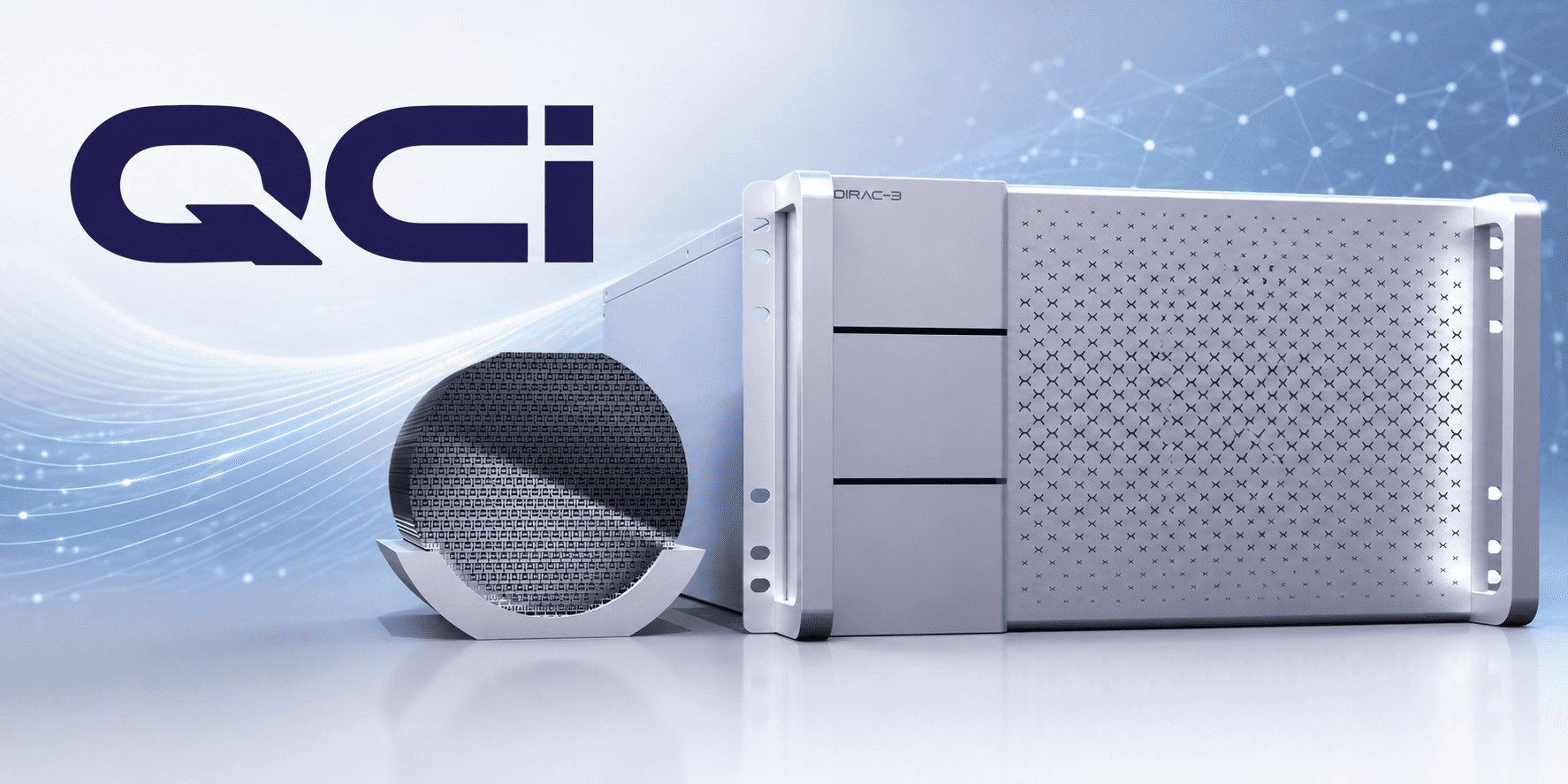
In June, the company said it sold, delivered and installed a Dirac-3 quantum optimization system at what it described as a leading global consulting firm. QCi said the machine will support optimization applications including portfolio optimization.
The transaction represents a concrete commercial step for the company’s quantum optimization business because the machine was sold and installed rather than simply being part of a research collaboration or planned deployment.
QCi did not identify the customer or disclose the value of the transaction in its quarterly announcement, limiting the ability to determine how significant the sale was financially.
The company also received a purchase order from an unidentified university for a quantum-secure communications system intended for research into secure networking. The value of that order also wasn’t disclosed.
Separately, QCi said its NeuraWave photonic reservoir computing system reached what it calls deployment readiness. Reservoir computing is an approach to artificial intelligence in which a physical or mathematical system processes changing signals before a simpler conventional computer analyzes the output.
QCi’s system combines photonics with digital computing and is aimed at AI inference and signal processing in areas including defense, telecommunications, robotics and industrial monitoring.
The company also signed a framework agreement with Planck Dynamics that could eventually involve multiple dozens of NeuraWave systems and have an aggregate program value exceeding $10 million.
That potential value remains conditional as QCi said deployments depend on specified customer milestones and other conditions.
Financial Controls Remain an Issue
QCi’s quarterly filing also contains a disclosure that management concluded that its disclosure controls and procedures were not effective as of June 30 because of material weaknesses in its internal controls over financial reporting.
QCi said the weaknesses didn’t result in a material misstatement of the financial statements included in the quarterly report. The company also said it has added accounting personnel, documented additional financial procedures and is working to improve information-technology and financial controls, with a goal of remediating the weaknesses by the end of 2026.
The issue is important for a company undergoing rapid expansion because acquisitions place additional demands on accounting, financial reporting and internal controls.



![Luminar Semiconductor [Acquired by Quantum Computing Inc]](https://s3.us-east-2.amazonaws.com/tqd.s3.bucket/logos/luminar_semiconductor.jpg)
![NuCrypt [acquired by Quantum Computing Inc]](https://s3.us-east-2.amazonaws.com/tqd.s3.bucket/images/e53a83f5-0a01-4141-a8d8-dd88f83dc9ab.png)
![NHanced Semiconductors [Acquired by Quantum Computing Inc.]](https://s3.us-east-2.amazonaws.com/tqd.s3.bucket/prod/images/nhanced_semiconductors_acquired_by_quantum_computing_inc..jpeg)