


By combining the long-range connectivity of photonic qubits with near-deterministic entanglement mediated by cavity-coupled atoms, Quantum Source’s new blueprint lays out a concrete, quantitative path toward practical fault-tolerant quantum computing.
Insider Brief
- Quantum Source has proposed a compound photon-atom architecture that combines atomic qubits and photonic connectivity to address scalability challenges in fault-tolerant quantum computing.
- The architecture uses a reusable photon-atom unit cell based on a trapped rubidium-87 atom inside a high-finesse cavity to perform near-deterministic entanglement, photon generation, and quantum operations.
- Quantum Source’s numerical analysis suggests the proposed design could support fault-tolerant computation with reduced hardware overhead, although experimental validation of the full architecture remains ongoing.
Today’s quantum processors have demonstrated remarkable scientific progress. Researchers have improved qubit fidelities, extended coherence times, and executed increasingly sophisticated algorithms. Strip away the differences among superconducting circuits, trapped ions, neutral atoms, and photonic processors, and every quantum computing effort is chasing the same goal: error correction robust enough for fault tolerance. Reaching it demands both scale, with enough physical qubits operating below threshold, and connectivity, the ability to entangle qubits that are far apart.
With error correction, useful applications are expected to require logical error rates below roughly 10⁻¹², while today’s best physical qubits and gates operate at error rates of 10⁻³ to 10⁻⁴. Bridging that gap requires encoding each logical element redundantly across hundreds to a thousand physical qubits. As a result, algorithms involving a few thousand high-quality logical qubits translate into machines with (on the order of) a million physical qubits, all operating comfortably below the error-correction threshold. (Broader industry estimates sometimes run higher; the figures depend on the application and the error-correcting code.) On the other hand, connectivity is the ability to perform entangling operations between physically distant qubits. High connectivity enables more efficient error-correction codes and more flexible logical circuits.

In the fault-tolerant era, reliable error correction is the requirement that matters and connectivity is central to achieving it at scale.
No hardware platform today meets both requirements on its own, and each stumbles in its own way. Superconducting processors are fast and precise but rely predominantly on local couplings in planar layouts, which constrain connectivity. Trapped ions offer excellent gate fidelities, but crowding of the shared motional modes degrades entangling operations as ion chains grow. Neutral-atom arrays can rearrange their connectivity by physically shuttling atoms, but shuttling and mid-circuit measurement push error-correction cycles into the millisecond range.
Photonic qubits are unique in this context because they invert the trade-off. Photons barely decohere, single-qubit operations are straightforward with linear optics, and once entanglement is established, connectivity is effectively unrestricted. An entangled photon can be routed to interact with any part of the machine. The real problem arises earlier, at the point of creating that entanglement.
Because photons pass through one another without interacting and linear optics provides no intrinsic nonlinearity, entangling gates between independently propagating photons are probabilistic, and so are the photon-pair sources these platforms typically rely on. A heralding signal flags successful attempts, and architectures compensate through redundancy and massive multiplexing. Unfortunately, reaching utility scale this way carries an overhead of roughly six orders of magnitude in source and gate resources, along with stringent demands that photons from independent sources be mutually indistinguishable.
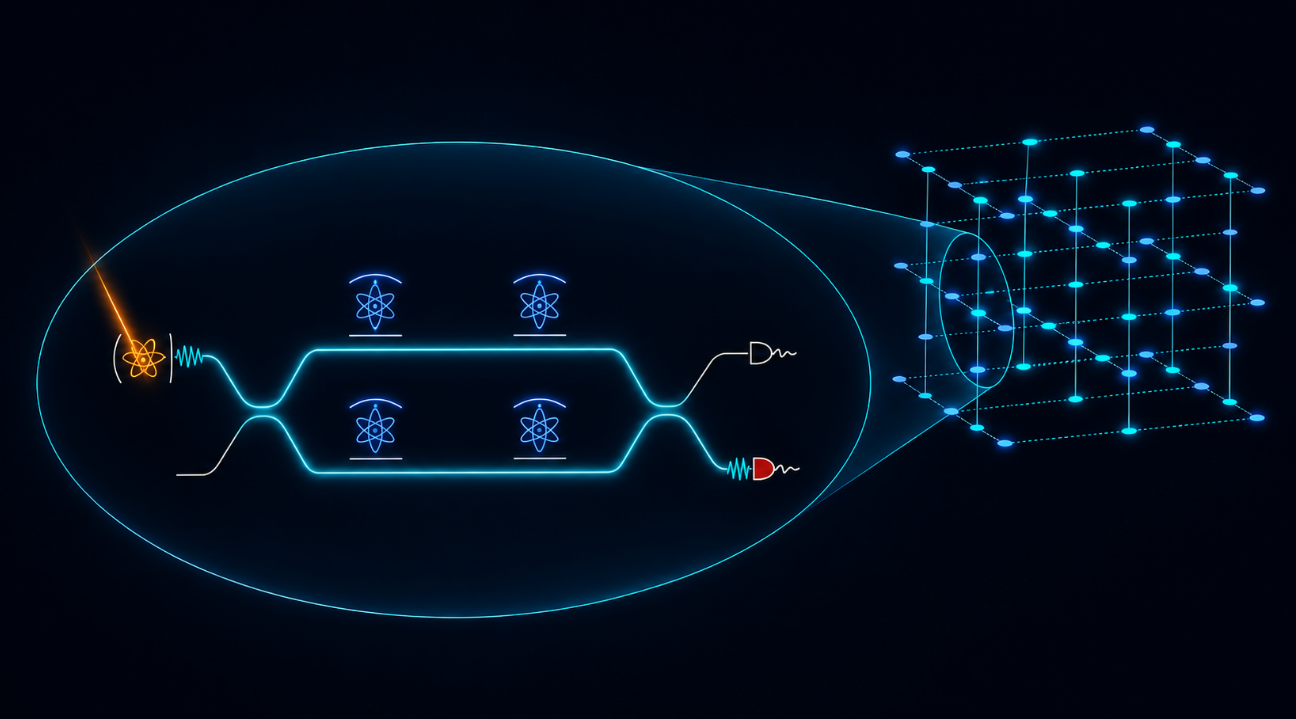
Quantum Source’s Blueprint is aimed squarely at this bottleneck by means of a single, reusable compound photon-atom building block. This building block performs the platform’s principal physical operations near-deterministically, and a numerically analyzed architecture shows how it could be assembled into a fault-tolerant machine.
A Unit Cell that Replaces Probability with (Near) Certainty
Unlike classical logic gates, quantum gates perform calculations by exploiting entanglement and superposition, allowing the state of one qubit to directly influence another. In matter-based platforms, these interactions arise naturally through physical mechanisms such as electromagnetic or capacitive coupling between nearby qubits. Independently propagating photons, however, rarely interact strongly enough to perform the same task on their own. That limitation is not fundamental to photons themselves but to linear-optical architectures, in which entangling operations between separate photons are inherently probabilistic.
Quantum Source‘s Blueprint addresses this challenge by replacing probabilistic photon-photon interactions with a near-deterministic photon-atom interaction. The Blueprint shifts the focus from designing separate hardware for each stage of quantum computation to creating a single reusable module capable of performing many of the architecture’s most important physical operations. The mechanism begins with the unit cell: a single rubidium-87 atom trapped in a microscopic, high-finesse Fabry-Pérot cavity, tuned near one of rubidium’s well-characterized optical transitions.
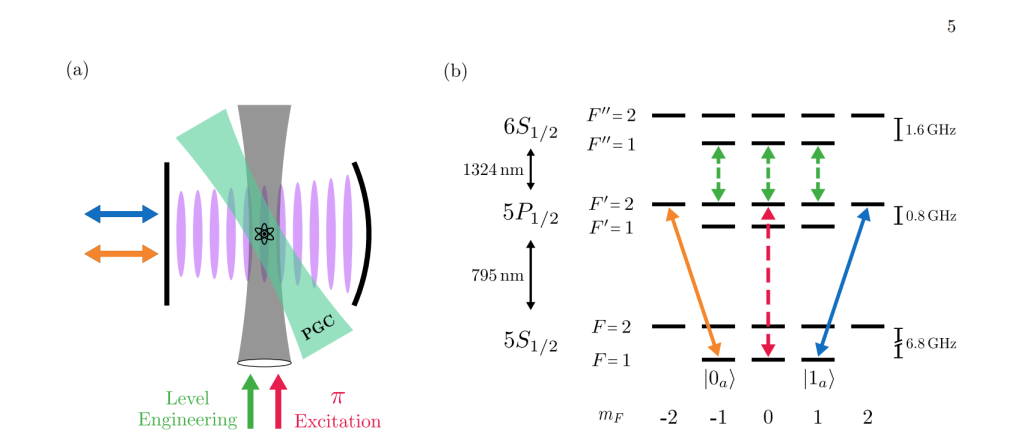
This cavity quantum electrodynamics module performs several essential functions within the proposed architecture. Rather than allowing a photon to pass an atom only once, the cavity confines the optical field so that the coupling between the incoming photon and the atomic transition becomes sufficiently strong to enable a controlled interaction. The light bouncing between the cavity’s mirrors interacts with the atom so strongly that a single photon and a single atom can exchange quantum information with near-unit probability.
As a result, the unit cell effectively serves as a single module that accomplishes three tasks. For starters, it prepares and measures the atomic qubit. This is achieved starting with a photon-atom Bell pair creation. Measurement of the photon projects the atom to the required state in a heralded manner, , so that a detected photon certifies that the operation was successful. The unit cell generates single photons on demand with projected near-deterministic performance, sidestepping the lower efficiencies of heralded probabilistic sources. All of this occurs on projected physical-operation timescales of tens of nanoseconds.
The unit cell implements the photon-atom entangling gate that enables computation. The gate itself is a controlled-phase (CZ) interaction realized through reflection. A photon is routed to bounce off the cavity, and the phase it acquires depends on the quantum state of the trapped atom inside. The atom’s quantum state determines whether the cavity mode couples to an atomic transition. The mechanism depends on whether the photon can build up inside the cavity at all. When the atom is uncoupled from the incoming photon’s polarization, the cavity acts as an empty, resonant cavity: the photon enters, circulates, and leaks back out with a characteristic phase shift. When the atom is coupled, the joint resonance shifts enough that the photon is turned away almost immediately, with a different phase. That difference, present only because a single atom can shift a cavity’s resonance this dramatically, is the entangling operation. Rather than serving as a specialized component dedicated to a single task, the same physical building block is reused throughout the processor.
Quantum Source’s Blueprint proposes a symmetrized version of this gate. In this scheme, both atomic basis states interact symmetrically with the cavity mode and experience equal-magnitude reflection amplitudes. This symmetry suppresses coherent errors arising from atom-state-dependent loss imbalance, a principal error mechanism in cavity-based quantum gates. While seemingly subtle, the improvement suppresses atom-state-dependent loss-imbalance errors and increases the robustness of the proposed entangling operation.
In this architecture, the atom is not merely an interaction mediator inserted to enable photon communication. Both photons and atoms carry logical information. The atom serves as a full computational qubit while also acting as a reusable entanglement site and short-term quantum memory. Photons provide modularity and long-range connectivity, establishing connections between computational regions while participating directly in the generation of large, entangled resource states.
Instead of separating computation and communication into distinct quantum systems, this architecture enables stationary and flying qubits to work together, each leveraging the physical properties nature already provides. That division of labor addresses one of the longstanding tensions in quantum computer design. Atoms naturally excel at controlled quantum interactions and temporary information storage. Photons excel at rapidly transporting quantum information across complex optical networks with effectively unrestricted connectivity. Rather than forcing either system to perform physically difficult tasks, the architecture is built around their complementary strengths.
The reusable unit cell, therefore, becomes far more than a hardware component. Because each atomic cavity module performs many of the architecture’s essential operations before reuse, the proposed design substantially reduces the amount of specialized hardware required in the overall system. Because entanglement is generated through direct photon-atom interaction rather than interference between independently generated photons, the architecture requires neither strict photon indistinguishability nor the massive multiplexing overhead that probabilistic gates demand. In other words, it becomes the fundamental architectural primitive from which a larger quantum computer can be assembled.
From Unit Cells to a Fault-Tolerant Machine
Quantum Source’s Blueprint is not a single gate but a full set of hardware building blocks: one reusable unit cell that prepares and measures atomic qubits, generates single photons on demand, and performs near-deterministic photon–atom entanglement. Its broader objective is to show how these building blocks can be assembled, at scale, into the logical elements of a fault-tolerant quantum computer.
Rather than executing quantum algorithms through long sequences of dynamically scheduled gates, the proposed architecture uses the measurement-based model of quantum computation. In this paradigm, the machine prepares a large, entangled resource, or cluster state, and then computes by measuring it, qubit by qubit, layer by layer. The blueprint’s target structure is the Raussendorf–Harrington–Goyal (RHG) lattice, best understood as a three-dimensional version of the surface code.
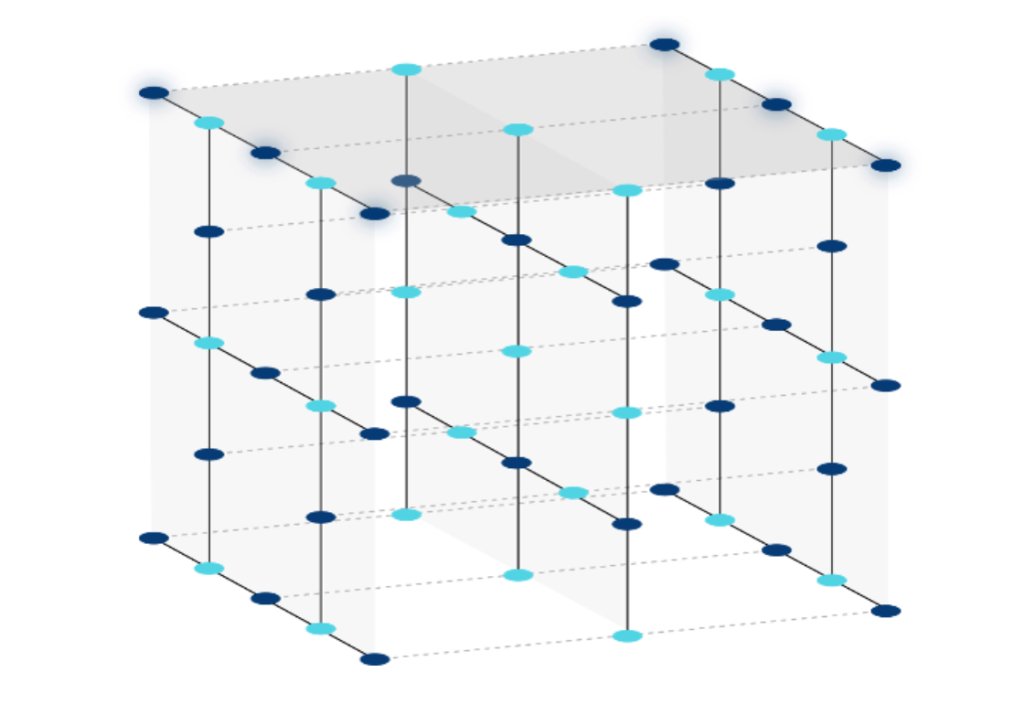
The architecture maps naturally onto this computational model. The RHG lattice is bipartite by construction. One sublattice maps to photons, the other to atoms. Construction proceeds through repeated photon cycles: a photon is generated on demand, undergoes a sequence of near-deterministic CZ gates with several atoms, and is then measured.
Once an atom has completed all its scheduled entangling gates, its state is transferred onto a photon for measurement, and the atom is reset and reused in the next round. One useful analogy is to imagine the atoms as reusable stitching points that repeatedly tie together passing photonic qubits into an increasingly complex computational fabric. Throughout the process, the atoms remain active computational qubits, temporarily storing quantum information, while repeatedly participating in successive entangling operations.
It is through this process that Quantum Source’s Blueprint lays its claim for scaling. This claim rests on connectivity. Because photons can establish effectively unrestricted connections across the processor, the architecture is not confined to the predominantly local connectivity that characterizes many existing hardware platforms. Atom recycling also serves as a separate, complementary benefit: within the proposed generation scheme, reusing atoms cuts the number of cavities and associated control components by more than an order of magnitude, though the saving comes at the cost of additional, lossy delay lines needed to hold photons between interactions.
The atoms’ role in short-term memory also gives the architecture a subtle advantage: a degree of freedom in timing. Photon generation and routing can be delayed until the appropriate atomic resources are ready, easing the demands on optical switching and real-time classical processing. Such connectivity could eventually support future fault-tolerant architectures based on more hardware-efficient quantum low-density parity-check (qLDPC) codes as those methods mature.
Putting Numbers on Fault Tolerance
With the conceptual architecture in place, Quantum Source’s Blueprint simulates the proposed system’s behavior under a hardware-aware (loss-aware) noise model. In this model, photon loss is treated as the dominant error mechanism. Within this intentionally simplified framework, Quantum Source analyzes the construction of the RHG lattice, evaluates logical Clifford operations, and estimates photon-loss thresholds for fault-tolerant operation. Other sources of error, such as finite atomic fidelities, atomic loss, and additional system-level noise, are explicitly identified as future work rather than being hidden behind optimistic assumptions.
When a photon disappears partway through its sequence of entangling gates, the links it never completed are missing from the cluster state. Those absent bonds can silently corrupt neighboring error-correction checks without leaving a direct measurement signature, an effect called bond-loss propagation. The Blueprint faithfully models this damage, exploiting the fact that photon loss is heralded at measurement and that each photon interacts with only a handful of atoms. The resulting payoff is a loss-aware decoder that preserves the optimal scaling of the logical error rate with code size.
In this way, Quantum Source not only defines the scope of its simulations but also provides a transparent assessment of what has been analyzed today and what remains to be addressed through future experimental development. The headline number is a photon-loss threshold of approximately 2.6% per physical gate, corresponding to roughly 15% total loss over a photon’s full trajectory through the machine. That result covers the Clifford gate set. Universal computation requires one more ingredient, a non-Clifford gate, typically the T-gate. Here, Quantum Source offers two complementary, not-yet-optimized routes to the required resource magic states, both built from operations the platform already performs natively, with full technical details deferred to forthcoming work.
A Blueprint Rather than a Finished Machine
Quantum Source’s Blueprint does not claim that a fault-tolerant quantum computer has already been built, nor does it suggest that the remaining engineering challenges are minor. Instead, it shows that no single figure carries the argument; the combination does.
On one end, near-deterministic entanglement removes the defining bottleneck of purely photonic platforms. Projected physical operations in the tens of nanoseconds (to be distinguished from the full system clock rate) contrast with the millisecond error-correction cycles of neutral-atom platforms, removing the speed penalty usually associated with matter qubits.
Similarly, effectively unrestricted connectivity removes the geometric constraints that complicate code design and fault-tolerant algorithm implementation, and may eventually enable more hardware-efficient qLDPC. The rubidium-cavity system avoids the dilution-refrigerator cryogenics required by superconducting processors. The atoms’ fast, cavity-enhanced operations mean the architecture does not rely on the exceptionally long coherence times that neutral-atom platforms aim for. Instead, each atom performs only a short sequence of rapid operations and needs coherence long enough relative to those operations, not to an entire computation.
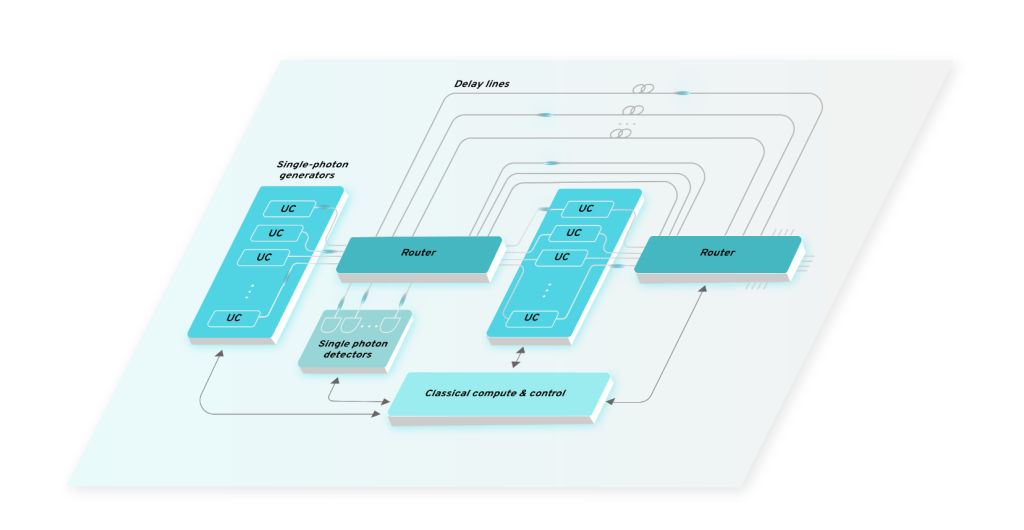
In the end, the Blueprint remains a theoretical design that has been worked out and numerically analyzed, with experimental validation of the full architecture still ahead. Realizing the proposed architecture will also require advances across multiple areas of quantum engineering. Reliable trapping and manipulation of individual rubidium atoms must be consistent across large arrays of cavity modules. High-finesse optical cavities must be fabricated to deliver reproducible performance at scale. Fast optical routing, low-loss delay lines, high-efficiency single-photon detectors, classical control electronics, and real-time decoding systems must all work together as an integrated computational platform.
These are substantial engineering challenges, many of which extend well beyond the reusable unit cell itself. Nevertheless, this does not detract from the Blueprint. It distinguishes questions of physics from questions of engineering.
Quantum Source’s Blueprint outlines a coherent architectural pathway toward fault-tolerant computation. The underlying physical operations are analyzed quantitatively, and their projected performance is evaluated using numerical simulations. Completing the roadmap will require considerable experimental progress, but the destination is now defined with far greater clarity.
An Integrated Answer to a Fragmented Checklist
Quantum computing has long had its checklist: well-characterized qubits, reliable initialization and measurement, coherence that outlasts operations, a universal gate set, and, for machines built from stationary and flying qubits, a faithful interface between them.
Quantum Source‘s compound photon-atom Blueprint proposes an integrated approach to meet these requirements, in which complementary quantum systems cooperate via a common, reusable building block. The Blueprint addresses many of the requirements traditionally optimized in isolation, such as connectivity, reusable hardware, high-probability entangling operations, and fault-tolerant computation, all within a single coherent framework.
Stationary atoms provide controllable interactions, temporary memory, and measurement. Flying photons provide long-range connectivity and distribute quantum information across the processor. With a numerically analyzed route, supported by explicit numbers and scope, Quantum Source’s Blueprint shows how these building blocks and operations, when repeated, could generate the fault-tolerant computational structures required for large-scale quantum algorithms.
Whether this architecture ultimately becomes the foundation of future quantum computers remains an open question that only experimental progress can answer. Until then, it remains a blueprint, not a computer. But the physical layer and the fault-tolerance framework now rest on one shared foundation, and in a field where these two conversations have often run in parallel, uniting them may prove to be what matters most.