
Insider Brief
- Atomionics has opened a quantum sensing hub in Singapore and is developing marine applications for its quantum gravimetry technology with support from Enterprise Singapore and Cap Vista.
- The company’s GRAVIO system is being adapted for ocean applications to measure gravitational signals from the seabed, subsurface structures, and underwater environments.
- Atomionics plans to use its quantum sensing platform for applications including maritime infrastructure monitoring, resource exploration, and subsurface mapping.
The seabed is the largest unexplored territory on Earth. Today, Singapore moved to change that.
Atomionics is bringing quantum gravimetry to the ocean—a marine intelligence capability that aims to read the sea in three dimensions: through the water, across the seabed, and into the ground beneath. The work is supported by Enterprise Singapore and Cap Vista, the strategic investment arm and a fully-owned subsidiary of Defence Science and Technology Agency (DSTA).
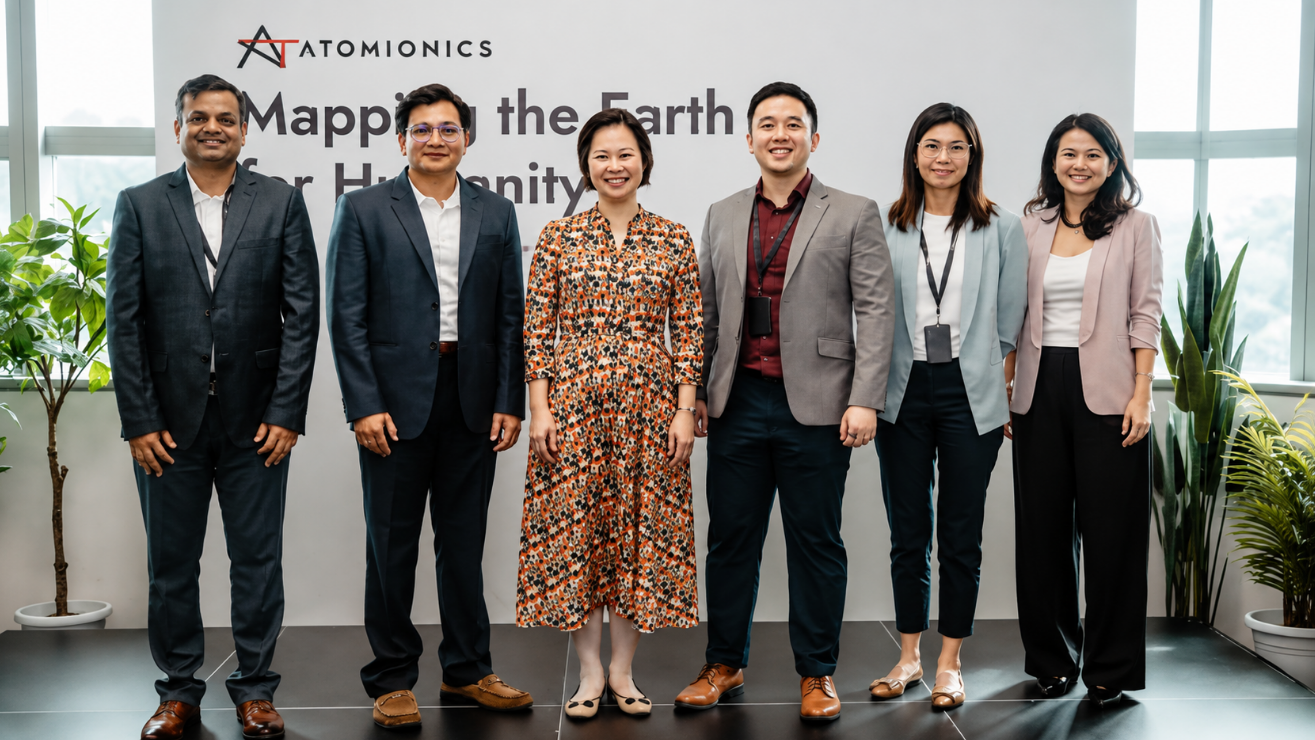
It was announced at the opening of Atomionics‘ new headquarters at Alexandra Technopark, officiated by Ms Gan Siow Huang, Minister of State for Trade and Industry.
More of the surface of Mars has been mapped at high resolution than the floor of our own oceans. The reason is not a lack of interest but that the tools have never existed to see through water and sediment at scale. The seabed and its geology, the objects and infrastructure that rest on it, and the movements of mass through the water above it have all stayed effectively dark.
Quantum gravimetry changes what can be seen. Every mass leaves a signature in the gravitational field—on the seabed, beneath it, or moving through the water above. By reading those signatures, Atomionics’ instrument, GRAVIO, reconstructs the underwater world in three dimensions. No contact. No emitted signal. Nothing that anyone could detect. Turned toward the sea, it reaches into a domain that has never been mapped this way before.
“To see beneath the water is to hold an advantage that spans defence, energy, and infrastructure,” said Dr. Ravi Kumar, Co-founder and CTO of Atomionics. “We are building the ability to secure the cables that carry the world’s data, find the resources beneath the seabed, and know the seafloor before we build on it.”
Few nations have more at stake beneath the waterline than Singapore. The world’s second-busiest container port runs on its waters. The undersea cables landing on its shores carry the digital traffic of a region. Its harbours, its channels, and the approaches that keep global trade moving all depend on knowing precisely what is happening beneath the surface. A domain that can be mapped and re-read at will is one that can be secured, monitored for interference with critical infrastructure, and kept navigable as the demands on it grow. This is the capability that Atomionics is building—at home, in Singapore’s own waters, for its own future.
Singapore is among the first to take quantum sensing out of the laboratory and into the water. Cap Vista’s investment in Atomionics is part of its broader strategy to nurture and grow promising deep-tech companies with potential dual-use applications for defence and security.
“Cap Vista invests where commercial technology and strategic capability converge, and quantum sensing sits squarely at that intersection,” said Eunice Ooi, CEO, Cap Vista. “We are proud to support Atomionics in both their tech and business roadmaps, especially in opening up possibilities in the new marine domain.”
Atomionics has an ongoing partnership with the Future Systems and Technology Directorate (FSTD), MINDEF Singapore, and Cap Vista to advance its quantum technology for dual-use application. Building upon this foundation, the parties are now exploring further collaborations to introduce quantum gravimetry to the ocean.
GRAVIO already runs commercially across Asia, Australia, Europe, and the United States. It has been proven in one of the harshest settings a sensitive instrument can face: an active mine, surrounded by blasting, haul trucks, and constant industrial vibration. There, GRAVIO built a 3D model of the ground that matched drill-hole ground truth to better than 95% without a single extra hole drilled. An instrument that holds quantum precision through the shockwaves of an active mine is an instrument built for the pitch and roll of the open sea. And what lies beneath the sea is worth reaching: the critical minerals whose supply the world is racing to secure, the reserves that still power it, and the carbon storage beneath the seabed. None of it can be reached without first being seen.
Behind all of it is a larger ambition: to build the first living, 3D map of the Earth’s subsurface—land and sea—updated continuously rather than guessed at once a generation. The move into the ocean is a decisive step toward it.
To build this marine capability, and the generations of instruments that follow, Atomionics has opened Asia’s first integrated quantum sensing hub at Alexandra Technopark. Under one roof, the 5,700+ sq ft facility holds the entire life of a quantum instrument: three laboratories for physics, mechanical assembly, and electronics alongside the AI platform that turns raw gravity into readable subsurface maps. In the physics lab, guests see the measurement happen in front of them: inside GRAVIO, a cloud of atoms is released into freefall and caught by pulses of laser light, and from that fall alone the machine reads the pull of the Earth beneath it. Along the corridor, the Quantum Experience Gallery lays out the sensors generation by generation, the physical record of how a technology this precise gets built.
“Atomionics’ achievements demonstrate the growing strength of Singapore’s quantum ecosystem and the conducive environment that enables frontier research to be translated into globally relevant deep-tech innovations. Enterprise Singapore is proud to support companies like Atomionics as they scale breakthrough technologies from Singapore to international markets, reinforcing our position as a growing hub for deep-tech innovation and commercialisation.” said Emily Liew, Assistant Managing Director, Enterprise Singapore.