QuiX Quantum Unveils Path to Universal Photonic Quantum Computing with Logical Qubits


Insider Brief
- QuiX Quantum released Dedalo, a photonic quantum computing architecture designed to support universal, fault-tolerant systems based on logical qubits that can operate alongside classical supercomputing infrastructure.
- The architecture emphasizes energy efficiency, manufacturability, resource efficiency, error correction, modular scalability and hybrid data-center deployability as requirements for practical quantum systems.
- QuiX says Dedalo focuses on photon-loss-tolerant logical qubits, modular photonic hardware, semiconductor-compatible fabrication and telecom-style interconnects as a path toward scalable photonic quantum computing.
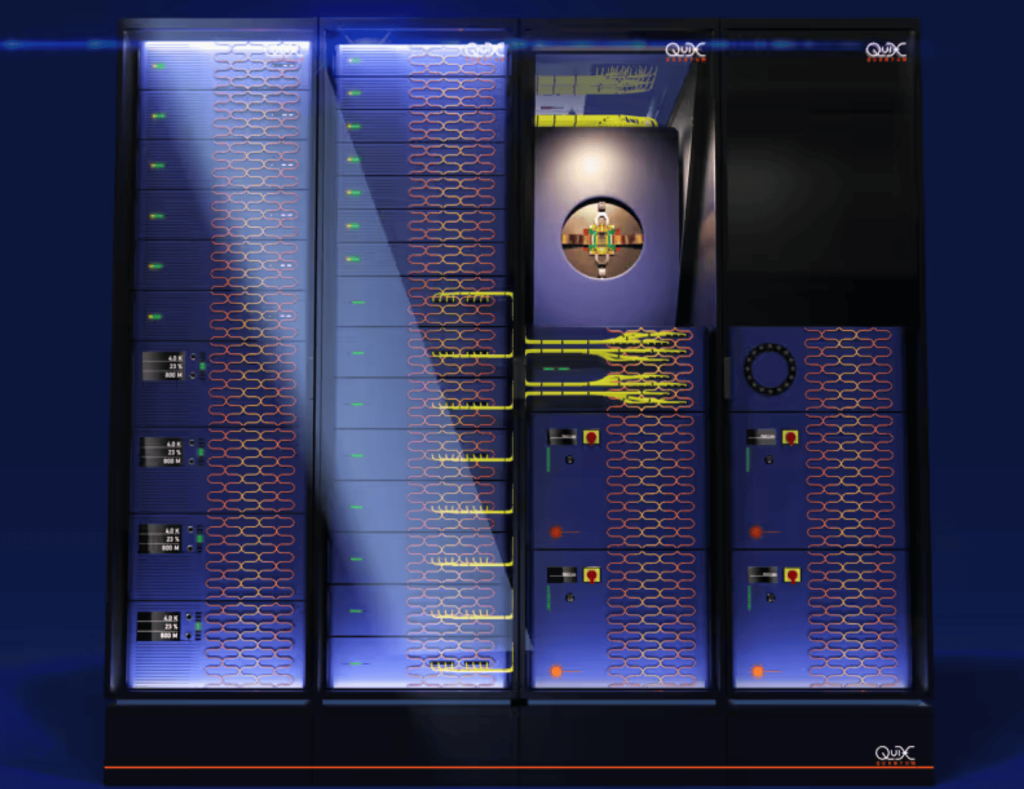
PRESS RELEASE — QuiX Quantum today released its vision of universal photonic quantum computing with logical qubits through Dedalo, the company’s new system architecture designed to achieve practical, fault-tolerant systems that work seamlessly with classical supercomputers.
Useful quantum computing depends on more than qubit performance. To become practical computing infrastructure, fault-tolerant universal quantum systems must be manufacturable, energy efficient, modular and room-temperature to co-exist alongside supercomputers where real workloads will be developed, tested and executed. This makes system architecture a determining factor in whether quantum computers can support real-world applications and deployment.
In a new white paper, QuiX Quantum says the key to this future is building advanced photonic components and bringing them together into a fault-tolerant architecture that can scale. To do so, the company is connecting logical qubits, photon-loss protection, modular photonic hardware and data center deployability into one system-level roadmap.

“A broader adoption of quantum computers requires systems which do not need specialized and hard-to-maintain environments,” said Dr. Ing. Stefan Hengesbach, CEO at QuiX Quantum. “The industry needs architectures that can both scale efficiently and fit into the infrastructure where real workloads will run. Dedalo is our blueprint for that future.”
“Companies, researchers, and technical leaders evaluating how to get from today’s quantum prototypes to practical systems should download our white paper now to see how we can help them achieve this long sought-after industry milestone,” Robin Wittlan, CCO at QuiX Quantum said.
What Practical Quantum Systems Require
The Dedalo white paper presents QuiX Quantum’s vision of the system-level requirements needed to move quantum computers toward practical computing infrastructure. Specifically, the white paper organizes those requirements around six priorities for building quantum systems that can scale:
- Energy efficiency – Helps reduce infrastructure complexity, cooling burden and operating cost
- Volume Manufacturability – Supports repeatable production through semiconductor-compatible fabrication
- Resource efficiency – Reduces hardware overhead on the path to useful quantum computation
- Efficient error correction – Enables reliable operation as quantum systems scale
- Modular scalability – Allows systems to grow across modules, racks, sites and workloads
- Hybrid deployability – Supports operation alongside classical HPC, AI and data-center infrastructure.
Why Photonics and Logical Qubits
QuiX Quantum’s architecture focuses on combining uniquely integrated photonics technology, discrete variable qubit encoding and room-temperature operation, which the white paper positions as the best path to fault-tolerant-scale universal quantum computing. Key advantages include silicon nitride photonic integrated circuits that can be produced using established semiconductor fabrication processes; fiber-based and telecom-compatible interconnects that support distributed architectures; minimized dependence on extensive cryogenic infrastructure; and modular scaling through interconnected photonic modules rather than a single monolithic processor.
A central focus of Dedalo is the use of logical qubits as a path toward fault-tolerant photonic quantum computing. Logical qubits encode information across multiple physical qubits so that errors can be detected and corrected without destroying the computation. For photonic systems, the dominant error is typically photon loss. Dedalo is designed to address this and demonstrate the generation, manipulation and measurement of photonic logical qubits, along with logical-basis measurements protected against photon loss.
“Photon loss is one of the defining challenges for photonic quantum computing,” said Emlyn Stephens, Head of Quantum Science at QuiX Quantum. “By focusing on logical qubits and loss-error tolerance, we are building toward an architecture that can support reliable computation as photonic systems scale.”
Designed for Hybrid, Fault-Tolerant Systems
The white paper emphasizes data center readiness as a core design principle. QuiX Quantum’s photonic approach is designed to take advantage of semiconductor manufacturing and standard telecom components with the goal of supporting quantum systems that can operate alongside classical HPC, AI and data-center infrastructure.
QuiX Quantum says Dedalo is intended to demonstrate a key step in that path by showing universal photonic quantum computing based on logical qubits protected against photon loss. The paper gives readers a more detailed view of how that system comes together, from photon generation and resource-state preparation to switching, feed-forward control, logical qubit operations and measurement. It also outlines the technical requirements that still matter for fault-tolerant photonic quantum computing, including low-loss photonic components, fast modulation, efficient photon sources, and scalable error-correction strategies.
“Dedalo reflects our view that the path to useful quantum computing is architectural,” said Andrew Roos, VP of R&D at QuiX Quantum. “It is about bringing together photonic hardware, control systems, error correction and deployment requirements into a coherent system design. That is what will determine whether quantum computers can move from laboratory systems to practical computing infrastructure.”
The full white paper, “Toward Photonic Quantum Computing with Logical Qubits: Dedalo Architecture White Paper,” is now available from QuiX Quantum. Readers can download the paper here to explore the Dedalo architecture in detail, including its approach to logical qubits, photon-loss tolerance, modular photonic system design and the requirements for bringing fault-tolerant photonic quantum computing into future data center and HPC environments.

Keep track of everything going on in the Quantum Technology Market. In one place.
Topics
Matt Swayne
With a several-decades long background in journalism and communications, Matt Swayne has worked as a science communicator for an R1 university for more than 12 years, specializing in translating high tech and deep tech for the general audience. He has served as a writer, editor and analyst at The Quantum Insider since its inception. In addition to his service as a science communicator, Matt also develops courses to improve the media and communications skills of scientists and has taught courses.
[email protected]

Stay Ahead of Quantum
Get the latest research, company news, and market intelligence every week.
MENTIONED IN THE ARTICLE