Aegiq Uses NVIDIA Ising AI for Photonic Quantum Computer Calibration

Insider Brief
- Aegiq integrated NVIDIA Ising AI models into the calibration workflow of its Artemis photonic quantum computer, reducing manual calibration requirements and improving operational efficiency.
- The deployment achieved a threefold reduction in weekly engineering time by automating the optimization of quantum source performance metrics such as brightness, purity, and indistinguishability.
- Aegiq plans to expand AI-assisted calibration and quantum error correction capabilities as it develops larger-scale fault-tolerant photonic quantum computing systems.
- The material in this article is taken directly from content published on Aegiq’s website and reflects the company’s description of its research and development efforts.
Quantum computers are inherently unstable systems, requiring frequent calibration to maintain optimal performance. Traditionally, this process relies on manual intervention, as traditional algorithmic approaches struggle to interpret complex data and balance competing figures of merit in this nascent technology. As systems scale-up, these manual processes can limit uptime, incur substantial engineering time and cost, and become a critical bottleneck. Addressing this challenge is essential to enable practical, large-scale quantum computing.
The NVIDIA Ising family of open-source AI models are specifically developed for key quantum computing workloads, addressing challenges in both calibration of systems and decoding for quantum error correction. In a first-of-its-kind, Aegiq has integrated NVIDIA Ising’s state of the art AI models into the calibration workflow of our first-generation photonic quantum computer, Artemis, currently deployed at the UK’s National Quantum Computing Centre (NQCC).
By integrating NVIDIA Ising calibration, Aegiq is significantly reducing the amount of manual intervention for this process. This initial deployment resulted in a 3x reduction in engineering time weekly, freeing up experts to focus on higher priority development tasks, while calibration can be conducted by non-specialists.

Details of first deployment
We applied the Ising Calibration model to maintain Artemis’s day-to-day performance. This means the AI needs to navigate a complex parameter space, adjusting multiple hardware settings to balance key source performance metrics such as brightness, purity and indistinguishability. All of this would usually require the attention of some of Aegiq’s quantum computing specialists, resulting in valuable time and effort being dedicated to this calibration task.
To scale-up, this paradigm cannot be maintained, as it would limit the number of maintainable systems to be deployed and would only get worse as the system scales. Imagine trying to calibrate thousands of components, , which will scale to millions in the utilty era – automated solutions are needed!
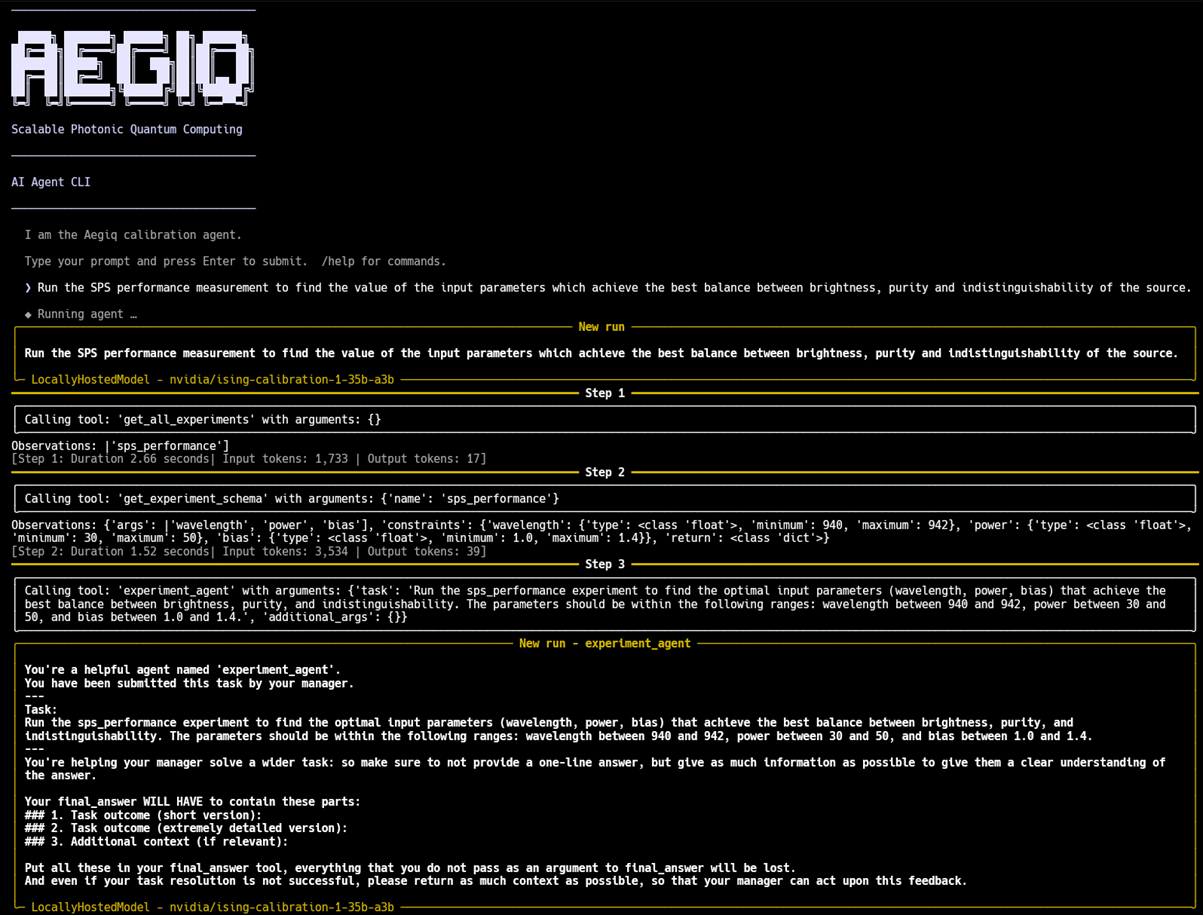
NVIDIA Ising offers a Calibration Vision-Language Model (VLM), which has been pre-trained on datasets spanning multiple quantum computing modalities. Aegiq,a member of NVIDIA Inception, hosts the VLM locally on an NVIDIA DGX Spark, enabling low-latency inference critical for real-time control.
The model operates within an agent-based architecture tailored for calibration tasks. This includes dedicated agents for orchestrating and running experiments, and specialised tools to enforce constraints on the parameter values that can be assigned to hardware. Notably, the model performed well out-of-the-box, without requiring additional training for our specific tasks.
Prompts in natural language are used to provide instructions to the deployed agent, allowing users to specify calibration objectives intuitively. The agent interprets these instructions, developing a plan before iteratively proceeding with the calibration task, analysing results and deciding the best course of action. Example prompts include:
- “Check the performance of the single photon source.”
- “Find the values of the laser power, wavelength and source bias which achieve the best balance of performance metrics.”
- “Perform a targeted sweep around the current hardware settings to find potential improvements to the source performance.”
When deployed on the Artemis system at the NQCC, the model successfully calibrates our first-generation quantum computer to deliver its target metrics.
Future of calibrating photonic quantum computers
With this first deployment, we have shown the power of AI enhanced calibration to streamline workflows and deliver the high performance that Aegiq’s quantum computers target. We have focused on calibration of the work horse of our approach, our quantum dots, but looking ahead, there are many other components and worklows where AI enhanced calibration can improve our customer experience while minimising engineering time and cost.
This includes designing our calibration routines, workflows, and frequency around this new AI enhanced paradigm, targeting new performance metrics, increased stability and uptime for our customers, and scaling up calibration to the next generation of fault-tolerant quantum computers Aegiq is developing.
In addition, Aegiq is making use of NVIDIA Ising decoding for quantum error correction, as we continue to revolutionise scalable photonic quantum computing with our QGATE architecture.
Keep track of everything going on in the Quantum Technology Market. In one place.

Mohib Ur Rehman
Covering quantum and emerging technologies, Mohib explores the intersection of technology, security, and society. His work also frequently examines surveillance infrastructure and the institutions shaping the digital world. In addition to his work at The Quantum Insider, he co-runs SK NEXUS, an independent technology publication that helps readers understand the technologies shaping their lives.

Stay Ahead of Quantum
Get the latest research, company news, and market intelligence every week.