

Insider Brief
- Researchers from the Hebrew University of Jerusalem and Weizmann Institute of Science found that the direction of a magnetic field can influence how chiral biological molecules and their isotopes behave, potentially offering new clues about the origins of life and molecular handedness.
- The study showed that heavier and lighter isotopes of the amino acid methionine behaved differently when passed through magnetized surfaces, with the effects changing depending on the orientation of the magnetic field.
- The findings suggest that quantum properties such as electron and nuclear spin may influence isotope chemistry, with possible applications in isotope separation, materials science, analytical chemistry, and the emerging field of quantum biology.
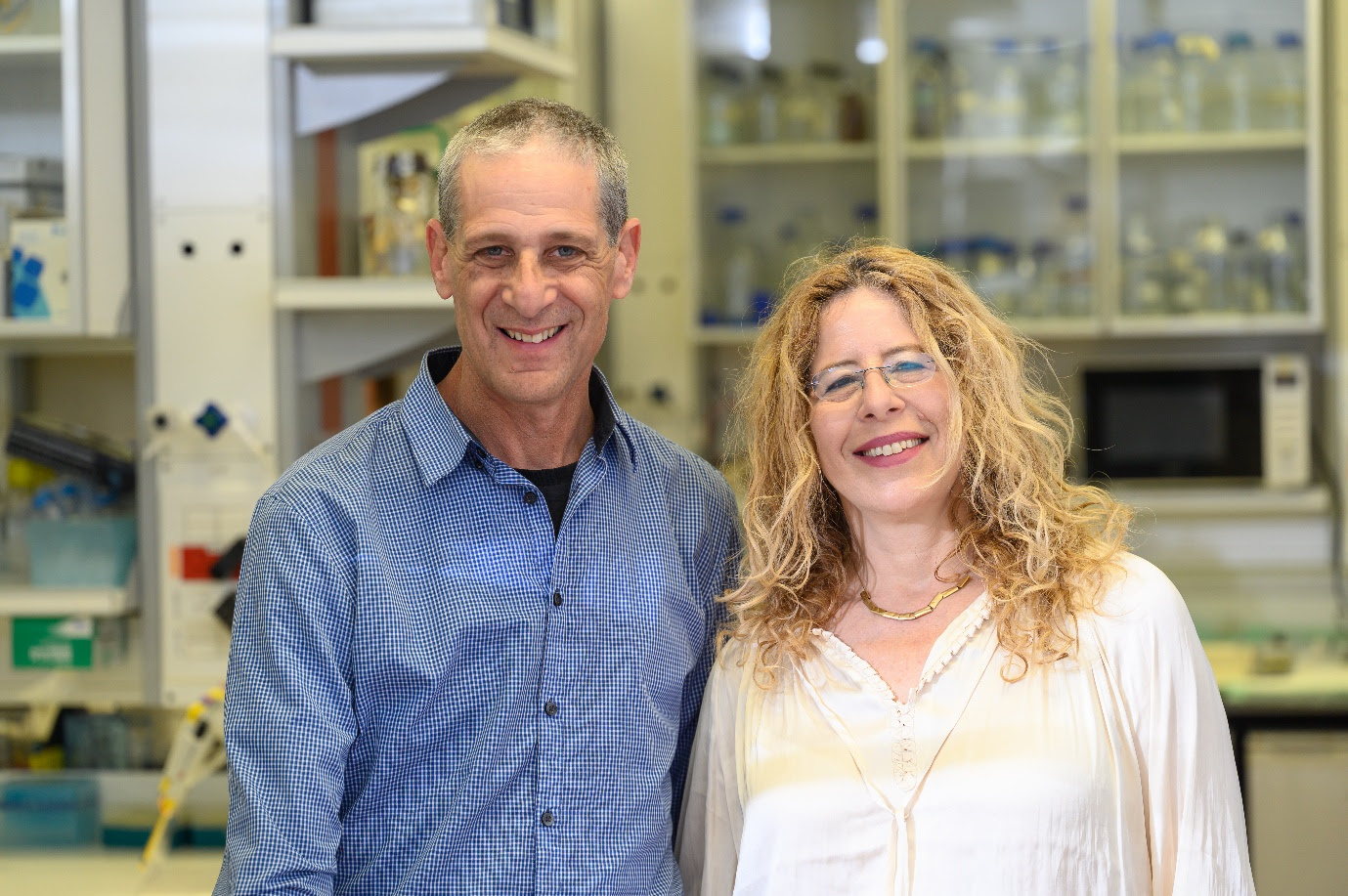
- Image: Yossi Paltiel and Michal Sharon (Ohad Herches)
PRESS RELEASE — In a new discovery researchers from the Hebrew University of Jerusalem and the Weizmann Institute of Science have found that something the direction of a magnetic field can influence how molecules of life behave at the most fundamental level and how early chemical processes linked to life may have unfolded
The study, led by Prof. Yossi Paltiel (Hebrew University) and Prof. Michal Sharon (Weizmann Institute), shows that tiny differences between atoms (different isotopes) can lead to measurable changes in molecular behavior when combined with an invisible quantum property known as electron spin. Separation of the different isotopes can be achieved by magnetic surfaces.
At the center of the story is L-methionine, an amino acid, a basic building block of life. Like other biological molecules, methionine has a specific “handedness,” meaning it exists in a form that is not identical to its mirror image. This property, called chirality, is a mystery: why did nature choose one “hand” over the other?

Now, the team’s findings suggest that magnetism and the spin of electrons may have played a role.
To explore this idea, the researchers created a clever experiment. They passed a solution of methionine molecules through a filter embedded with microscopic magnetic particles. Some of the molecules were slightly heavier than others, containing a rare form of carbon (¹³C instead of the more common ¹²C).
As the molecules flowed through, something unexpected happened.
Depending on the direction of the magnetization, the heavier and lighter versions of methionine behaved differently. In some cases, the heavier molecules were held back, while lighter ones passed through more quickly. Then, later in the process, the pattern reversed, as if the molecules were being temporarily “captured” and then released.
These effects were not random. They were consistent, measurable, and tied directly to the magnetic orientation.
So what’s going on?
The answer lies in a subtle quantum property: electron and nuclear spin. Particles behave a bit like tiny spinning tops, and their “spin direction” can influence how they interact with materials, especially when those materials are magnetic.
Chiral molecules like methionine are known to interact with electron spin in a special way, a phenomenon called chiral-induced spin selectivity (CISS). This means that the molecule’s shape can “filter” electrons based on their spin.
What this new research shows is that this same effect can extend to isotopes atoms that differ only slightly in mass and nuclear spin. In other words, spin and magnetism can influence not just how molecules react, but which versions of those molecules are favored.
At first glance, separating slightly heavier and lighter atoms might seem like a niche laboratory trick. But isotopes carry deep meaning in science, they are like chemical fingerprints, helping researchers trace the origins of molecules and understand how life emerged. The finding could also relate to the different isotope concentration in life.
“This work introduces spin as a new player in isotope chemistry,” the researchers explain.
That has profound implications. If magnetic environments, like those found on early Earth, could influence molecular behavior in this way, they might have helped shape the chemical pathways that led to life.
It also offers a fresh perspective on one of biology’s questions: why life chose a single molecular “handedness.”
The discovery doesn’t just look backward, it points forward.
Understanding how spin, magnetism, and molecular structure interact could open new doors in:
- Isotope separation technologies
- Advanced materials design
- Analytical chemistry
- And even quantum biology, an emerging field exploring how quantum effects influence living systems
In the end, the study reveals something both simple and profound: even at the smallest scales, direction matters.
A magnet pointing north or south can change how molecules move, interact, and separate. And those tiny differences may hold clues to the very origins of life.
About the Study
The research, titled “Spin-dependent isotopic fractionation of L-methionine,” was conducted by an interdisciplinary team from the Hebrew University of Jerusalem and the Weizmann Institute of Science and published in Chem (Cell Press, 2026). https://www.cell.com/chem/fulltext/S2451-9294(26)00059-8