
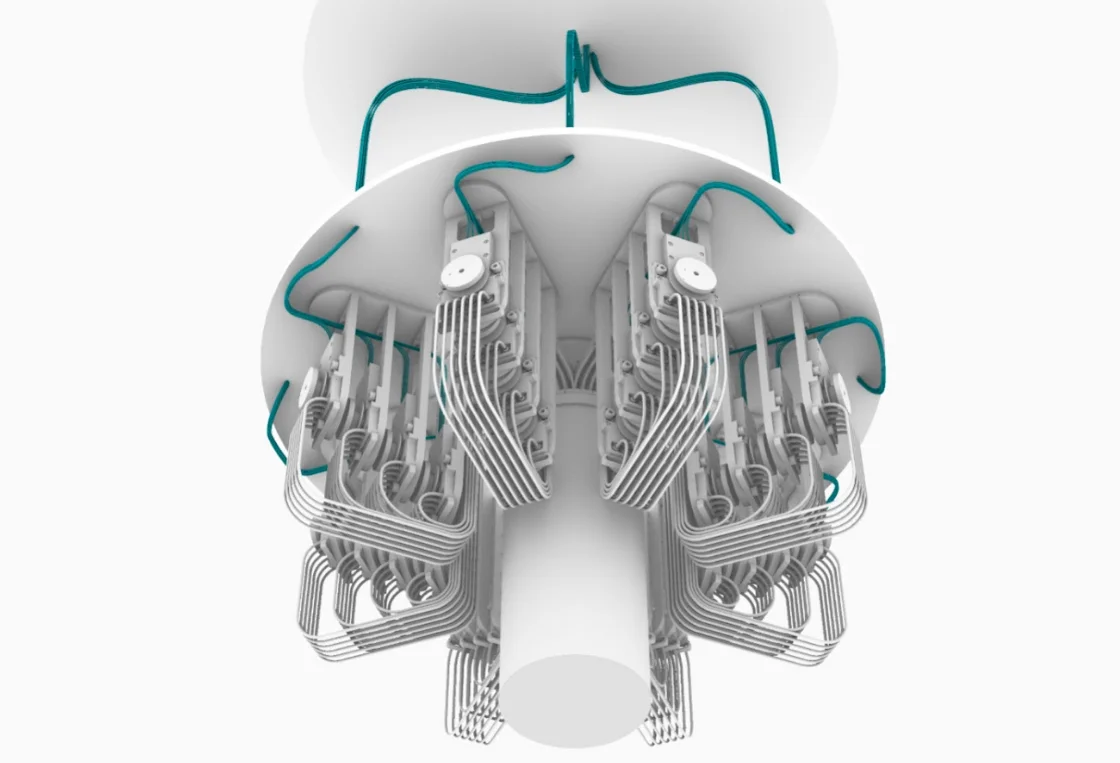


Insider Brief
- QphoX has launched a quantum transducer designed to connect microwave-based qubits with optical telecommunications networks, enabling long-distance transmission of quantum information.
- The device converts quantum states between microwave and optical signals, allowing quantum processors, memories, and sensors to communicate through standard optical fiber infrastructure.
- IBM will be the first partner to test the technology using its Quantum Networking Unit devices to explore distributed quantum computing architectures.
PRESS RELEASE — Quantum technology company QphoX has today announced the launch of the Quantum Transducer, a breakthrough product that directly aims at bridging the gap between microwave-based qubits and established optical telecommunications technologies.
By enabling high-fidelity quantum state conversion, the Quantum Transducer allows quantum information to travel through optical fiber networks at room temperature and over large distances.
With the Quantum Transducer, processors, memories, and sensors will seek to communicate seamlessly across distance, forming the foundation for scalable hybrid systems and future quantum networks.

Enabling rapid growth in modular quantum computing
The technology behind quantum processors is advancing rapidly, yet scaling systems remains a major challenge. One of the most promising approaches to overcome this challenge is to create modular quantum computers using optical interconnects, which promise to offer near-limitless reach and expand the ways in which quantum computers could soon achieve broad quantum advantage.
Simon Groeblacher, co-founder and CEO at QphoX, says:
“This is the first time the critical technology to interface microwave and optical systems over a low-noise, high-efficiency quantum link has been made commercially available. Thanks to our deep expertise in photonic integration and superconducting hardware, the Quantum Transducer is engineered for a possible integration into real-world quantum systems, not just laboratory demonstrations.”
“By connecting different quantum modalities, QphoX aims to create the foundation for distributed quantum computing architectures that could scale beyond today’s physical limits. We are looking forward to working with our partners and customers to explore how this link can connect quantum computing modules into large scale quantum systems.”
The Quantum Transducer is available today. IBM, a world leader in quantum computing, will be the first company to work with the Quantum Transducer to connect superconducting qubits via its Quantum Networking Unit (QNU) test devices.
“At IBM, we have a clear plan to deliver large-scale, fault-tolerant quantum computers by the end of this decade,” said Jerry Chow, CTO of Quantum-Centric Supercomputing at IBM. “As we look to build the future of computing, it is important we work with organizations such as QphoX to explore how novel technologies could help to scale quantum computers even beyond our roadmap and towards distributed networks.”