

Insider Brief
- Researchers at Singapore’s National Quantum Federated Foundry have partnered with Qolab to develop cryogenic low-pass filters aimed at scaling superconducting quantum processors.
- The collaboration focuses on manufacturing wafer-level cryogenic filters to reduce noise and enable denser, more reliable integration of qubit circuits.
- The filters are expected to be deployed in quantum systems at University of California, Los Angeles, supporting broader international hardware collaboration.
PRESS RELEASE — Singapore is strengthening its role in the global quantum hardware ecosystem through a new collaboration between researchers at the National Quantum Federated Foundry (NQFF) and Qolab, a quantum computing company co-founded by 2025 Physics Nobel Laureate Professor John M. Martinis.
Drawn by Singapore’s strong semiconductor and deep tech ecosystem, Qolab will work with Singapore researchers to develop new components essential for scaling next-generation quantum computing systems.
The research focuses on developing critical components, specifically cryogenic low-pass filters, for quantum processor chips1. These filters address a critical bottleneck in building larger, more powerful quantum computers.
“Building useful quantum computers requires scaling from dozens to millions of qubits, and that means we need not just more qubits but also reliable, manufacturable supporting hardware,” said Professor Martinis, Chief Technology Officer and Co-founder of Qolab. “Singapore’s strong capabilities in advanced semiconductor manufacturing makes it an ideal partner for Qolab as we develop critical components that will support the next generation of quantum computing.”
This collaboration comes as global momentum in quantum hardware accelerates. Through sustained research, innovation and enterprise (RIE) investments, Singapore has continued strengthening its capabilities across semiconductor manufacturing, advanced engineering, and quantum device development. This unique intersection of strengths, combined with Singapore’s open and collaborative approach to international partnerships, has positioned the country as an attractive base for leading quantum technology companies looking to develop and scale critical hardware.
The role of cryogenic filters in quantum computing
Superconducting qubits are one of the most mature and pioneering technology used by technology industry leaders to power quantum processors. These operate at temperatures close to absolute zero and are extremely sensitive to environmental noise. Cryogenic low-pass filters act as shields, blocking unwanted high-frequency signals. However, conventional filter solutions currently used in quantum computers are large, subject to errors, and difficult to manufacture at scale.
The collaboration will leverage complementary strengths from NQFF’s quantum device nanofabrication capabilities, and Qolab’s quantum computing systems expertise towards developing cryogenic filters that can be manufactured on semiconductor wafers – similar to how computer chips are made. This approach enables denser integration of filters directly with qubit circuits, allowing more qubits to fit into smaller, more reliable packages. The filters are expected to be deployed in quantum systems at the University of California, Los Angeles (UCLA).
“This collaboration demonstrates how Singapore can contribute critical quantum hardware components to the global ecosystem,” said Mr Ling Keok Tong, Executive Director of the National Quantum Office. “It brings together our strengths in semiconductor engineering, advanced manufacturing and quantum research to address real-world hardware challenges. With partners such as UCLA already committed to deploying these filters, it signals growing confidence in Singapore’s capabilities and strengthens our role in the global quantum supply chain.”
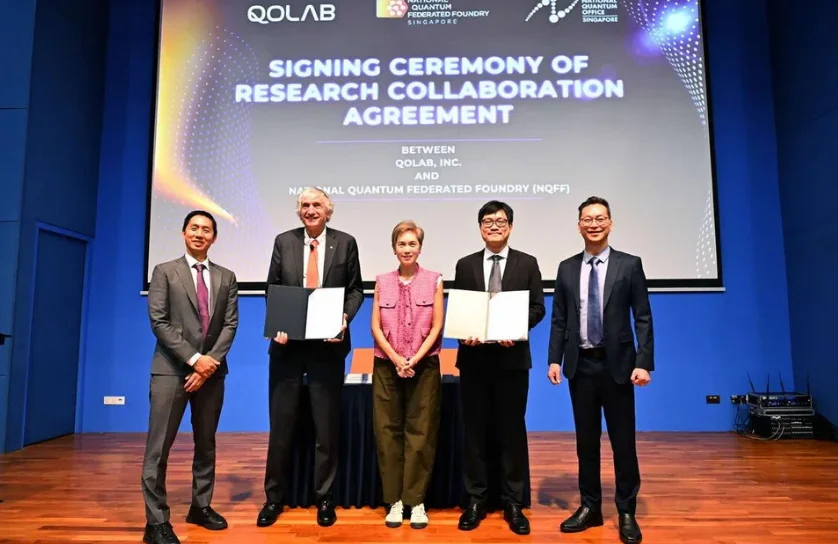
The research collaboration agreement was signed between NQFF and Qolab and witnessed by Minister for Digital Development and Information Josephine Teo. It was part of a quantum-related event today which commenced with opening remarks by Guest-of-Honour Minister Josephine Teo.
The event featured a public guest lecture – organised by the National Quantum Office (a national platform hosted by the Agency for Science, Technology and Research) and the National Research Foundation – by Professor Martinis on the history of superconducting qubits and the NQFF Industry Day, which showcased quantum hardware developments from industry partners and leading global players.