

Insider Brief
- Researchers demonstrated a new method to read the quantum state of Majorana-based topological qubits using a global quantum capacitance probe.
- The team engineered a minimal Kitaev chain device composed of two semiconductor quantum dots coupled through a superconductor to generate controllable Majorana zero modes.
- The experiment showed that while local charge measurements cannot detect the qubit’s parity state, a global probe can distinguish even and odd states in real time without compromising topological protection.
Researchers in Spain and the Netherlands report they have demonstrated a new way to read information stored in Majorana-based topological qubits, a long-sought step toward fault-tolerant quantum computing.
“This is a crucial advance,” Ramón Aguado, a CSIC researcher at the Madrid Institute of Materials Science (ICMM) and one of the study’s authors, said in a news release. “Our work is pioneering because we demonstrate that we can access the information stored in Majorana qubits using a new technique called quantum capacitance,” continues the scientist, who explains that this technique “acts as a global probe sensitive to the overall state of the system.”
The team published its findings in Nature.
Topological qubits store information non-locally, spreading it across a pair of quantum states known as Majorana zero modes rather than confining it to a single physical location. That distributed structure makes them resistant to local disturbances, because disrupting the stored information would require a coordinated, system-wide failure. But that same feature has posed a practical challenge that if the information is not localized, it becomes difficult to measure without undermining the qubit’s protection.
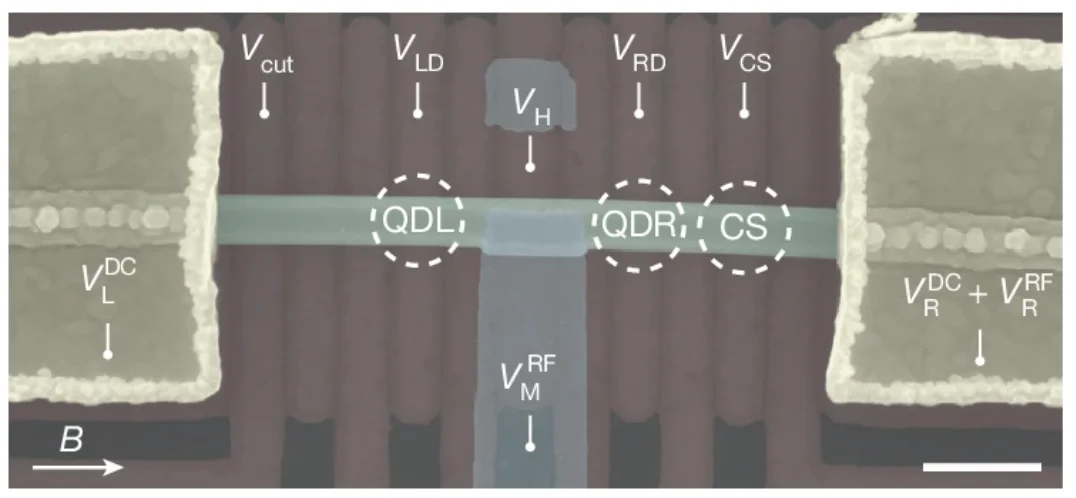
To address that problem, the researchers built a modular nanostructure known as a minimal Kitaev chain. The device consists of two semiconductor quantum dots coupled through a superconducting link, allowing the team to engineer Majorana modes in a controlled, bottom-up fashion. Unlike earlier experiments that relied on complex material combinations with limited tunability, the approach provides a simplified platform in which the key quantum states can be deliberately created and adjusted.
Using a quantum capacitance probe — a measurement technique sensitive to the collective state of the system rather than to local charge — the team was able to determine, in a single real-time measurement, whether the combined Majorana state was in an even or odd configuration. That parity distinction, which corresponds to whether the qubit is effectively occupied or unoccupied, forms the logical basis of the topological qubit.
According to the researchers, the results support the central claim of topological protection that conventional local charge measurements remain insensitive to the encoded information, while a global probe can reveal it without compromising the system’s underlying robustness.
“The experiment elegantly confirms the protection principle: while local charge measurements are blind to this information, the global probe reveals it clearly,” researcher Gorm Steffensen, a member of the team at the ICMM-CSIC, said, according to the release.
Another relevant result of this experiment is the observation of random parity jumps, which allows for the measurement of parity coherence exceeding one millisecond, which the researchers suggest is a promising value for future operations of a topological Majorana qubits.
This study combines a novel experimental methodology, developed primarily at Delft University of Technology, with the theoretical contribution of the ICMM-CSIC, which has been “crucial for understanding this highly sophisticated experiment,” the researchers said.