

Insider Brief
- A three-year collaboration between National Research Council of Canada and Quantum Valley Ideas Lab has developed Rydberg-atom–based sensors that could improve radio-frequency measurement and communications without traditional metal antennas.
- The sensors use highly excited Rydberg atoms to directly measure electric fields across a wide frequency range with high precision and stability, functioning as calibration-free dielectric sensors rooted in fixed atomic properties.
- The work has generated commercial momentum, including the launch of the spin-off company WaveRyde and early prototype testing, supporting Canada’s National Quantum Strategy focus on research translation and commercialization.
PRESS RELEASE — Imagine cell phones with better connectivity, radar systems that detect with greater precision, and power grids that run more efficiently. A new quantum technology called Rydberg sensors could help make this possible.
Developed through a 3-year collaboration between the National Research Council of Canada (NRC) and Quantum Valley Ideas Lab (QVIL), Rydberg sensors could someday transform how we communicate and measure radio signals.
These sensors are built from atoms placed in a highly excited state, known as Rydberg atoms. In this state, an atom’s electron orbits far from its nucleus, making it extremely sensitive to radio waves—the same kind used by cell phones, Wi-Fi, and radar systems.

“Rydberg sensors have the capacity to make communications better by making cellular equipment more reliable,” explained Dr. James Shaffer of Quantum Valley Ideas Lab. “It is a dielectric sensor that has a larger frequency range than conventional antennas.”
They are referred to as “dielectric sensors” because they do not contain metal and do not interfere with the electric fields they measure. They sense the field directly which helps them measure electronic signals with great precision.
Because Rydberg sensors rely on atomic properties fixed by nature, they don’t require external calibration. This means they serve as reliable, consistent measurement standards—an important advantage for technologies that depend on precision and stability.
“We are excited to see this technology moving forward towards atomic standards,” said Dr. Scott Beattie, Team Leader for the NRC’s Frequency and Time group at the Metrology Research Centre. “Measurement standards ensure consistent, accurate and reliable references. They support scientific research and quality control by providing common benchmarks around the world.”
The team combined expertise in Rydberg atoms, gas cell manufacturing, metrology, atomic clocks, and frequency measurements to advance these sensors. Together, they achieved the most accurate spectroscopic measurements yet of the structure of highly excited states in caesium atoms.
Spectroscopy—the study of how atoms absorb or emit light—provides insights into the atomic structures that make Rydberg sensors so sensitive.
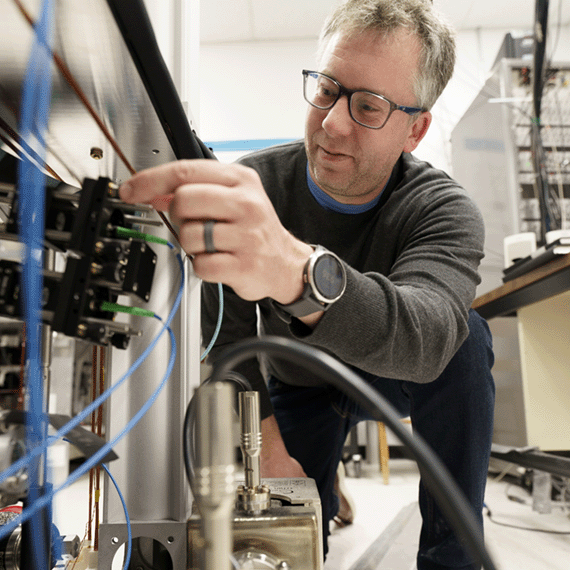
To accomplish this, the team cooled atoms to just above absolute zero using laser light. They also improved the design of gas vapour cells and compared the new sensors to calibrated antennas at QVIL, with the NRC contributing its world-class measurement expertise and guidance.
“This Canadian technology is world-leading.” said Dr. Shaffer
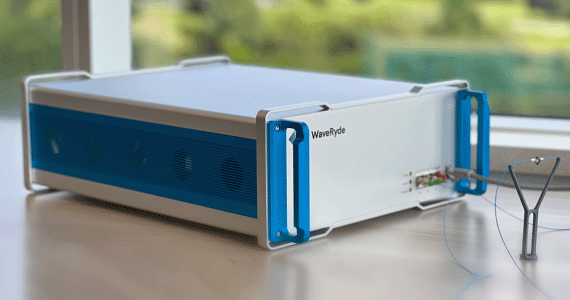
The research has already sparked commercial interest. Quantum Valley Ideas Lab has launched a spin-off company, WaveRyde, to bring Rydberg sensors to market. Two collaborators are currently testing prototypes, marking an important step toward real-world applications.
“This research illustrates how the NRC and its Canadian collaborators can work successfully together on new generations of quantum technology,” said Dr. Marina Gertsvolf, Director of the NRC’s Internet of Things: Quantum Sensors Challenge program. “This project exemplifies how Canadian research and industry lead the science of Rydberg sensors to develop new, commercially viable products that grow and strengthen the quantum ecosystem.”
The project also supports the 3 pillars of Canada’s National Quantum Strategy: advancing research, developing talent, and translating innovation into scalable, commercial products and services that benefit Canadians, industry, and the world.
This research was supported by the Internet of Things: Quantum Sensors Challenge program, with funding from the NRC’s Collaborative Science, Technology and Innovation program.
For more information, contact the team at NRC.QuantumSensors-CapteursQuantiques.CNRC@nrc-cnrc.gc.ca.