Qolab Strengthens Position with Strategic Partnerships and Global Expansion in 2025


Insider Brief
- Qolab made significant strides in 2025, achieving key partnerships, strategic collaborations, and product launches aimed at advancing scalable superconducting quantum hardware.
- The company led national quantum initiatives and contributed to the DARPA Quantum Benchmarking Initiative, driving performance standards for next-generation quantum systems.
- Qolab launched its Qolab Start system and expanded its international presence with its first deployment at the Israeli Quantum Computing Center (IQCC).
PRESS RELEASE — Qolab closed 2025 with a series of strategic collaborations, product deployments, and industry leadership milestones that underscore growing momentum behind its approach to scalable superconducting quantum hardware. Together, these advances mark foundational progress toward the company’s mission to build a commercially useful quantum computer through semiconductor-aligned manufacturing and system-level integration.
Throughout the year, Qolab deepened relationships with leading industrial and technology partners, advanced national quantum initiatives, and expanded its global footprint, laying critical groundwork for the transition from laboratory-scale systems to deployable quantum hardware.
In 2025 Qolab strengthened its strategic position through investments and collaborations with Applied Ventures and Western Digital, two global leaders in semiconductor manufacturing and precision engineering, and through its role as a co-leader of the Quantum Scaling Alliance, an industry consortium focused on full-stack co-design for deployable quantum–classical computing systems.

Qolab also contributed to national quantum initiatives supporting shared infrastructure and long-term technology development. As part of the DARPA Quantum Benchmarking Initiative, the company led superconducting quantum hardware efforts within a national consortium that includes Hewlett Packard Enterprise, Synopsys, Quantum Machines, 1Qbit, and the University of Wisconsin. These efforts are aimed at establishing rigorous performance benchmarks for next-generation quantum systems. In addition, Qolab contributed fabrication tooling and performance benchmarking expertise through the Department of Energy’s Quantum Systems Accelerator at Lawrence Berkeley National Laboratory.
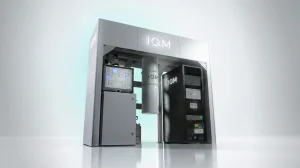
In December, Qolab launched Qolab Start, a superconducting qubit system designed for hardware research and workforce development. The company deployed its first superconducting-qubit devices at the Israeli Quantum Computing Center (IQCC), marking its first international installation and an important step in expanding its global footprint.
Qolab published multiple technical papers during the year, including Scaffold-Assisted Window Junctions for Superconducting Qubit Fabrication, which introduced a lift-off-free Josephson junction process compatible with semiconductor manufacturing. Statistics of Strongly Coupled Defects in Superconducting Qubits identified lift-off processes as a major source of decoherence providing critical insights to improve qubit performance and yield.
Qolab maintained an active presence across the global quantum ecosystem in 2025, with company leaders engaging directly with industry, government, and academic partners in key international markets. As part of a Middle East tour spanning the UAE and Israel, Qolab delivered keynote addresses, technical sessions, and academic lectures focused on advancing scalable quantum hardware. Engagements included visits to CyberQ, NYU Abu Dhabi (ADIA Lab), TII Quantum Labs, Tel Aviv University, the Hebrew University of Jerusalem, and in-depth technical discussions with regional research organizations supporting quantum deployment efforts.
Qolab also participated in major industry and scientific conferences, including APS, IEEE Quantum Week, and AQC, strengthening relationships with researchers, developers, and industry stakeholders across the quantum ecosystem.
Following the 2025 Nobel Prize in Physics awarded to Qolab cofounder and CTO Prof. John M. Martinis, the company saw increased U.S. and international media attention, with coverage linking the award to Qolab’s work in scalable superconducting quantum hardware and semiconductor-aligned fabrication, highlighting the company’s role in translating foundational research into engineered systems.
“Qolab’s mission is to translate decades of scientific progress in superconducting qubits into hardware that can be manufactured, scaled, and deployed,” said Alan Ho, CEO of Qolab. “In 2025, we focused on building the technical, industrial, and collaborative foundations needed to move from laboratory systems toward deployable quantum hardware.”

Keep track of everything going on in the Quantum Technology Market. In one place.
Topics

Mohib Ur Rehman
Covering quantum and emerging technologies, Mohib explores the intersection of technology, security, and society. His work also frequently examines surveillance infrastructure and the institutions shaping the digital world. In addition to his work at The Quantum Insider, he co-runs SK NEXUS, an independent technology publication that helps readers understand the technologies shaping their lives.

Stay Ahead of Quantum
Get the latest research, company news, and market intelligence every week.
MENTIONED IN THE ARTICLE
Qolab
Qolab is a company focused on advancing quantum computing by building high-quality qubits. They leverage cutting-edge semiconductor manufacturing processes to achieve this goal.
→

Hewlett Packard Enterprise
HPE is a global edge-to-cloud company. They connect, protect, analyze and act on various data and applications, from edge to cloud, and turn insights into outcomes.
→

Synopsys
Synopsys specializes in electronic design automation (EDA), semiconductor IP, and systems verification, focusing on enabling rapid innovation from silicon to systems. The company develops industry-leading tools for silicon design, photonics, and multiphysics analysis, supporting advanced chip development for AI, automotive, data center, and other high-tech markets. Synopsys emphasizes productivity and R&D partnership, delivering solutions that help customers accelerate time-to-market and achieve first-pass silicon success.
→
Quantum Machines
Quantum Machines develops operational and control systems (both hardware and software) for quantum computers.
→

US Department of Energy
The United States Department of Energy is a cabinet-level department of the United States Government concerned with the United States' policies regarding energy and safety in handling nuclear material.
→

Lawrence Berkeley National Laboratory
Lawrence Berkeley National Laboratory, operating under the U.S. Department of Energy, spearheads unclassified scientific research pivotal to climate technology. Their innovative work includes developing advanced energy-efficient technologies, renewable energy solutions, and cutting-edge climate modeling tools. These efforts are crucial in mitigating climate change, enhancing energy sustainability, and informing policy decisions to foster a resilient, low-carbon future.
→