Bright Prospects For Engineering Quantum Light


Insider Brief
- Researchers at UC Santa Barbara have developed models to understand the inefficiencies of single-photon emission, particularly at the telecom wavelengths needed for quantum internet, by examining atomic vibrations in photon emission processes.
- This research reveals that atomic vibrations reduce photon-emission efficiency as wavelengths increase to the infrared spectrum, while also offering insights into techniques for engineering brighter and more efficient quantum emitters through material selection and atomic-level engineering.
- Supported by the U.S. Department of Energy and NSF, the team’s findings, published in APL Photonics, aim to inform the development of quantum emitters for future quantum networks, potentially enhanced by coupling to photonic cavities with input from the UCSB Quantum Foundry affiliates.
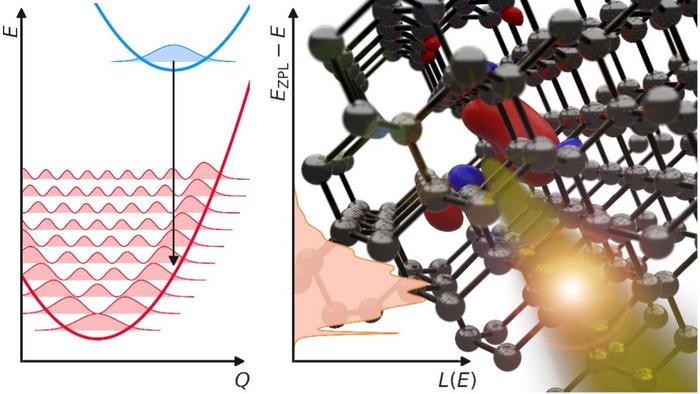
- Image: Concept illustration depicting a quantum defect emitting a single photon. (Mark Turianksy)
PRESS RELEASE — Computers benefit greatly from being connected to the internet, so we might ask: What good is a quantum computer without a quantum internet?
The secret to our modern internet is the ability for data to remain intact while traveling over long distances, and the best way to achieve that is by using photons. Photons are single units (“quanta”) of light. Unlike other quantum particles, photons interact very weakly with their environment. That stability also makes them extremely appealing for carrying quantum information over long distances, a process that requires maintaining a delicate state of entanglement for an extended period of time. Such photons can be generated in a variety of ways. One possible method involves using atomic-scale imperfections (quantum defects) in crystals to generate single photons in a well-defined quantum state.
Decades of optimization have resulted in fiber-optic cables that can transmit photons with extremely low loss. However, this low-loss transmission works only for light in a narrow range of wavelengths, known as the “telecom wavelength band.” Identifying quantum defects that produce photons at these wavelengths has proven difficult, but funding from the U.S. Department of Energy and the National Science Foundation (NSF) has enabled researchers in the UC Santa Barbara College of Engineering to understand why that is. They describe their findings in “Rational Design of Efficient Defect-Based Quantum Emitters,” published in the journal APL Photonics.

“Atoms are constantly vibrating, and those vibrations can drain energy from a light emitter,” says UCSB materials professor Chris Van de Walle. “As a result, rather than emitting a photon, a defect might instead cause the atoms to vibrate, reducing the light-emission efficiency.” Van de Walle’s group developed theoretical models to capture the role of atomic vibrations in the photon-emission process and studied the role of various defect properties in determining the degree of efficiency.
Their work explains why the efficiency of single-photon emission drastically decreases when the emission wavelength increases beyond the wavelengths of visible light (violet to red) to the infrared wavelengths in the telecom band. The model also allows the researchers to identify techniques for engineering emitters that are brighter and more efficient.
“Choosing the host material carefully, and conducting atomic-level engineering of the vibrational properties are two promising ways to overcome low efficiency,” said Mark Turiansky, a postdoctoral researcher in the Van de Walle lab, a fellow at the NSF UC Santa Barbara Quantum Foundry, and the lead researcher on the project.
Another solution involves coupling to a photonic cavity, an approach that benefited from the expertise of two other Quantum Foundry affiliates: computer engineering professor Galan Moody and Kamyar Parto, a graduate student in the Moody lab.
The team hopes that their model and the insights it provides will prove useful in designing novel quantum emitters that will power the quantum networks of the future.

Keep track of everything going on in the Quantum Technology Market. In one place.
Topics

Matt Swayne
With a several-decades long background in journalism and communications, Matt Swayne has worked as a science communicator for an R1 university for more than 12 years, specializing in translating high tech and deep tech for the general audience. He has served as a writer, editor and analyst at The Quantum Insider since its inception. In addition to his service as a science communicator, Matt also develops courses to improve the media and communications skills of scientists and has taught courses.
[email protected]

Stay Ahead of Quantum
Get the latest research, company news, and market intelligence every week.
MENTIONED IN THE ARTICLE

UC Santa Barbara
The University of California, Santa Barbara, is a public research university located in Santa Barbara, California, United States. It operates within the University of California system. Originating from an independent teachers' college in 1891, UCSB became part of the California State system in the 1920s and later joined the University of California system in 1944. It holds the distinction of being the third-oldest undergraduate campus within the system, following UC Berkeley and UCLA.
→

U.S. Department of Energy (DOE)
The mission of the Department of Energy is to ensure America's security and prosperity by addressing its energy, environmental, and nuclear challenges through transformative science and technology solutions. In September, 2022, Research supported by ASCR demonstrated that classical machine learning algorithms can accurately predict ground state properties and classify quantum phases of matter using data generated from quantum experiments. In November, 2022, Research supported by Q-NEXT revealed that the performance of a sensor network is constrained by the intrinsic noise associated with the quantum states used in the network. In March, 2023, Research funded by DOE SC NP achieved the first experimental observation of entanglement between dissimilar particles, specifically positive and negative pions. In August, 2023, Research funded by DOE SC BER demonstrated strong preservation of entanglement in a two-photon absorption process involving organic molecules, offering a new approach for developing quantum light-based spectroscopy and microscopy.
→