


Insider Brief
- Purdue University has joined the Chicago Quantum Exchange (CQE).
- CQE is an intellectual hub that has led the Midwest in becoming a central driver of U.S. leadership in quantum technologies.
- Central to Purdue’s membership is the university’s Purdue Quantum Science and Engineering Institute (PQSEI), which brings together leading quantum researchers and leverages collaborations with industry, government and academia.
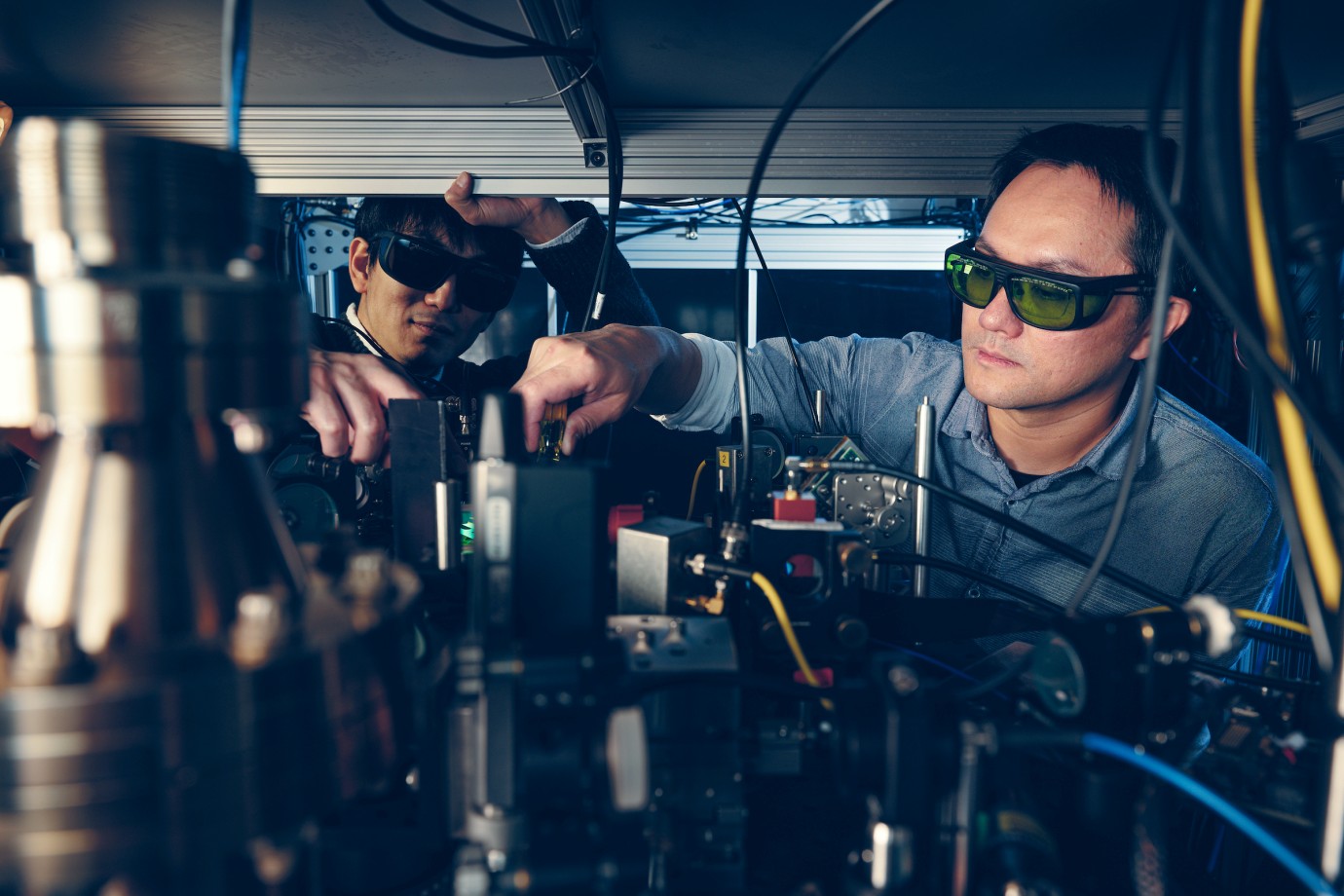
- Image: Purdue University researchers work toward developing quantum materials. (Photo by Charles Jischke courtesy of Purdue University.) Story: CQE
PRESS RELEASE — Purdue University has joined the Chicago Quantum Exchange (CQE) in the collaborative effort to advance the science and engineering of quantum information, build the future quantum workforce, and drive the nation’s quantum economy.
As the newest member of the CQE, an intellectual hub that has led the Midwest in becoming a central driver of U.S. leadership in quantum technologies, Purdue joins interdisciplinary research activity anchored by the University of Chicago, the U.S. Department of Energy’s Argonne National Laboratory and Fermi National Accelerator Laboratory, the University of Illinois Urbana-Champaign, the University of Wisconsin–Madison, and Northwestern University. The CQE is based at the University of Chicago’s Pritzker School of Molecular Engineering and includes nearly 50 corporate, international, nonprofit and regional partners.
Central to the membership is the Purdue Quantum Science and Engineering Institute (PQSEI), which brings together leading quantum researchers and leverages collaborations with industry, government and academia to drive discovery of quantum phenomena and development of chip-scale quantum systems for tomorrow’s technology. The PQSEI consolidates the strengths of approximately 60 faculty affiliates and hundreds of other researchers in multiple departments across campus such as chemistry, computer science, electrical and computer engineering, mathematics, materials science, and physics.

“Joining the Chicago Quantum Exchange represents an unparalleled opportunity for Purdue University to amplify our impact in the quantum realm.” Patrick Wolfe, Purdue University provost and executive vice president for academic affairs and diversity
Quantum science is also a pillar of Purdue Computes, a strategic university initiative to further scale Purdue’s research and educational excellence.
“Joining the Chicago Quantum Exchange represents an unparalleled opportunity for Purdue University to amplify our impact in the quantum realm,” said Patrick Wolfe, Purdue University provost and executive vice president for academic affairs and diversity. “By working together, Purdue and our peers within the CQE can accelerate their focus on developing quantum technologies that could revolutionize the way we communicate, compute and sense the world around us.”
The agreement marks the seventh member for the CQE, which brings together institutions’ intellectual talents, research capabilities and engineering capacities in one of the largest collaborative teams working on quantum information science in the world. With the addition of Purdue, the CQE community includes more than 210 researchers spanning a range of expertise in quantum information technology.
“The CQE’s continued expansion enables researchers to draw from additional areas of expertise, driving interdisciplinary, multi-institutional collaborations that lead to important breakthroughs and strengthening the Midwest ecosystem as it leads the nation to an inclusive and sustainable quantum economy,” said David Awschalom, the Liew Family Professor in Molecular Engineering and Physics at the University of Chicago, director of the Chicago Quantum Exchange, senior scientist at Argonne, and director of Q-NEXT, a Department of Energy Quantum Information Science Research Center. “By adding Purdue University to the CQE, we deepen our community’s resources and enhance opportunities for students and others interested in careers in quantum information science and engineering.”
Purdue provides curriculum, experiential learning opportunities and outreach efforts to help develop the quantum engineers and scientists of the future.
Purdue is a core member of the Quantum Science Center (QSC), one of five multidisciplinary National Quantum Information Science Research Centers supported by the U.S. Department of Energy. Purdue annually hosts the QSC’s Quantum Summer School on its West Lafayette campus. Alexandra Boltasseva, the Ron and Dotty Garvin Tonjes Distinguished Professor of Electrical and Computer Engineering, serves as the workforce development lead for the QSC.
“Training quantum researchers is crucial for addressing skill shortages in the rapidly advancing field of quantum technologies. Purdue provides a significant curriculum, experiential learning opportunities and outreach efforts to help develop the quantum workforce of the future,” said Boltasseva, who also serves as Purdue’s faculty lead for the CQE collaboration. “Together with our colleagues across the CQE, our efforts can ensure a skilled workforce capable of driving innovation, economic growth and societal progress in this transformative field.”
Workforce development and advancing research for the benefit of society are also at the heart of the PQSEI’s regional collaborative research efforts, such as the National Science Foundation-backed Center for Quantum Technologies (CQT). The Purdue-led effort joins the institution with Indiana University Bloomington, University of Notre Dame and Indiana University-Purdue University Indianapolis in developing novel quantum technologies to address significant industry challenges. Industry and government members of the CQT include the Air Force Research Laboratory, AWS, Cummins, D-Wave Systems, Eli Lilly & Co., Entanglement Inc., Hewlett Packard Enterprise, Peraton, Quantum Corridor and Toyota.
“Through our participation in the Chicago Quantum Exchange, we recognize the opportunity to amplify our collective impact, driving forward the frontiers of quantum science and engineering.” Yong Chen, the Karl Lark-Horovitz Professor of Physics and Astronomy, professor of electrical and computer engineering, and the director of the Purdue Quantum Science and Engineering Institute
Purdue West Lafayette also is a founding member of the Midwest Quantum Collaboratory, which was launched in 2021 with research partners at the University of Michigan and Michigan State University.
“Collaboration is the catalyst for innovation,” said Yong Chen, the Karl Lark-Horovitz Professor of Physics and Astronomy, professor of electrical and computer engineering, and the director of the PQSEI. “Through our participation in the Chicago Quantum Exchange, we recognize the opportunity to amplify our collective impact, driving forward the frontiers of quantum science and engineering.”
The CQE has already played a key role in fostering the cross-sector partnerships at the center of the region’s growing strength in the field — and its institutions have attracted significant investment, including $280 million in federal funding through the 2018 National Quantum Initiative Act. The state of Illinois has also invested $200 million in quantum research facilities, and Illinois Gov. JB Pritzker has proposed $500 million for quantum technologies in his FY 2025 budget. In addition, IBM and Google invested a combined $150 million last year in partnerships with the University of Chicago and the University of Tokyo to develop two separate plans to advance quantum computing.
n October, the Biden-Harris administration named the Chicago region an official U.S. Economic Development Administration Regional Innovation and Technology Hub for quantum technologies, a designation that opens the door to new federal funding and recognizes its growing strength to be at the center of the nation’s quantum economy. The region’s Bloch Quantum Tech Hub, a cross-sector coalition projected to drive $60 billion in economic impact by 2035, was one of 31 designees from 400 applications nationwide.