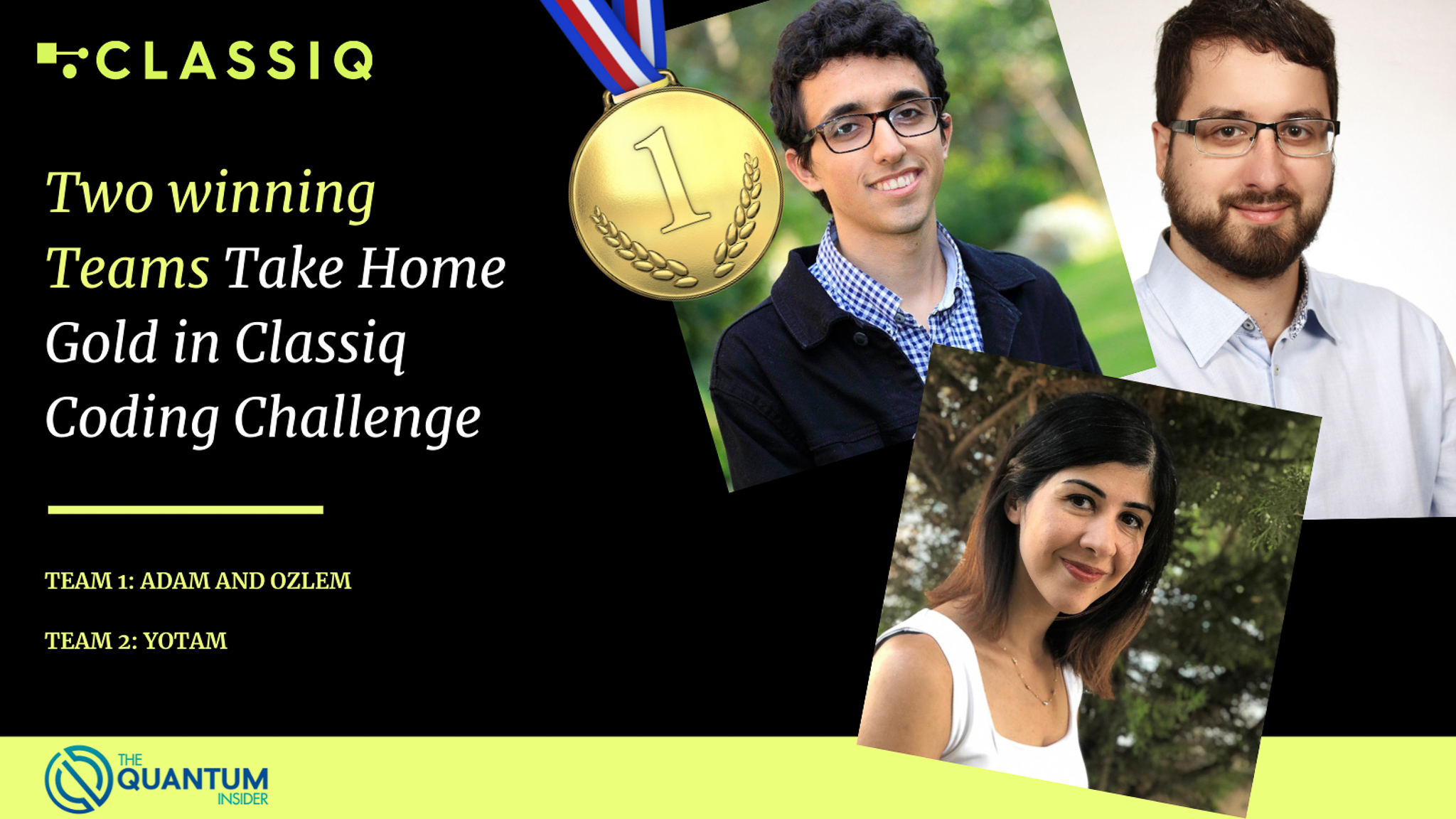

Teams of quantum developers from all over the world – and from all over the age brackets — took part in the Classiq Coding Challenge. Here are three gold-medal winners to offer insights on the competition and what it takes to grapple with the huge challenges of quantum algorithm design and execution.
Constraint Satisfaction
First, the judges awarded Adam Glos and Ozlem Salehi Köken, of Poland, gold for their approach to the constraint satisfaction challenge – solving a Kakuro puzzle, a mathematical take on the crossword puzzle. Constraint satisfaction problems are “NP-complete” problems that are hard to solve classically. A quantum solution has wide-ranging implications: supply chain, packing optimizations, design verification, route planning, and many more.
Glos has a doctoral degree in computer science and based his dissertation on quantum walks – but that’s just the beginning of Glos’s own quantum walk.

“Recently I have focused on quantum optimization and related aspects,” said Glos, adding, “Most of my knowledge which helped with the Classiq problem comes from self-studying, Qiskit tutorials, and the IBM Quantum Challenge. I’m dedicating a lot of my time to quantum, as both a researcher at the Institute of Theoretical and Applied Informatics, Polish Academy of Sciences and in a quantum-relevant position in Algorithmiq. And finally, I’m part of QWorld Association. Quantum is my life!”
Glos said Qiskit was not ideal for implementing a multi-controlled NOT with restricted ancilla, which made him start a project that was about choosing an optimal implementation. It made for an interesting challenge.
“Classiq ‘forced me’ to contribute to the quantum community in a new way,” he said.
Glos and Köken broke down the challenge into three parts. Understanding the problem took around 1-2 hours while the design itself took no more than 1-3 hours.
“The implementation was done mostly on Köken’s side, but I believe it took some time as we tried to make the code easy to understand – both for us and the jury,” said Glos.
For the full solution from Glos and Köken, as well as other winners of this challenge, please see this post on the Classiq site

Log-Normal Distribution
Yotam Vaknin, of Israel, won the gold medal for a solution to the log-normal distribution challenge.
Vaknin has PhD from Hebrew University of Jerusalem and is an Intern at Amazon Center for Quantum Computing at Caltech. Vaknin added he learned to work with quantum circuits during an internship at IBM’s quantum computing group.
Although the challenge took about a day to solve, Vaknin found the competition interesting.
“I didn’t think about simulating probability distributions before, and it was an interesting puzzle,” Vaknin said.
If you found this article to be informative, you can explore more current quantum news here, exclusives, interviews, and podcasts.