Quantum Computing 101: Can a Cat be Alive and Dead at The Same Time?

Katia Moskvitch


The Insider Brief:
- Qubits, unlike classical bits, can exist in a superposition of 0 and 1, the idea Schrödinger’s famous cat was invented to illustrate. Entanglement links qubits in ways classical computers struggle to simulate at scale.
- Superconducting qubits must be cooled to around 10 thousandths of a degree above absolute zero, far colder than outer space, to protect their fragile quantum states.
- Quantum computers won’t replace laptops, but they could transform the simulation of molecules and materials and break today’s public-key encryption, which is driving the shift to post-quantum cryptography.
Everyone in quantum gets the same questions from friends, family and colleagues outside the field. What is a qubit, really? Why do quantum computers need to be so cold? And will one replace my laptop? Here are the short answers.
A classical computer stores information in bits, each either 0 or 1. A quantum computer uses qubits. Like a bit, a qubit gives a 0 or a 1 when you measure it. Before it is measured, though, it can be in a superposition: a combination of 0 and 1 at the same time, with each outcome carrying a certain probability.
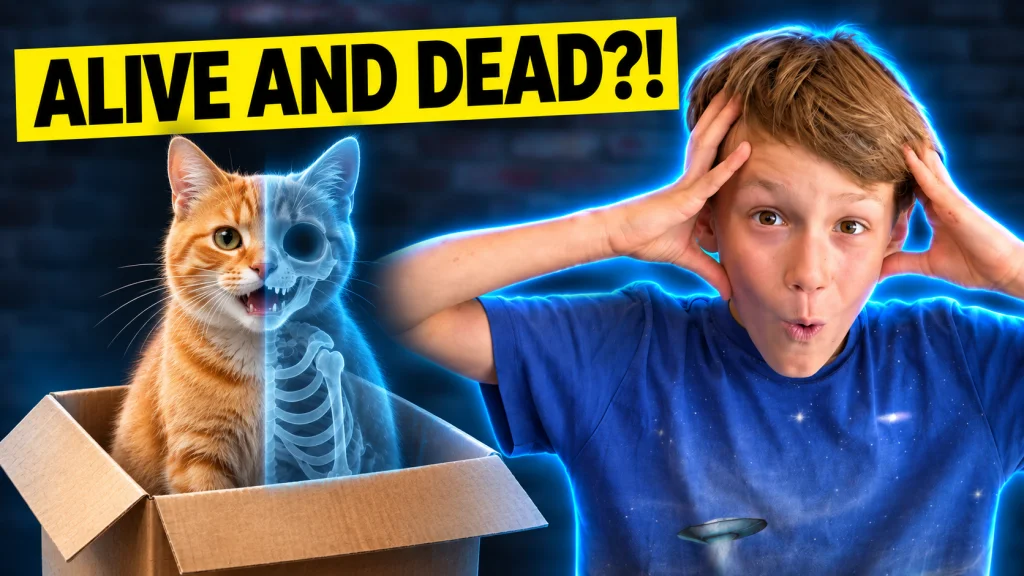
Schrödinger’s cat
In 1935, Erwin Schrödinger imagined a cat sealed in a box whose fate depends on a single quantum event. By the rules of quantum mechanics, until someone opens the box, the cat is in a superposition of alive and dead. Schrödinger meant it to show how strange quantum theory looks when stretched to everyday objects, and the paradox stuck.
Cats never behave like this, but qubits do. The catch is that superposition is fragile. Measure a qubit, or let its surroundings disturb it, and the superposition is lost: the qubit ends up behaving like an ordinary bit. The cat in the box is a reminder of how carefully a qubit has to be shielded from the outside world.
Entanglement
Qubits can also be entangled. Their states become linked, so that measuring one tells you something about the other, however far apart they are. Entanglement does not let anyone send messages faster than light, but it gives quantum computers correlations that classical computers struggle to simulate once more than a few dozen qubits are involved. Combined with superposition, it lets a quantum computer represent a number of states that doubles with every qubit added. Quantum algorithms use interference to make wrong answers cancel out and right ones reinforce, so that the right answer is the likely one when the qubits are measured.
Why so cold?
Many of today’s leading quantum computers, including the machines built at ETH Zurich’s Quantum Device Lab, use superconducting qubits: tiny electrical circuits that only behave quantum mechanically when cooled almost to absolute zero. Even a little heat jostles a qubit out of its fragile state, an effect called decoherence. So the chips sit inside dilution refrigerators, at around 10 thousandths of a degree above absolute zero. That is far colder than outer space, at about 2.7 degrees above absolute zero.
What quantum computers will and won’t do
Quantum computers are not faster versions of ordinary ones. For email, video or spreadsheets, they offer no advantage, and they will not replace laptops or phones.
Where they could change things is on specific problems that overwhelm classical machines: simulating molecules and materials for new drugs, batteries and catalysts, and possibly some optimisation problems, though the advantage there is less clear. A large enough machine could also break the public-key encryption that secures much of the internet today.which is why governments and companies are already moving to post-quantum cryptography.
Getting there means building machines with many more, and far more reliable, qubits than exist today. That is the engineering challenge labs and companies around the world are now racing to solve.
Watch the video
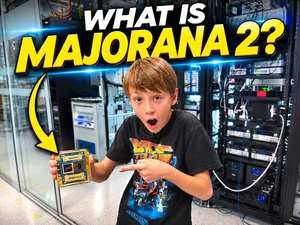
Dr. Anatoly Kulikov from ETH Zurich’s Quantum Device Lab walks through all of this in a 13-minute episode of The Quantum Kid, filmed live at wow² Space at ETH Zurich. It’s worth sending to anyone who has ever asked you what you actually do.
▶️ Can a cat be alive and dead at the same time? Quantum physics finally explained
The Quantum Kid is part of Tesseract Quantum, a Swiss non-profit for quantum education, awareness and workforce development, which partners with The Quantum Insider.

Keep track of everything going on in the Quantum Technology Market. In one place.
Topics
Katia Moskvitch

Stay Ahead of Quantum
Get the latest research, company news, and market intelligence every week.
MENTIONED IN THE ARTICLE