Train the Trainer: Inside MAHE’s Hardware-First Bet on Quantum
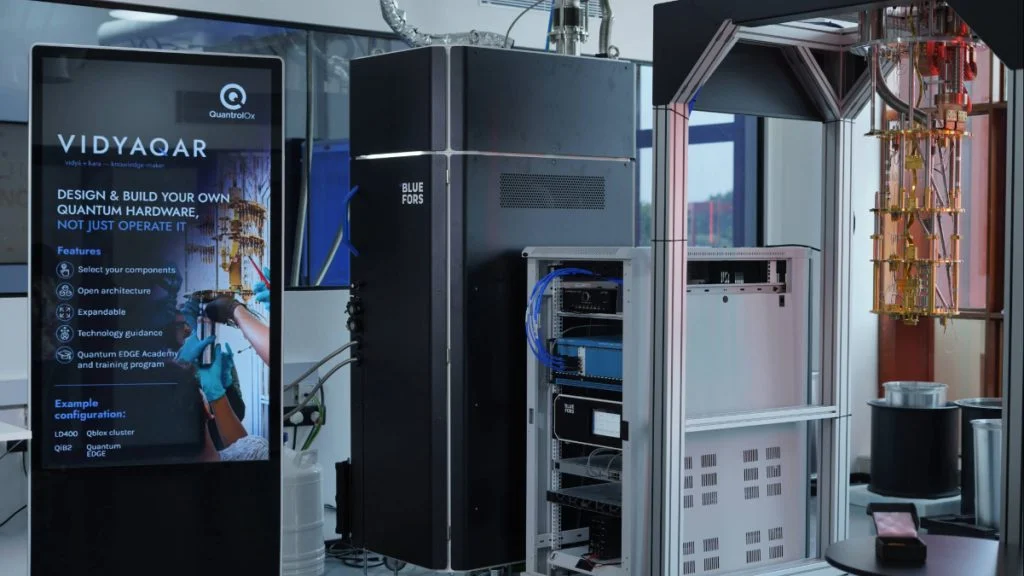


Through its partnership with QuantrolOx, Manipal Academy of Higher Education is preparing educators like Dr. Chandrakantha Bekal to run a live quantum facility.
Insider Brief
- India’s quantum ambitions are moving from theory and software toward physical systems, and the limiting factor is people who can operate the hardware. As domestic startups and projects like the upcoming IBM Quantum System Two in Amaravati bring real machines online, the country needs an on-the-ground workforce that its software-heavy education system hasn’t produced.
- Manipal Academy of Higher Education (MAHE), through an MoA with QuantrolOx, has set up Q-Hub@MAHE on the open-architecture VIDYAQAR platform, which lets the university choose its own QPUs, electronics and dilution refrigerators. It paired the facility with the Quantum EDGE Academy, a simulator-style training environment.
- With its dilution refrigerator installed and the facility ready for live experiments, MAHE is now focused on running the system reliably and building local troubleshooting skills. Over a 3-to-5-year horizon, the university aims to establish a fully operational quantum hub and a home-grown, hardware-literate workforce, starting with first- and second-year undergraduates.
For Chandrakantha Bekal, teaching had never been a lifelong interest. After completing his master’s degree in product design and manufacturing, Bekal stepped into the hustle and bustle of job hunting in India, seeking a position in the engineering industry. But life had a different plan.
After positive client feedback on his teaching skills, Bekal spent a few years in the educational sector, assisting various clientele and students alike. This unexpected spark became a consistent thread of interest. In 2018, Bekal completed his doctoral degree in computational biomechanics at the Manipal Academy of Higher Education (MAHE) and then moved through various teaching roles within the School of Mechanical Engineering, gaining valuable research and teaching experience within the MAHE ecosystem. Yet Bekal couldn’t shake the feeling that something was missing.
As fulfilling as his academic career had been thus far, Bekal’s core research was largely theoretical, spanning computational biomechanics, fluid dynamics, microfluidics, and materials science. The deeper he dove into the microscopic realm, the more he realized there was plenty of room to work in the bottom. The quantum realm was calling, and for a mechanical engineer like Bekal, that meant a persistent itch to get his hands dirty and gain hands-on knowledge. Thankfully, he didn’t have to wait for too long.

In the summer of 2026, Bekal signed in at work and found an open call for MAHE faculty members. The call was part of a “train-the-trainer” strategy to help workforce development in establishing a quantum computing hub at the university. At long last, Bekal’s opportunity had arrived, but the journey to quantum at MAHE had begun much earlier.
Building the Classroom Before the Machine
The history of quantum computing in India remains fresh and ever-evolving. The country’s approach to quantum computing mirrors its historic tech evolution, shifting from absorbing global software paradigms to actively building foundational, deep-tech infrastructure. Nevertheless, software and theory have been India’s biggest players, complete with multiple AI and data centers peppered across the nation. More recently, this status quo has shifted, with growing recognition of the need to build hardware that can further elevate India’s role in the global tech landscape.
In the early stages, the nation’s quantum landscape was primarily academic and theoretical, driven by isolated research labs and foundational physics departments. However, just as India transitioned from a back-office service provider into a global hub for software innovation, its quantum ecosystem has rapidly industrialized over the last few years. Driven by efforts such as the National Quantum Mission (NQM) and fueled by a surge of domestic hardware startups, the country is moving from pure simulation to commissioning its own physical quantum systems, such as the upcoming IBM Quantum System Two in Amaravati.
This shift marks a mature phase in India’s technological trajectory, where it no longer just adopts technologies, but actively co-authors the next computational frontier. In this emerging landscape, MAHE formally signed an MoA with QuantrolOx to establish the Q-Hub@MAHE ecosystem and launch the Quantum EDGE Academy. This collaboration grew out of an ongoing conversation about the university’s growing ambition to expand into algorithmic research, building on its successful legacy in the medical and pharma domains. To that end, the university had a reputation for introducing novel, innovative technologies to the country, and this time, quantum computing was in the crosshairs.
However, recognizing that the quantum hardware sector remains largely in the research phase, MAHE’s leadership pivoted toward a “capability development” and educational approach. The university redirected its focus to building the quantum computing educational frontier before moving on to developing and engineering quantum computing hardware. That’s when QuantrolOx entered the conversation. While many industry players presented rigid “black-box” systems, QuantrolOx made its distinct position clear from the start: they were not a software applications vendor, but an expert in managing quantum computing systems and putting them together.
To gauge the global landscape firsthand, MAHE’s leadership—at the suggestion of QuantrolOx CEO Vishal Chatrath—embarked on a quantum laboratory tour through tech hubs like Zurich, Delft, Gothenburg, and Helsinki to examine existing ecosystems. This exploration ultimately shaped a joint vision for an open-component framework rather than proprietary vendor lock-in. The synergy found its perfect match in QuantrolOx’s newly developed VIDYAQAR platform. This open-architecture hardware ecosystem gave the university the flexibility to select and integrate its own preferred Quantum Processing Units (QPUs), electronics, and dilution refrigerators into a custom, collaboratively designed lab.
Underpinning this physical deployment was the Quantum EDGE Academy, an integrated training platform that functions like a flight simulator for quantum labs. This combined offering allowed students to learn the full operational ladder, mastering the practical physics and measurement of superconducting hardware without requiring immediate, unassisted access to multi-million-dollar machinery. By prioritizing this transparent, open-architecture approach and leveraging QuantrolOx’s network of European hardware partners, the collaboration effectively bridged the gap from classroom education to translational quantum engineering.
The initial launch of this joint program between MAHE and QuantrolOx set the imperative for the development of an “on-the-ground” workforce to operate the quantum facility, the very same call to which Bekal would respond.
Answering the Call
“I had no idea about quantum computing nor that MAHE was setting up a lab, until I received an email from the Director, enlisting candidates for this very purpose,” says Bekal, now a trainer at MAHE’s Q-Hub.
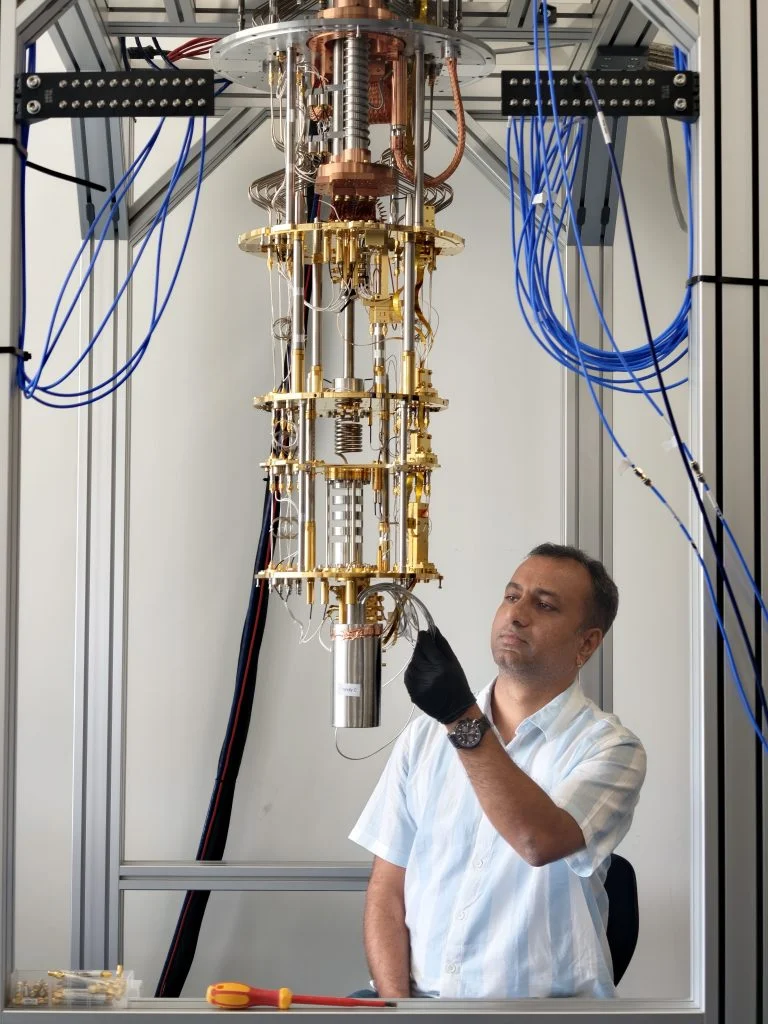
He wasn’t the only one to answer the call that summer. What followed was a rigorous candidacy program that specifically targeted four select faculty members and seven advanced students from both the university’s main campus in Manipal and its off-campus center in Bangalore. “To get selected, we had to go through extensive training, testing, as well as subsequent examinations and interviews,” recalls Bekal. “I count myself happy for being where I am today; I was lucky enough to be selected.”
Passing those initial hurdles was not the end of the story. Bekal and his cohort used the Quantum EDGE Academy platform, capitalizing on its virtual environment, as a foundational stepping stone. “We mastered the core concepts, simulated superconducting hardware, and learned the fundamentals of quantum measurement. The real adventure came after,” teases Bekal.
After building a baseline familiarity with quantum computing with the Academy, Bekal and his cohort moved into a formal, two-phase program (also detailed in QuantrolOx’s recent whitepaper): first handling hardware fundamentals at MAHE’s Bengaluru campus, then traveling to the QuantrolOx laboratory and QuTech at TU Delft in the Netherlands to work directly on the live VIDYAQAR system and dilution refrigerators.
Now, finally back in Bengaluru, Bekal has closed the page on his primary training, and is now actively involved in the lab’s daily proceedings. From teacher to trainer, Bekal finds his new position both familiar and new. Training with the Quantum EDGE Academy helped Bekal overcome his lack of a specialist background in quantum computing while also leveraging his strengths. “The initial basic training with the dilution refrigerator was something I really enjoyed,” comments Bekal. “As everything about the refrigerator involved a working knowledge of thermodynamics, something that I’m very comfortable with, my background perfectly matched up, and I finally got to do something hands-on.”
A Workforce in Waiting
Today, Bekal’s role is to ensure the dilution refrigerator system operates smoothly. Interestingly, Bekal has also found a way to couple his technical responsibilities with his teaching experience. “The Quantum EDGE Academy provides an effective entry point for prospective researchers into the world of quantum computing,” says Bekal. “But there is also the need to maintain and consistently develop a ground-level knowledge base that speaks to students and novice operators.”
On this front, Bekal has leveraged his teaching skills to consolidate the technical details and operational processes relevant to the dilution refrigerator into a comprehensive manual that could serve as a guide for future users. “To develop a strong workforce in the future, it’s important that we, at present, document and build a knowledge base that provides future users with the adequate know-how about every part of the quantum ecosystem being created at MAHE,” says Bekal.
The two institutions at the center of this story, QuantrolOx and MAHE, also share this mindset. This vision reached a major milestone recently with the official installation of their primary infrastructure, clearing the path for live experiments. MAHE currently deploys a dilution refrigerator system as the operational anchor for its Q-Hub@MAHE quantum engineering facility. With the quantum experimentation infrastructure fully ready, the immediate focus now shifts to ensuring the dilution refrigeration system runs smoothly while building robust local troubleshooting capabilities.
For MAHE, this setup is vital to shifting India’s traditional educational landscape. While the country has historically leaned heavily toward a theoretical perspective—with the vast majority of engineering talent funneled into software applications—MAHE is deliberately enforcing a hands-on, hardware-first approach. Working with QuantrolOx, MAHE is now introducing first and second-year undergraduate students to the mechanics of superconducting qubits. In doing so, the university is actively deciphering the “black box” of quantum engineering. While the short-term goal is to train an agile, on-site campus team that can run the lab independently, the long-term vision looks toward a 3-to-5-year horizon where a fully-operation and supported quantum hub is established at MAHE.
By empowering educators like Bekal to anchor the lab on campus today, this approach ensures that when the technology fully matures, a specialized, home-grown workforce is already primed to drive application-based research and innovation across India.
MAHE’s approach is one answer to a wider problem: the industry can only train quantum hardware specialists as fast as its experts and machines allow. To learn more about the hardware skills bottleneck and what funders, educators and employers can do about it, read QuantrolOx’s white paper, Diagnosing the Quantum Workforce.

Keep track of everything going on in the Quantum Technology Market. In one place.
Topics

Resonance
The Quantum Insider is the leading online resource dedicated exclusively to Quantum Computing. You can contact us at [email protected].

Stay Ahead of Quantum
Get the latest research, company news, and market intelligence every week.
MENTIONED IN THE ARTICLE