MTSU Hosts Interstate Hackathon to Expand Quantum Computing Education


Insider Brief
- Middle Tennessee State University (MTSU) led the three-day Interstate Quantum Hackathon, bringing together 250 registrants from 14 U.S. states and 29 countries to explore quantum computing.
- More than 40% of registrants reported no prior quantum computing experience, with participants receiving four weeks of introductory training before tackling challenges in molecular simulation, quantum machine learning and optimization.
- The event brought together universities, industry partners and government representatives, including IBM Quantum and the Tennessee Department of Economic and Community Development, to support quantum education and workforce development.
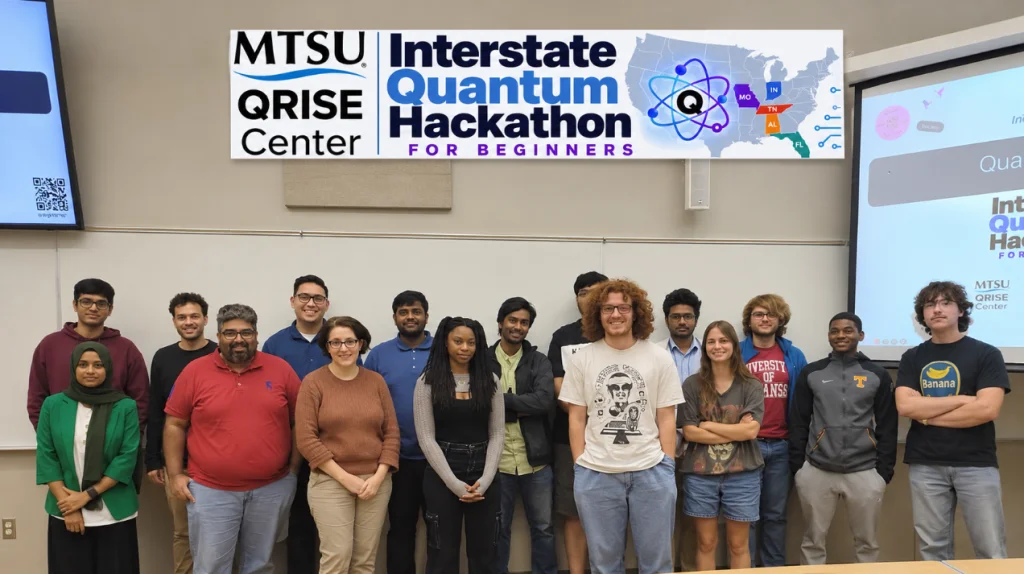
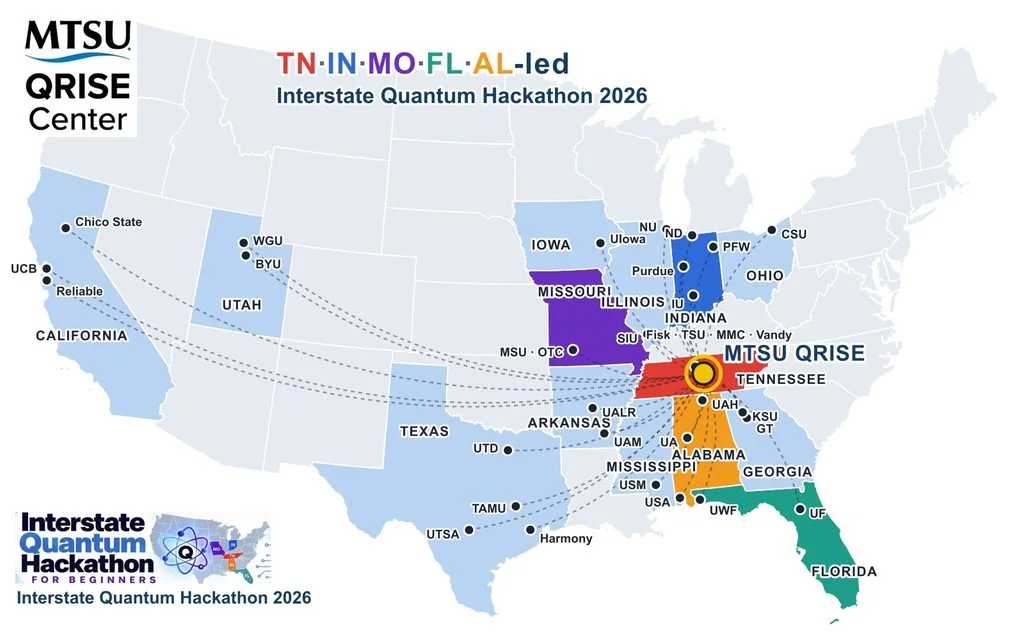
PRESS RELEASE — The Interstate Quantum Hackathon for Beginners was led by MTSU’s Quantum Research, Interdisciplinary Science and Education (QRISE) Center in collaboration with universities across Tennessee, Indiana, Missouri, Florida and Alabama. The three-day event brought together students from different institutions and academic backgrounds to explore quantum computing, develop practical skills and tackle computational challenges inspired by real-world applications.
For MTSU, the hackathon represented more than a competition. It demonstrated how a public research university can bring together academic institutions, industry partners and emerging talent to help prepare the workforce for a rapidly developing field. The hackathon was led by Hanna Terletska and Abhijit Chakraborty of Middle Tennessee State University (MTSU), together with David Liu of Purdue University Fort Wayne.
Organizers at participating institutions included Mohammad Arif Hossain, John Villanova and Varun Puram from MTSU; Ridwan Sakidja from Missouri State University; Aaron Wade from the University of West Florida; Sergei Gleyzer and Konstantin Matchev from the University of Alabama; Dinh Nguyen from the University of Alabama in Huntsville; Ning Zhang from Fisk University; Tyler Sax from Tennessee State University; and Pushpita Chatterjee and Lei Qian from Meharry Medical College.

“What makes this initiative particularly meaningful is that we are not just creating opportunities for students at MTSU; we are bringing together universities, researchers and industry partners across the country to make quantum education more accessible,” said Hanna Terletska, Director of QRISE Center. “Talent exists everywhere, but opportunities do not. As a public research university, we have an important role to play in connecting that talent, building partnerships and preparing the workforce that will help move quantum technologies from research laboratories into real-world applications.”
Making quantum computing accessible and preparing the next generation of problem-solvers
Students participated through a hybrid format, working at local university sites and connecting virtually with other teams, mentors and speakers. The event brought together regional public universities, research institutions and historically Black colleges and universities, creating opportunities for students who might not otherwise have access to specialized quantum programs.
As quantum computing advances from laboratory research toward emerging applications, preparing people to turn this technology into practical solutions is becoming increasingly important. Building more capable quantum computers is only part of the challenge. Scientists, engineers, programmers and industry professionals must also learn to identify useful problems, develop and test algorithms, and understand where quantum approaches might eventually offer an advantage over conventional methods.
Hands-on initiatives such as the Interstate Quantum Hackathon help bridge classroom learning, scientific research and future industry needs. Designed for beginners rather than only experienced programmers, the event welcomed students with little or no previous quantum computing experience. More than 40 percent of registrants reported having no prior experience in the field. The overwhelming response to the hackathon also underscored how much these opportunities are needed. With 250 registrants spanning 29 countries and 14 U.S. states, including many newcomers to quantum computin, the event revealed a strong appetite for accessible, hands-on training.
For MTSU and its partners, that enthusiasm reinforces the importance of expanding pathways that connect students with quantum research, practical problem-solving and future careers in industry.
To prepare participants, organizers provided four weeks of introductory training in quantum computing fundamentals, IBM’s Qiskit programming tools, quantum algorithms and potential scientific and industrial applications. During the three-day competition, students worked in interdisciplinary teams on molecular simulation, quantum machine learning and optimization challenges. Researchers are investigating these approaches for possible future applications in materials and drug discovery, energy systems, manufacturing and logistics. These are promising research directions, not established advantages of today’s quantum computers.
The experience went beyond writing code: students practiced defining problems, choosing computational approaches, testing algorithms, interpreting results and collaborating with peers and mentors across universities. These skills will be important as quantum technology develops and employers seek people who can connect emerging tools with real scientific and industrial needs.
Building a quantum community across the states
“Quantum computing is advancing rapidly, but developing the technology is only part of the equation,” said Hanna Terletska, professor of physics and director of MTSU’s QRISE Center. “We also need people who know how to use it to solve meaningful problems. Through this hackathon, we are giving students the opportunity to move beyond theory, gain hands-on experience and begin thinking about how quantum computing could address real challenges in science and industry.”
“On Thursday, most of these students had never written a line of quantum code. By Saturday they were presenting working solutions to real problems,” said Abhijit Chakraborty. “The interstate format created a shared learning experience across campuses, connecting students and mentors who would not ordinarily work together.”
“By partnering with MTSU’s QRISE Center and expanding Purdue University Fort Wayne’s Qiskit Fall Fest partner site into a multistate and virtual format, the Interstate Quantum Hackathon has created a truly open on-ramp for quantum education,” said David Liu of Purdue University Fort Wayne. “Supported by IBM Quantum and the NSF QC4MC project, we scaled a localized partner site into a massive gateway that connected beginners across state lines and 29 countries to solve real-world problems, proving that regional collaboration is the key to building a diverse, workforce-ready quantum community.”
Connecting academia with industry and government
The hackathon also highlighted the growing relationship between quantum education, industry and Tennessee’s economic development priorities. The second day, Oct. 23, was Quantum Industry Day, which brought students together with leaders in quantum technology from industry and state government. The keynote speaker was Sophy (Soyoung) Shin, a developer advocate with IBM Quantum Content & Education.
Shin builds the hands-on labs behind IBM Quantum Learning, the Qiskit Global Summer School and the IBM Quantum Challenge, the same kinds of learning materials many hackathon participants used, since teams worked in Qiskit, IBM’s open-source software for programming quantum computers. In her talk, “Quantum Computing Today: Where We Are and What Comes Next,” Shin walked students through recent progress in quantum hardware and algorithms, IBM’s roadmap toward large-scale, fault-tolerant quantum computers by the end of the decade, and how students can get involved now through open-source tools, online courses and community events. IBM Quantum’s Qiskit Fall Fest program also provided participation certificates for the event.
A special guest that day was Braden Stover, senior advisor to the commissioner on nuclear and quantum strategy at the Tennessee Department of Economic and Community Development. Stover welcomed participants and introduced the Tennessee Quantum Initiative, Gov. Bill Lee’s statewide effort to grow quantum research, infrastructure and jobs, to which the state has committed $43 million. Home to Oak Ridge National Laboratory and to the nation’s first commercially available quantum network, run by EPB in Chattanooga, Tennessee is positioning itself as a national leader in quantum technology. Stover told students that this growth depends on people trained to use the technology, with expertise in physics, computer science, mathematics, engineering and related fields.
“Building Tennessee’s quantum workforce starts with giving students opportunities to put their knowledge to work. Events like the Interstate Quantum Hackathon help students tackle challenging problems, collaborate across institutions and see a future for themselves in this growing field,” Stover said. “TNECD is proud to see MTSU translating the goals of the Tennessee Quantum Initiative into meaningful opportunities for Tennessee’s next generation of talent.”
Part of a broader quantum education and research strategy at MTSU
“Under Dr. Terletska’s leadership, the QRISE team at MTSU has become a leader in quantum education, bringing students together with researchers and industry professionals to gain hands-on experience with emerging technologies,” said Greg Van Patten, dean of the College of Basic and Applied Sciences. “This is exactly the kind of work we want to see coming out of our college, where strong academic programs, meaningful research and industry partnerships prepare students for careers in the high-tech fields that are shaping the future of our state and country.”
“This hackathon demonstrates how our physics faculty are taking the lead in creating new opportunities for students, both at MTSU and beyond,” said Ron Henderson, chair of MTSU’s Department of Physics and Astronomy. “By bringing together universities, industry partners and students from across the country, we are making emerging quantum technologies more accessible while preparing the next generation of scientists and innovators.”
The hackathon builds on a growing portfolio of quantum research and education at MTSU. The university currently holds eight active quantum awards from the National Science Foundation, the U.S. Department of Energy and the National Institute of Standards and Technology, totaling $13.4 million.
Since 2023, MTSU has developed an undergraduate concentration in quantum information science and engineering, expanded quantum computing courses to students at partner institutions and built pathways that begin well before college. Through the QRISE Center, the university runs K-12 programs, including summer camps for younger students and professional development for teachers, and works with community colleges to open routes into quantum careers for students who might not otherwise find them.
The Department of Energy recently renewed its $2.2 million support for the MTSU-led TN-QuMat consortium, which brings together university partners and Oak Ridge National Laboratory to advance quantum materials research while giving students research and internship opportunities. At the graduate level, MTSU is part of a $2 million National Science Foundation Research Traineeship (NRT) award (Co-PI Terletska) that trains Ph.D. students at the intersection of quantum science and artificial intelligence, preparing the Ph.D. researchers the growing quantum industry will need. These initiatives create multiple entry points into quantum technologies, from high school classrooms and undergraduate courses to advanced research, national laboratories and industry.
Supporting Tennessee’s quantum future
The hackathon was sponsored by Middle Tennessee Electric (MTE), reflecting its growing partnership with MTSU’s QRISE Center to advance quantum innovation and workforce development. As researchers explore potential quantum applications in energy, collaborations between universities and utilities can help connect scientific research with real-world industry needs.
The event also received support from IBM Quantum’s Qiskit Fall Fest and MTSU’s Department of Physics and Astronomy, whose faculty played a leading role in organizing the interstate initiative.
The event also received support from IBM Quantum’s Qiskit Fall Fest and MTSU’s Department of Physics and Astronomy, whose faculty played a leading role in organizing the interstate initiative.
The initiative was also supported by Hanna Terletska’s National Science Foundation ExpandQISE award (No. 2328752). David Liu’s NSF CyberTraining QC4MC project also contributed to the broader collaborative effort in quantum education.
More information about the Interstate Quantum Hackathon: https://iq-hackathon.github.io/hackathon-beginners-26/. Learn more about MTSU’s quantum programs: https://quantum.mtsu.edu/.

Keep track of everything going on in the Quantum Technology Market. In one place.
Topics

Mohib Ur Rehman
Covering quantum and emerging technologies, Mohib explores the intersection of technology, security, and society. His work also frequently examines surveillance infrastructure and the institutions shaping the digital world. In addition to his work at The Quantum Insider, he co-runs SK NEXUS, an independent technology publication that helps readers understand the technologies shaping their lives.

Stay Ahead of Quantum
Get the latest research, company news, and market intelligence every week.
MENTIONED IN THE ARTICLE
MT
Middle Tennessee State University
Middle Tennessee State University’s QRISE is a world-class hub for advancing quantum discovery, innovation, education, workforce, and economic development. QRISE is dedicated to driving breakthroughs that will shape the next generation of technology and transform how we understand and harness the quantum world. Through pioneering research, collaborative partnerships, and hands-on learning, QRISE prepares students to become leaders in the rapidly evolving quantum world and prepares them for the careers of the future. The center serves as a catalyst for innovation by connecting academia, industry, and government to strengthen Tennessee’s role in the national quantum ecosystem, expand economic opportunity positioning MTSU as the driving force of scientific and technological progress.
→

IBM
IBM is an iconic technology pioneer founded in 1911 as the Computing-Tabulating-Recording Company and officially renamed International Business Machines Corporation in 1924. Beyond foundational computing, IBM possesses a deep legacy in aerospace and defense from building the guidance computers and Instrument Unit for NASA's historic Apollo missions to partnering with Airbus on CIMON, the first AI assistant on the ISS.
→