Wolfspeed Introduces Optical-Grade Silicon Carbide for Augmented Reality and Quantum Computing


Insider Brief
- Wolfspeed has commercially introduced its transparent silicon carbide (TSiC) technology, targeting applications in augmented reality, quantum computing and advanced optics.
- The optical-grade substrates are designed for low optical absorption and wafer flatness, with silicon carbide’s optical and thermal properties making it a candidate material for AR waveguides and quantum devices.
- Wolfspeed is advancing 200 mm optical-grade substrates while developing 300 mm TSiC technology for future applications, including systems that use silicon carbide to host qubits and transmit quantum information through light.
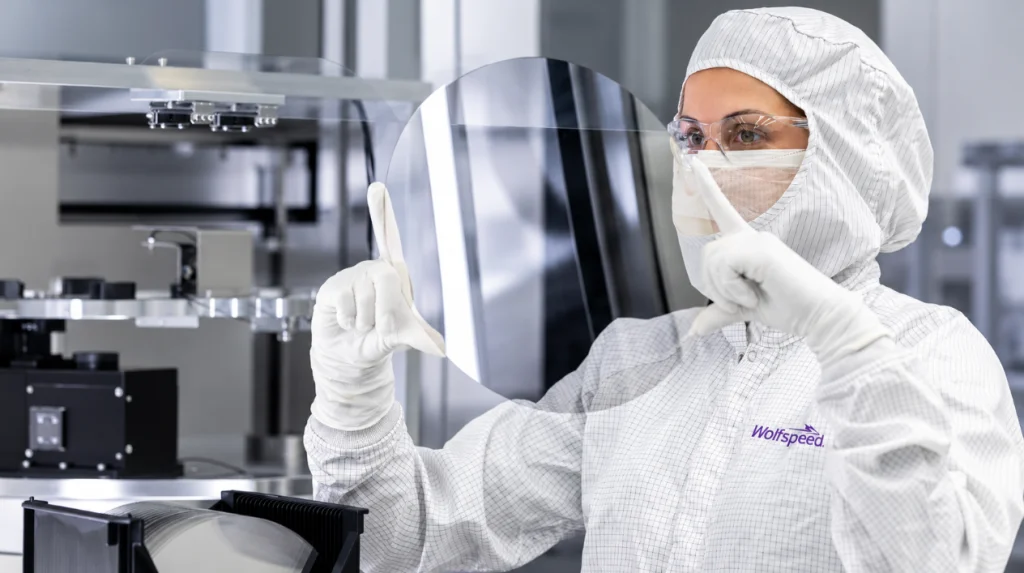
PRESS RELEASE — Wolfspeed, Inc. (NYSE: WOLF), a global leader in silicon carbide (SiC) technology, today announced the commercial introduction of its proprietary transparent silicon carbide (TSiC™) technology expanding the potential of silicon carbide to enable next-generation augmented reality (AR), quantum computing and advanced optical applications.
Wolfspeed builds on more than 35 years of silicon carbide innovation, including its pioneering work in LED technology and extensive experience manufacturing high-purity semi-insulating (HPSI) wafers. Wolfspeed’s optical-grade TSiC™ substrates are engineered for exceptionally low optical absorption and superior wafer flatness. Silicon carbide’s high refractive index, low birefringence, hardness and thermal conductivity make it a promising material for next-generation AR waveguides, supporting wider fields of view, improved image quality and more compact wearable devices.
Beyond AR, TSiC™ technology offers significant potential in quantum computing, with the ability to host quantum bits (qubits), preserve their quantum states and transmit quantum information through light—all within a single silicon carbide crystal. Unlike many alternative materials, silicon carbide can support all these functions.

“Wolfspeed’s leadership in silicon carbide innovation extends well beyond traditional semiconductor applications,” said Katrin Feurle, Vice President, Beyond Power at Wolfspeed. “Our proprietary TSiC™ technology and extensive intellectual property portfolio position us to help enable breakthroughs in augmented reality, quantum computing and other emerging markets, reinforcing the versatility and transformative potential of silicon carbide.”
“For years, the dream of truly immersive, all-day augmented reality glasses has run up against the hard limits of optical materials — you simply couldn’t get a wide field of view, high image quality, and a lightweight, wearable form factor all at once,” said Barry Silverstein, a display systems and optics industry expert at the University of Rochester and former Chief Technology Officer and Senior Director of Optics and Display Products at Meta Reality Labs. “Silicon carbide changes that equation. Its exceptionally high refractive index lets a single-layer waveguide do the work that previously took stacked optics, which is the kind of step-change the industry needs to move AR from a novelty into everyday eyewear. Wolfspeed’s work on optical-grade TSiC™ technology is exactly the type of materials innovation that can finally unlock that potential.”
Wolfspeed’s technology is supported by a robust intellectual property portfolio, securing our technology advances with a strong intellectual property position. The company continues advancing its 200 mm optical-grade substrates while developing 300 mm TSiC™ technology to support future market requirements.
More information on TSiC™ technology, including requests for samples, is available here.

Keep track of everything going on in the Quantum Technology Market. In one place.

Mohib Ur Rehman
Covering quantum and emerging technologies, Mohib explores the intersection of technology, security, and society. His work also frequently examines surveillance infrastructure and the institutions shaping the digital world. In addition to his work at The Quantum Insider, he co-runs SK NEXUS, an independent technology publication that helps readers understand the technologies shaping their lives.

Stay Ahead of Quantum
Get the latest research, company news, and market intelligence every week.
MENTIONED IN THE ARTICLE