IQM Demonstrates Entanglement Across a Complete 54-Qubit Processor


Insider Brief
- IQM Quantum Computers reports that its cloud-accessible Emerald system has achieved a Greenberger–Horne–Zeilinger (GHZ) entangled state across all 54 qubits simultaneously.
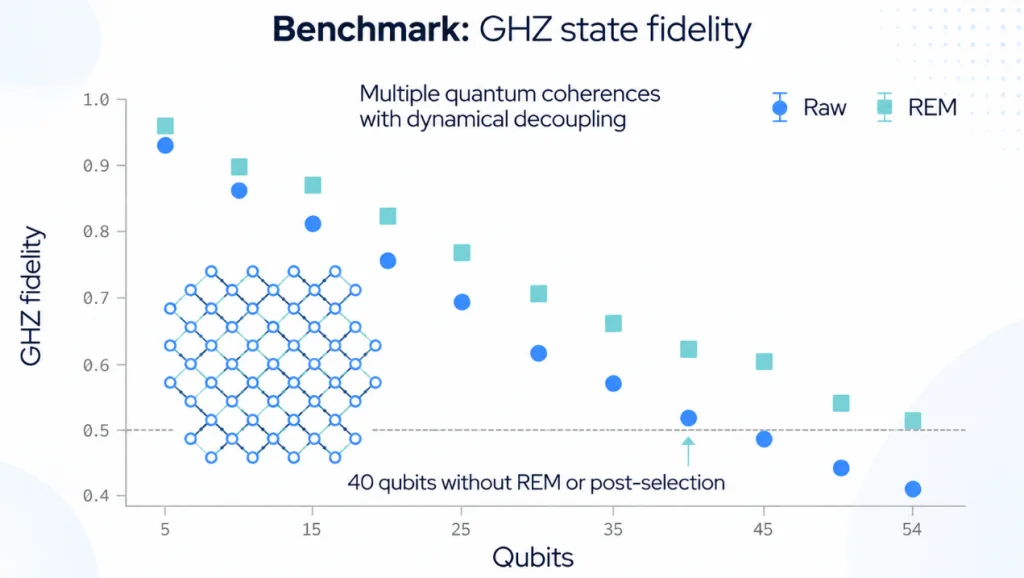
- The company measured a fidelity of 0.516 across the full processor with readout error mitigation applied, exceeding the 0.500 threshold cited for distinguishing genuine entanglement from noise.
- IQM attributes the result to improvements in calibration, gate selection and automated state preparation, and says cloud customers can access the system’s full-chip performance.
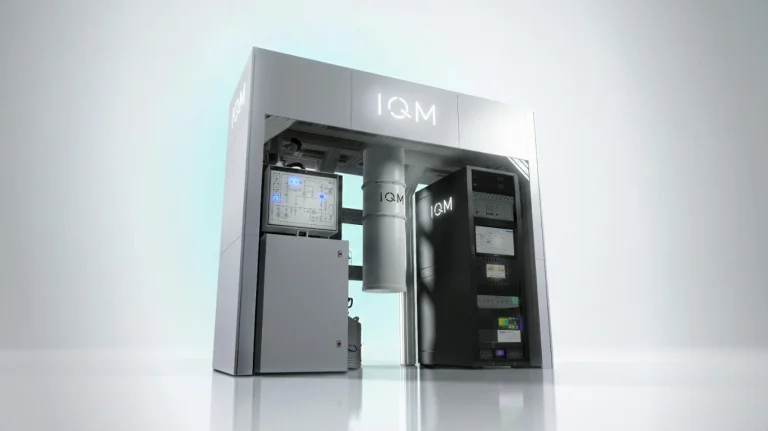
PRESS RELEASE — IQM Quantum Computers (Nasdaq: IQMX), a global leader in superconducting quantum computers, today announced that its cloud-accessible IQM Emerald system has fully entangled all 54 qubits on the chip simultaneously, a result that shows the system’s computational quality holds up when every qubit is put to work at once. IQM’s cloud customers now have access to that same full-chip performance, so their computations can draw on the entire processor rather than a fraction of it.
These results rank among the strongest reported for any commercially available quantum computer, giving customers access to state-of-the-art, high-quality processors. Until now, a user running a comparable demonstration on IQM Emerald could reliably use on the order of 30 qubits within a single algorithm. Studies on large quantum chips often use only a fraction of the available qubits, commonly 10 to 20, even when the hardware has many more. Emerald’s result shows the alternative: an entire processor working together on one computation.
“Entangling the entire chip means every qubit and every connection between them has to work correctly in the same circuit. Getting there came down to being smarter about how we prepare the state itself, choosing the gate order to keep idle time to a minimum,” said Craig Ciesla, CTO, IQM Quantum Computers. “Our current and prospective cloud customers now have the chance to benefit from the same tools and system performance that made this achievement possible.”

The demonstration used a Greenberger–Horne–Zeilinger (GHZ) state, a standard benchmark for large-scale entanglement, prepared across the entire IQM Emerald processor. The result was enabled by a smarter, automated routine for state preparation that selects the best two-qubit gates while weighing gate fidelity against qubit idle time, choosing both the qubits and the gate order to minimize idle time as the state is built. IQM measured a fidelity of 0.515 at 40 qubits without readout error mitigation (REM) and 0.516 at the full 54 qubits with REM applied, both above the classical threshold of 0.500 that separates genuine entanglement from noise.
The result builds on roughly a year of hardware and calibration work across IQM’s technical teams, including an updated calibration methodology, an improved gate set and continued deployment of error-reduction tools such as dynamical decoupling and qubit selection. These improvements led to an error rate reduction of up to 50% for quantum operations in the processor.
The automated state-preparation routine is part of IQM’s broader effort to automate the operation of quantum computers. This development, along with IQM’s AI-driven agentic calibration work, is part of a broader effort to automate the tuning of quantum systems.

Keep track of everything going on in the Quantum Technology Market. In one place.

Mohib Ur Rehman
Covering quantum and emerging technologies, Mohib explores the intersection of technology, security, and society. His work also frequently examines surveillance infrastructure and the institutions shaping the digital world. In addition to his work at The Quantum Insider, he co-runs SK NEXUS, an independent technology publication that helps readers understand the technologies shaping their lives.

Stay Ahead of Quantum
Get the latest research, company news, and market intelligence every week.
MENTIONED IN THE ARTICLE