UbiQD Wins New Mexico Grant for Quantum Light Source Development


Insider Brief
- UbiQD has secured a New Mexico Technology & Innovation Office grant to develop a quantum dot-based light source designed to produce individual photons reliably at room temperature for quantum computing applications.
- The project will fund optical equipment and device prototyping at UbiQD’s Los Alamos headquarters, building on earlier research with Los Alamos National Laboratory into single-photon emission from cadmium-, lead- and mercury-free quantum dots.
- UbiQD is also developing its intellectual property portfolio, which the company says includes 17 granted U.S. patents, 23 granted international patents and 27 pending applications, including a patent for a fiber-coupled broadband light source
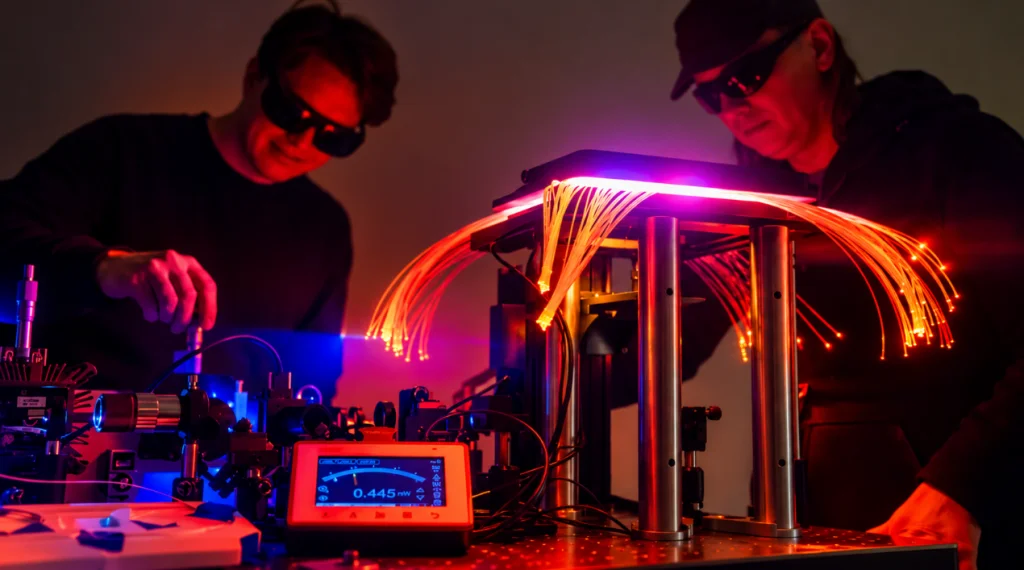
PRESS RELEASE — UbiQD, Inc., a global leader in quantum dot technology and manufacturing, has received a $200,000 grant through New Mexico’s Quantum Technologies Award from the Economic Development New Mexico (EDNM) Department through its Technology and Innovation Office (TIO). The grant funds development of a key component for quantum computers and ultra-secure quantum communication networks: a specialized light source, connected directly to a fiber optic cable, that emits single particles of light, one at a time, on demand.
Most of today’s quantum computers store information in superconducting circuits that must be chilled to a fraction of a degree above absolute zero inside large, expensive refrigerators. Another approach uses individual particles of light, called photons, to carry information. Photons can travel efficiently over long distances, which also makes them the natural choice for secure quantum communication networks, and light-based systems need far less extreme cooling. However, they do depend on a special light source that produces exactly one photon at a time, on demand. Typical light sources either emit a plurality photons at random, wasting most of their output, or must themselves be cooled to near absolute zero.
Nothing available today addresses all the needs: safe materials, room temperature operation (not inside expensive refrigeration systems), tunable emission, fiber optic cable-coupled, and reliability at scale. UbiQD has spent a decade developing quantum dot technology, and researchers have shown in published studies that this class of materials can do exactly what quantum hardware companies need.

“Quantum computing is what originally drew me into this field, and this project is an exciting opportunity to bring our technology full circle,” said Hunter McDaniel, PhD, Founder and CEO of UbiQD. “New Mexico has the foundational science, and we have the infrastructure and team to turn decades of quantum dot materials development into products that accelerate the quantum computing industry. We’re grateful to the state’s Technology & Innovation Office for their support.”
McDaniel first worked in quantum computing as an undergraduate researcher in Nobel laureate John Martinis’ research group at UC Santa Barbara. His TEDx talk on quantum technology is available here.
The grant will fund optical equipment and device prototyping at UbiQD’s Los Alamos headquarters. The team will first measure how reliably its quantum dots are at producing single photons, then refine the materials until they meet industry performance targets. The work builds on a 2024-2025 partnership with Los Alamos National Laboratory under the Technology Readiness Gross Receipts (TRGR) Initiative, which produced some of the first detailed measurements of this kind for UbiQD’s safer proprietary I-III-VI semiconductor quantum dots (free of cadmium, lead, and mercury).
“We’re not just manufacturing materials, we’re building an optical product and an IP position in the quantum industry,” added Nikolay Makarov, Senior VP of R&D at UbiQD and principal investigator on the grant. “Now we’re using what we learned to build a light source that delivers one photon at a time, reliably, at room temperature.”
Before joining UbiQD, Makarov co-authored a Los Alamos study published in 2017 showing that copper indium disulfide quantum dots can emit single photons at room temperature.
That journey from lab research to a patentable product is also why UbiQD has spent several years building its patent portfolio. UbiQD owns or exclusively licenses 17 granted U.S. patents and 23 granted international patents, plus 27 applications pending. The portfolio is built in three layers: foundational patents on the quantum dot material itself, turning that material into usable forms such as films and concentrates, to specific end uses, including security inks, agriculture, and solar. Some of the foundational patents trace back to Dr. McDaniel’s original research at Los Alamos National Laboratory and licensed technology from M.I.T. and the University of Washington.
This includes US patent #12,085,443, “Fiber-coupled Broadband Light Source,” also granted in Korea, Canada, Netherlands, Germany and France. It applies to two fast-growing areas: faster connections between computer servers inside AI data centers, where conventional electrical wiring is becoming a bottleneck, and quantum hardware.
The project expands UbiQD’s efforts to commercialize quantum dot technology across a range of emerging industrial markets. In addition to developing applications and manufacturing quantum dot materials, the company is pursuing strategic partnerships, product integration, and technology licensing across agriculture, energy, security, photonics, and other sectors. UbiQD’s expanding intellectual property portfolio provides a foundation for these activities and enables new business models.

Keep track of everything going on in the Quantum Technology Market. In one place.

Mohib Ur Rehman
Covering quantum and emerging technologies, Mohib explores the intersection of technology, security, and society. His work also frequently examines surveillance infrastructure and the institutions shaping the digital world. In addition to his work at The Quantum Insider, he co-runs SK NEXUS, an independent technology publication that helps readers understand the technologies shaping their lives.

Stay Ahead of Quantum
Get the latest research, company news, and market intelligence every week.
MENTIONED IN THE ARTICLE