Quantum Art Research Outlines More Efficient Quantum Approach to Wave Modeling


Insider Brief
- Quantum Art presented research on a quantum algorithm that uses known wave physics to simplify large-scale wave simulations, with potential applications in telecommunications, seismic modeling and engineering.
- The method constructs physically allowed wave states directly, aiming to avoid computational overhead that limits existing quantum approaches as the modeled region grows.
- The company estimates that some simulations requiring 10¹⁸–10²¹ classical grid points could potentially use roughly 100 qubits, although practical implementation depends on further hardware advances.
PRESS RELEASE — – Quantum Art, a developer of full-stack, fault tolerant quantum computers based on trapped-ion qubits and a proprietary, dynamically reconfigurable multi-core architecture, recently presented new research, detailed in this paper, that solves wave-propagation problems long thought intractable for classical supercomputers – unlocking new simulation capabilities for seismic modeling, structural engineering, and materials science.
Simulating how waves, from radio signals to sound, travel through space demands enormous computing power, and that demand grows sharply when the area being modeled gets larger but the level of detail cannot be reduced. The stakes are real for industries that depend on precision: telecom carriers predict network coverage, engineers model how buildings and materials hold up under stress, and geophysicists track how seismic waves move through the earth. The research explains the science behind the large-scale wave-simulation results the company previously demonstrated in May through a joint project with a leading Israeli governmental research and development agency.
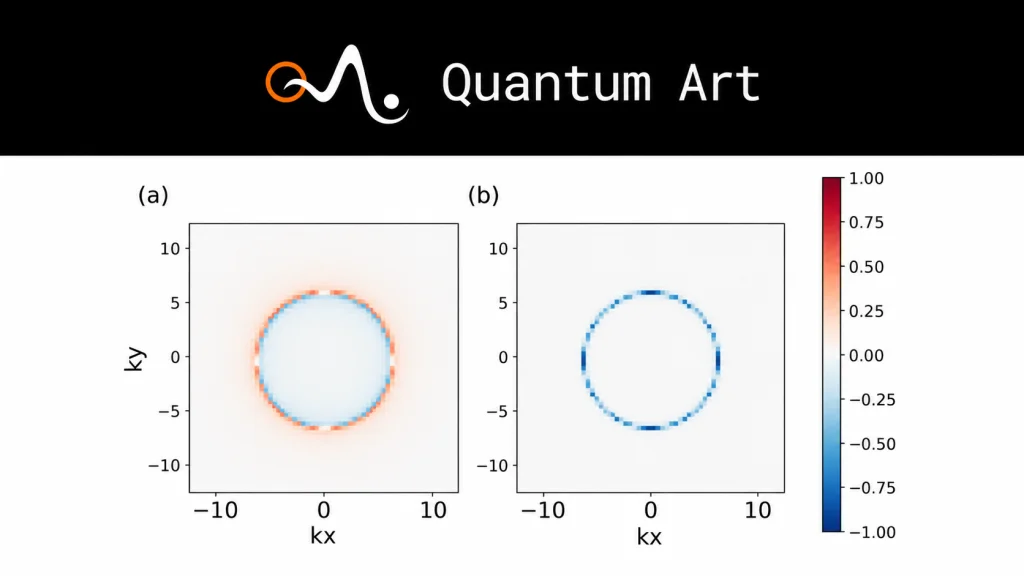
Quantum computers hold a key advantage here: they can represent extremely large problems using relatively few qubits. Most existing quantum methods, however, treat a wave problem as a vast, generic mathematical puzzle. They solve a huge system of equations by brute force, with little regard for what the equations describe. Waves follow strict physical rules: a wave of a given frequency travels at a fixed speed in a given medium, so every direction it could possibly travel in can be pictured as the hand of a clock. Because the speed is fixed, every hand is the same length, so their tips can only trace out one perfect circle. Anything off that circle is physically impossible. Prior methods still expend effort searching far outside that circle, checking possibilities that the physics has already ruled out. As a result, they tend to slow dramatically or lose their quantum advantage, especially on a large-scale problem.

Quantum Art’s new approach turns known wave physics into a shortcut. Rather than asking the quantum computer to solve the full mathematical puzzle, it directly builds that circle of physically allowed wave directions and marks the location of each wave source on it. The answer is constructed from the known shape of wave physics instead of being calculated from scratch. It is the difference between searching an entire library page by page and walking straight to the one shelf where the book is known to be.
The approach reflects a pattern that runs through Quantum Art’s work more broadly: the company again uses physics itself to shorten the path toward practical quantum computing. The same philosophy shapes its hardware, where trapped-ion qubits, multi-qubit gates, and a dynamically reconfigurable multi-core architecture are built around the physical behavior of the system rather than engineered around it.
Amit Ben Kish, Chief Technology Officer at Quantum Art, said, “This paper explains the underlying science behind our approach and shows it is not limited to radio and electromagnetic signals. The same principle applies to any wave governed by a fixed relationship between frequency and speed, which opens the door to simulating problems in sound, radar, and seismic wave propagation.”
Until now, quantum approaches to these problems have run into a wall. Some require running the quantum computer for longer and longer stretches as the simulated area grows. Others, which search the full mathematical space and keep only the useful part, succeed so rarely on large problems that they would need to be repeated an extraordinary number of times. Either way, the quantum advantage erodes as the modeled regions get larger.
Quantum Art’s new method removes that wall. Because it builds only the part of the answer that matters, the number of attempts required stays roughly the same whether the simulated area is the size of a room or a mountain range, and computational effort grows only slowly as the simulation becomes more detailed. Its chances of success even improve as more wave sources are involved. A detailed, three-dimensional simulation of radio waves spanning tens of kilometers, accurate to the centimeter, can require 10¹⁸-10²¹ classical grid points – a scale that is far beyond what even today’s largest supercomputers can practically handle, yet potentially within reach of a quantum computer with on the order of 100 qubits. Reaching that scale in practice will also build on continued hardware progress, including Quantum Art’s multi-qubit gates, which compress circuit depth and reduce the error introduced as systems scale up.
For the first time, this makes it plausible for a quantum computer to efficiently model steady wave patterns (i.e., sound, radar, or seismic waves at a fixed frequency) across regions far larger than any classical computer could handle.

Keep track of everything going on in the Quantum Technology Market. In one place.
Topics

Matt Swayne
With a several-decades long background in journalism and communications, Matt Swayne has worked as a science communicator for an R1 university for more than 12 years, specializing in translating high tech and deep tech for the general audience. He has served as a writer, editor and analyst at The Quantum Insider since its inception. In addition to his service as a science communicator, Matt also develops courses to improve the media and communications skills of scientists and has taught courses.
[email protected]

Stay Ahead of Quantum
Get the latest research, company news, and market intelligence every week.
MENTIONED IN THE ARTICLE