

Insider Brief
- UMass Amherst hosted NeSQom 2026, a workshop that brought together researchers in quantum networking, quantum information science, quantum security and classical networking.
- About 50 researchers from across the U.S. discussed open problems and systems architecture for hybrid classical-quantum networks to inform the National Science Foundation’s research agenda.
- The workshop produced open-problem statements focused on areas including quantum networking, distributed quantum computing, quantum sensing and quantum key establishment.
PRESS RELEASE — Quantum computing, an emerging subfield of engineering and computer science that relies on quantum mechanics to tackle problems that are out of reach for today’s most powerful classical computers – could change computing forever.
But first, researchers need to overcome some challenges.
“Quantum computing uses quantum mechanics to process information in fundamentally different ways from today’s computers,” said Taqi Raza, assistant professor of electrical and computer engineering in UMass’s Riccio College of Engineering.

Classical computers use binary bits to process complex information; quantum computers use qubits, harnessing the laws of quantum mechanics. Regular bits can exist as either 1 or 0; qubits can be 1, 0 or a combination of the two. These properties could make quantum computers more efficient than classical computers, which in turn could lead to large-scale system advances for medical, environmental, cybersecurity and other applications.
But quantum information is fragile, which poses problems for storage, transmission and reliable operation, Raza said.
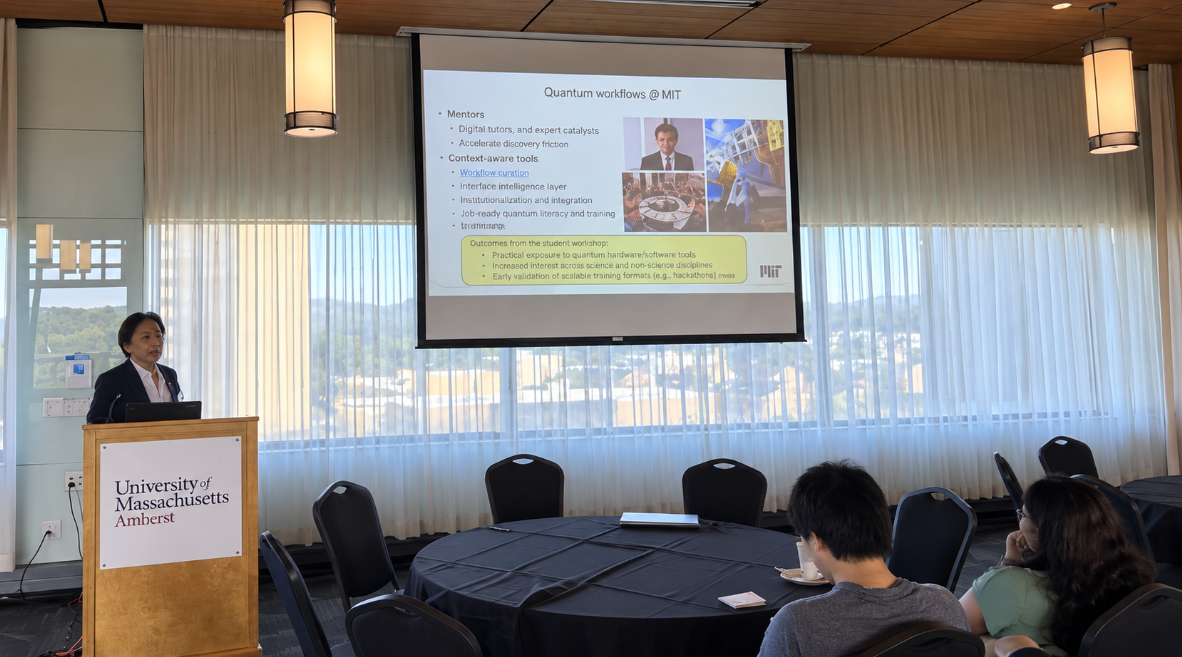
Researchers around the world are working on this and other challenges of quantum computing, and approximately 50 from across the U.S. gathered recently at UMass Amherst to discuss quantum networking, quantum information science, quantum security and classical networking. Their goal was to help guide the National Science Foundation’s quantum computing research agenda.
The event, called NeSQom 2026 (NSF Workshop on Quantum Communication and Networked Systems), was held in the Campus Center Sept. 10-11. It was organized by Raza and Don Towsley, director of the Quantum Information Systems Institute and distinguished professor in the Manning College of Information and Computer Sciences at UMass Amherst.
“The workshop’s central theme was how to build the systems architecture for future quantum networks: what ideas can be borrowed from classical networking, what must change because of the unique properties of quantum systems, and what new abstractions and research directions are needed,” Raza said.
The workshop comprised selected research talks, panels, breakout sessions and open discussions. Researchers from a variety of fields – classical networking, quantum communications, computing and sensing – collaborated on identifying “problems that cannot be solved within one community alone,” Raza said.
That cross-disciplinary collaboration was intentional. “One of the main goals of the workshop was to bring the classical and quantum networking communities together and identify open problems and research directions that can help shape a future NSF research agenda,” Raza said.
Each field has its strengths to contribute. “Building a quantum internet is not only a quantum-physics problem,” Raza said. “It also requires new ideas in networking, computer systems, security and engineering fields, which is why bringing these communities together is so important.”
At present, NSF funding for research in quantum networking comes from two separate programs, one for physics and one for classical networking. “We believe that this workshop has taken a large step towards removal of barriers between these communities and fostered a consensus for the need of an NSF research program focused on hybrid classical-quantum networks,” Towsley said.
The ideas presented at this event “can help enable larger and more reliable hybrid classical-quantum networks that connect quantum computers, sensors and communication systems,” Raza noted. “This workshop will pave the way towards the quantum internet.”
Entanglement, a special quantum relationship between qubits that can persist across a distance, “is the critical resource required by most networked quantum applications including quantum key establishment, distributed quantum computing and distributed quantum sensing,” Towsley said. “Development and deployment of a quantum internet is the critical element needed to generate and distribute entanglement to these applications.”
Ultimately, the workshop produced open-problem statements to contribute to the development of a quantum computing research agenda for the National Science Foundation.
The quantum internet is still a long way off, but events like this workshop will help to bring it closer – after all, asking and investigating important questions is what research is all about.
“Quantum networking is still at an early stage, which makes this an important time for different research communities to jointly define the architecture and research questions rather than developing individual components in isolation,” Raza said. “These discussions can help NSF to understand where new research is needed.”