

Insider Brief
- Chinese researchers developed a compact quantum magnetometer that detected underground train activity, located a buried magnet and monitored a geomagnetic storm in field tests.
- The instrument uses a 7-cubic-centimeter sensing probe and automatically restores measurements within a second after strong magnetic interference is removed.
- The findings suggest the system could support mineral exploration, environmental monitoring and searches for unexploded ordnance.
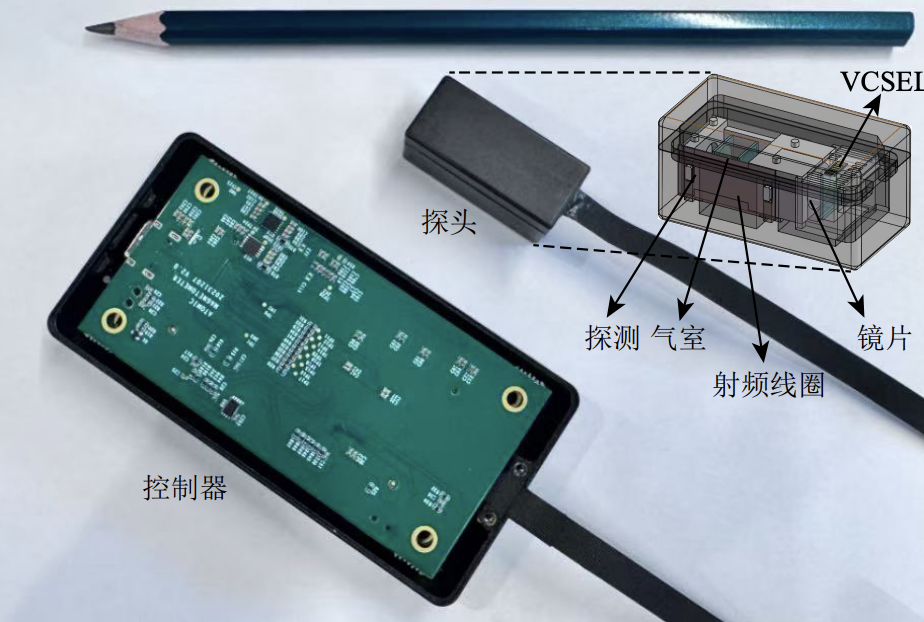
- Image: Schematic diagram and photograph of the miniaturized magnetometer system from the study.
Chinese researchers developed a compact quantum magnetometer that detected underground train activity, located a buried magnet and monitored a geomagnetic storm in field tests.
The instrument uses a small sensing probe — about the the size of two dice placed side by side — and automatically restores measurements within a second after strong magnetic interference is removed.
In the study, the researchers’ compact quantum magnetometer — with separate electronics controls — detected underground train activity and located a buried magnet, demonstrating capabilities that could support geological surveys and searches for concealed objects with potential defense applications.

According to the South China Morning Post, the researchers said the system was meant to be used for anti-submarine warfare (ASW), however, the study itself did not test submarine detection and doesn’t seem to establish military detection ranges.
The device combines a sensing probe measuring about 7 cubic centimeters with the ability to track rapidly changing magnetic fields and automatically recover after strong interference interrupts measurements, according to a study in Acta Physica Sinica that was computer translated into English.
Researchers Xin Wang, Min Jiang and Xinhua Peng report that the instrument addresses a practical obstacle for quantum sensing. Instruments sensitive enough to measure tiny magnetic changes must also withstand movement, changes in orientation and environmental interference to become useful outside controlled laboratories.
The team includes researchers affiliated with the University of Science and Technology of China, Hefei National Laboratory and a marine navigation and control laboratory at China State Shipbuilding Corp.
In controlled laboratory tests, the instrument could detect tiny magnetic variations while also keeping pace with rapid changes in field strength. Its measured noise level was about five million times smaller than the background magnetic field used in the tests, and it could track changes equivalent to half that field’s strength in a single second.
This advance centers on combining sensitivity, small size and recovery from interference in a device tested under outdoor conditions.
Using Atoms to Measure Magnetic Fields
The system works by using a magnetometer to measure magnetic fields through their effect on rubidium atoms. Laser light prepares the atoms inside a small vapor cell so their collective magnetic response can be measured. A radio-frequency magnetic field then drives the atoms into resonance — which means matching the signal’s frequency to the atoms’ natural magnetic rhythm –changing how much light they absorb.
The frequency at which this resonance occurs depends on the surrounding magnetic field. By continuously adjusting the radio frequency to follow that resonance, the instrument calculates the field’s strength.
Simply put, the atoms provide a magnetic reference, while the laser and electronics read how that reference responds to its surroundings.
The researchers packed the optical components, heating elements, radio-frequency coils and light detector into a probe measuring 3 centimeters by 1.5 centimeters by 1.5 centimeters. The rubidium vapor cell inside measures just 4 millimeters on each side.
It’s important to note that references to the 7-cubic-centimeter figure just describes the sensing probe, rather than the entire instrument. Separate control electronics operate the laser, maintain temperatures and keep the measurement system tracking the atomic response. The study reports steady operating power consumption of about 5 watts for the complete system.
As the saying goes, there are no solutions, only trade-offs and, in this case, shrinking an atomic sensor creates trade-offs. A smaller vapor cell contains fewer atoms contributing to the measurement, while collisions with its walls can disrupt their magnetic behavior, according to the researchers.
The team adjusted the radio-frequency field strength and electronic feedback to improve sensitivity while preserving the ability to follow changing conditions. Too little feedback leaves the instrument unable to keep pace. Too much introduces extra noise as the electronics repeatedly overshoot the correct frequency.
Recovering After Interference
A central feature of the design is its ability to recognize when it has lost the atomic resonance needed for a valid measurement.
This failure, known as losing lock, can happen when a magnetic field changes faster than the electronics can follow. Rotating the probe or moving it through a region where the field varies sharply across space can also weaken the signal.
The researchers added a monitoring method that examines a component of the light signal at twice the modulation frequency. This component reveals whether the expected resonance remains present.
When that signal falls below a specified threshold, the system stops ordinary tracking and scans its frequency range to find the resonance again.
The team tested the recovery process by moving a permanent magnet near the probe, deliberately creating interference strong enough to disrupt its operation. After the magnet was withdrawn, the instrument regained the resonance and resumed measurements in less than a second.
The test included a brief period when the readings were invalid. The recovery system therefore reduces the duration of a measurement failure but doesn’t necessarily ensure uninterrupted valid data under every disturbance.
Laboratory calibration also established the instrument’s limits. The reported sensitivity was measured inside magnetic shielding with a carefully controlled background field, rather than inferred from the outdoor experiments.
Its effective measurement bandwidth was 41.4 hertz, indicating how quickly a repeating magnetic signal can vary before the instrument’s response becomes substantially weaker. The researchers acknowledge that some comparable devices reach bandwidths around 100 hertz by sacrificing sensitivity.
Storms, Trains and a Buried Magnet
Three field experiments examined whether the laboratory performance translated into useful measurements.
During extended geomagnetic monitoring, the instrument recorded the June 1, 2025, storm that the study identifies as a severe, G4-class event. The researchers compared its readings with data from the Cheongyang observatory in South Korea, part of the INTERMAGNET international magnetic observatory network.
Although the locations had different background field strengths, the storm-related patterns and timing closely matched, according to the study. The instrument recorded the event without losing lock or interrupting its data.
A second experiment placed the sensor at the surface above a subway station to measure magnetic changes associated with underground trains.
Records from two train movements showed similar patterns during braking, station stops and departure. The researchers linked these changes to the large electrical currents involved in braking and propulsion. At times, the magnetic field changed by more than 2,000 nanoteslas per second.
The experiment demonstrated detection of activity from concealed moving targets in an urban environment. It did not establish how far away a train could be detected or whether the instrument could distinguish different types of hidden vehicles.
The third experiment tested handheld detection of a buried object.
Researchers concealed a cylindrical permanent magnet about half a meter underground within a 40-meter-by-25-meter field, which, for comparison, is about the size of of four tennis courts. Its position was withheld from the people conducting the search.
The probe was mounted on a nonmagnetic carbon rod and carried along a back-and-forth survey route, remaining about 5 to 10 centimeters above the ground. Magnetic readings were recorded alongside position data and used to construct a two-dimensional map.
The map revealed paired high and low magnetic-field regions characteristic of a magnet. The researchers report that the inferred location agreed well with the actual burial position, although they did not provide a numerical positioning error.
The test supports further work on portable magnetic surveys. It used a deliberately magnetic target in farmland selected for low interference, however, rather than mixed buried debris or unexploded ordnance.
Future Applications and Research Directions
The findings have defense relevance because the study addresses problems that can hinder magnetic searches for concealed objects, particularly interference and movement during measurement.
But detecting a train’s electrical activity or a shallow permanent magnet does not establish submarine-detection capability. The paper reports no underwater trials, operational detection distances or false-alarm rates for military targets.
Future research will likely address the sensor’s ability to measure total magnetic-field strength rather than all three directional components. Its signal can weaken substantially at unfavorable orientations, and sufficiently rapid disturbances can exceed both its tracking capability and the assumptions behind its recovery method.
The researchers plan to investigate a pulsed measurement approach known as free induction decay, which observes the atoms’ response after excitation. They expect that approach could expand the bandwidth into the hundreds of hertz.
They also propose applying known magnetic fields along three perpendicular directions to develop measurements of both field strength and direction.
If it scales, the device could find home commercially with potential deployments including distributed geomagnetic monitoring networks, contactless traffic sensing, surveys of underground metal infrastructure, mineral exploration and searches for unexploded ordnance.