Novo Holdings Report: Quantum Investment Must Move Beyond Hardware to Build Applications


Insider Brief
- Analysts argue that quantum investment must expand beyond hardware to applications that turn computing advances into valuable business decisions.
- The report identifies domain-specific algorithms and vertical platforms as potentially defensible positions that remain comparatively underfunded.
- Life sciences stand out because companies already pay to improve high-value molecular decisions, although early quantum applications will likely address narrow problems within larger classical workflows.
Quantum investors must begin backing applications that turn emerging machines into useful business tools, according to a new report from Novo Holdings. The report identifies life sciences as one of the clearest opportunities for building commercially defensible quantum applications.
The report points to the industry’s next stage that will require investment in domain-specific algorithms, customer workflows and application platforms alongside continued spending on quantum hardware — such as processors and components. Companies that can establish these positions before fault-tolerant quantum computers become widely available could capture a large share of the technology’s lasting economic value.
Novo Holdings’ Seed Investments Quantum Team said roughly 70% of the approximately $13.9 billion invested in private quantum-computing companies between 2014 and 2025 went to hardware and components. This estimate, however, doesn’t include public-market transactions and government programs, which would make that total much higher.

That concentration was necessary to advance quantum computers, but it has left the application layer underfunded relative to its potential value, according to the report, which draws on semiconductor industry history, published quantum hardware roadmaps, peer-reviewed research and market data. Hardware supplies computing capacity, while applications connect that capacity to decisions customers will pay to improve.
Novo Holdings is the holding and investment company responsible for managing the assets of the Novo Nordisk Foundation. It is also a major life-sciences investor, giving the report particular credibility in its assessment of quantum computing for pharmaceutical research and related fields.
Control Points May Matter More Than Technology Layers
One aspect the report challenges is the common practice of dividing the quantum market into hardware, software and applications and then trying to determine which layer will become the most valuable.
Novo Holdings instead suggests that value will collect around specific “control points.” These are capabilities that are difficult to reproduce, become embedded in customer operations and remain under the control of a company that can retain the resulting economic benefits.
The report identifies three requirements for such a position — a capability must be scarce, customers must become dependent on it and a company must be able to own it. Technical difficulty alone is not enough, the analysts suggest.
The semiconductor industry provides the model for that argument. Companies captured lasting value at different points in the semiconductor supply chain. ASML established control over advanced lithography equipment, TSMC built manufacturing operations that chip designers rely on and Arm turned its processor architecture into a widely licensed standard. Nvidia combined chips, software and a large developer community into a broader computing platform.
Those companies do not share the same business model or position in the supply chain. What they share is control over a capability that customers cannot easily reproduce or replace, the report said.
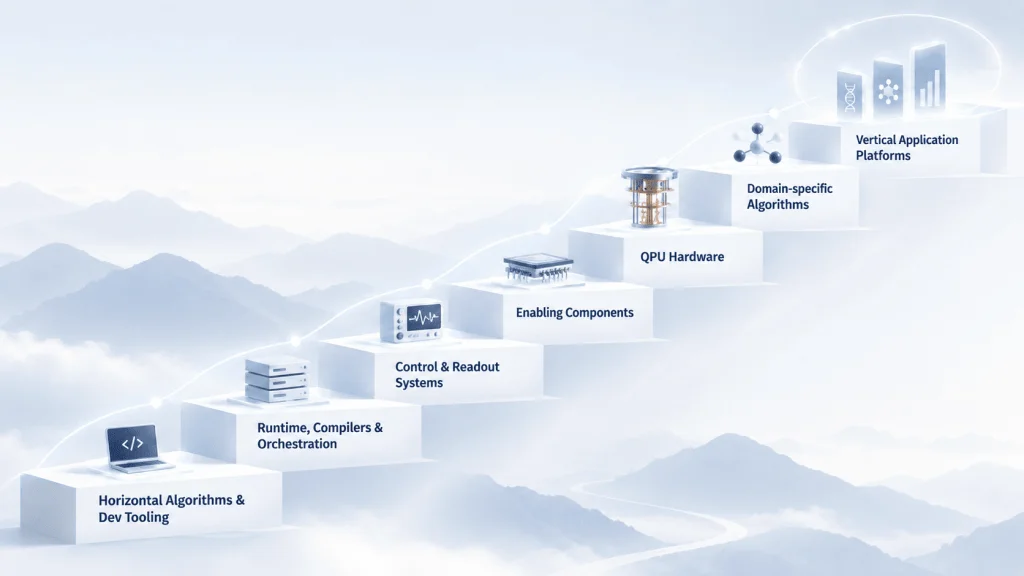
Applied to quantum computing, that framework produces a more complicated picture than the usual hardware-versus-software debate. Quantum processors, enabling components and control systems possess substantial technical scarcity, but they require large amounts of capital and remain divided among competing architectures.
Other parts of the stack may be technically important without becoming strong independent businesses. Novo Holdings said quantum error correction, compilers, runtimes and general developer tools could become essential but still struggle to capture lasting value. Hardware manufacturers and cloud platforms could include those capabilities as product features, or several interchangeable suppliers could compete for the same customers.
A compiler translates an algorithm into instructions a particular quantum processor can execute. Quantum error correction uses multiple physical qubits to protect useful quantum information from noise. Both functions will be important to fault-tolerant computing, but importance does not guarantee that an independent provider will control the market.
An exception could emerge if one company creates a tool or standard that becomes deeply embedded across the industry. In that case, customers and developers could build around it, making it difficult to replace.

become sufficiently embedded that customers find it difficult or risky to replace it, and be controlled by
a company able to retain part of the resulting economics. Durable value emerges only where scarcity,
dependency and ownership reinforce one another. — Novo Holdings
Application Companies Face an Early Opening
Novo Holdings places domain-specific algorithms and vertical application platforms in a more favorable position. These companies could combine specialized technical knowledge with lower capital requirements and closer customer relationships.
“Several positions could become durable control points, but for an independent new entrant one stands out,” the analysts write. “The application layer, domain-specific algorithms and vertical platforms offer the strongest current combination of scarcity, a dependency it can build, ownership through validation and data, and is far less capital intensive than the rest of the stack. It is also largely unclaimed, because the industry is only now approaching early fault-tolerant regimes and no company has yet embedded deep enough to capture it.”
The report indicates, then, that the valuable capability is not simply ownership of an algorithm. It includes identifying an important customer problem, translating that problem into a calculation, reducing its hardware requirements, selecting an appropriate quantum system, validating the result and incorporating it into an existing business process.
Improving an algorithm can also bring an application forward on the hardware timeline. Reducing the number of quantum operations or the depth of a calculation could allow a problem to run on an earlier and smaller fault-tolerant machine.
Novo Holdings analysts write that the opportunity to establish these application positions exists before large-scale fault-tolerant systems arrive. Companies can use the intervening period to develop customer relationships, collect proprietary data and prove that their calculations improve real decisions.
That may require a different business model from the software subscriptions commonly associated with application companies. Early quantum businesses may begin by performing customized scientific work for individual customers.
According to the report, what matters is not whether the company calls its work consulting or software, but whether each customer project helps it build something it can use again. A valuable project should add reusable software, algorithms, validation results, data or workflow knowledge. Over time, those assets should reduce the amount of custom work required to serve the next customer.
Revenue from unrelated projects would not provide the same benefit. The company must gradually turn specialized work into a repeatable, software-supported service or platform.
The report divides fault-tolerant development into two possible periods. An early period could begin in the late 2020s or early 2030s, when machines may have hundreds to low thousands of logical qubits but remain constrained by accuracy, speed and the number of operations they can complete. A scaled period could follow in the mid-2030s or later, with greater capacity and more repeated commercial use.
Logical qubits are error-corrected units of quantum information constructed from larger numbers of physical qubits. Their number alone does not determine whether a useful calculation can run. Circuit depth, error rates, operating speed, measurement requirements and classical processing also affect performance.
The report presents these periods as scenarios rather than forecasts. Companies that depend entirely on the later period would effectively be betting their businesses on hardware manufacturers meeting their roadmaps. Novo Holdings sees a stronger case for companies that can generate revenue and build useful assets before then.
Life Sciences Offer Valuable Decisions
Life sciences serves as the report’s main example of how an application company could establish a defensible position.
Novo Holdings does not claim that biology as a whole is a quantum-computing problem. Most difficulties in drug development arise from biological complexity, experimental limits and clinical execution rather than a lack of computing power.
The potential opportunity is narrower with some important molecular decisions depending on electronic behavior that is difficult for conventional computers to model accurately. These include how chemical bonds form and break, how charge moves through a molecule and how certain excited electronic states behave.
Pharmaceutical and biotechnology companies already spend money on computational chemistry, molecular modeling and contract research to improve such decisions. A quantum application provider would therefore not need to persuade customers to create an entirely new quantum budget. It could compete for existing spending by producing a better scientific result.
The report identifies strongly correlated electronic structures, reaction mechanisms and selected excited-state calculations as some of the more credible early targets. Strong correlation occurs when the behavior of electrons becomes too closely linked for common approximations to describe reliably.
The initial fault-tolerant computers would not simulate an entire drug-development process. They could perform a difficult calculation on a small but important part of a molecule while conventional computers handle the rest.
“The common thread is specificity,” the analysts write. “Early fault-tolerant quantum computers will not model a biological process end to end; they will address the small, decisive part of a workflow where classical approximations break down, and the investable company is the one that identifies that bottleneck, formulates it, reduces the resource requirement, and integrates the result so it changes a decision.”
Protein-ligand binding illustrates both the opportunity and the limit. Determining how strongly a potential drug binds to a target depends on electronic structure, but it also requires modeling the molecule’s shape, surrounding solvent, motion and other effects. An early quantum computer might improve one local electronic calculation without replacing the rest of the classical workflow.
The report is more cautious about broad claims involving molecular generation, docking, screening, biological data and clinical optimization. It does not consider those areas core near-term quantum-computing targets, particularly as classical computing and artificial intelligence continue to improve.
Materials, energy and chemical applications may reach useful quantum performance sooner. Problems involving catalysts, batteries, photovoltaics and other materials can contain smaller electronic regions that map more naturally onto constrained quantum systems.
Novo Holdings nevertheless considers life sciences especially attractive from an investment perspective. Pharmaceutical research involves repeated, high-value decisions, established scientific workflows and experiments that can validate computational results. Those features could allow an application company to accumulate proprietary data and become embedded in customer operations.
Classical Competition Remains a Major Risk
The report does offer a warning that the defensible asset in life sciences is unlikely to be a quantum algorithm by itself. Algorithms can be published, reproduced or displaced by advances in conventional computing.
A stronger position would combine the calculation with experimental validation, proprietary data and integration into a customer’s research process. The company would own the trusted method for turning a calculation into a decision rather than relying solely on a claimed computing advantage.
That approach could also provide protection if classical methods close part of the performance gap before suitable quantum machines arrive. A company that has accumulated validated data and become part of a pharmaceutical workflow could remain valuable even if the underlying calculation no longer requires a quantum computer.
Novo Holdings identifies several conditions that could challenge its argument. Useful calculations may require more quantum resources than expected. Better computational accuracy may not change which experiments or drug candidates customers select. Pharmaceutical, hardware or cloud-computing companies could also build the necessary capabilities internally instead of purchasing them from independent application providers.
The scientific basis for major quantum advantages in ground-state chemistry also remains contested, the report said. Investors must therefore evaluate specific calculations rather than relying on broad claims about quantum drug discovery.
Despite those risks, Novo Holdings‘ analysts reports that waiting for mature fault-tolerant computers could leave investors and startups too late to establish the strongest application positions. Customer dependence, validation records and proprietary datasets take years to develop.
“As the industry approaches application-relevant fault-tolerant regimes, the window to take an application-layer control point starts to narrow, as workflows emerge and embed, and the data compounds,” the analysts conclude. “To date, and rightfully so, capital has concentrated upstream into hardware, leaving the layer that converts constrained quantum resources into customer decisions underfunded relative to the potential value it will create. The value at stake for industries adopting quantum far exceeds the revenue that will accrue to the technology providers, and we read that asymmetry as directional support that the prize sits with those who convert the capability into applied outcomes, not with those who supply the hardware.”

Keep track of everything going on in the Quantum Technology Market. In one place.
Topics

Matt Swayne
With a several-decades long background in journalism and communications, Matt Swayne has worked as a science communicator for an R1 university for more than 12 years, specializing in translating high tech and deep tech for the general audience. He has served as a writer, editor and analyst at The Quantum Insider since its inception. In addition to his service as a science communicator, Matt also develops courses to improve the media and communications skills of scientists and has taught courses.
[email protected]
Stay Ahead of Quantum
Get the latest research, company news, and market intelligence every week.