Researchers Use IBM Quantum Computer to Test Drug-Docking Method


Insider Brief
- Researchers demonstrated a resource-efficient hybrid quantum-classical method for molecular docking on an IBM quantum processor.
- The method represented 18- and 14-variable docking problems using six and five qubits, respectively.
- The quantum hardware identified the same molecular contacts as classical calculations, although the small-scale tests didn’t demonstrate quantum advantage.
A team of Singapore-based researchers reports that a hybrid quantum-classical method could offer a new route to studying drug candidates using today’s Noisy Intermediate-Stage Quantum (NISQ) devices.
The researchers used the method to examine how two small molecules bind to proteins. In both tests, the quantum computer identified the same molecular contacts as conventional computer calculations.
The approach also reduced the number of qubits needed to handle each problem. One test used six qubits to represent 18 variables, while the other used five qubits to represent 14 variables.

The study, published as a preprint on arXiv, was conducted by researchers at Singapore’s Agency for Science, Technology and Research (A*STAR), the National University of Singapore and Nanyang Technological University.
The findings don’t show that quantum computers can perform molecular docking better or faster than classical computers at this point. The test problems remained small enough to solve with conventional methods. Instead, the results demonstrate how researchers might fit parts of a drug-discovery problem onto current quantum hardware, which are currently limited by noise, errors and the number of usable qubits.
The method is designed to assist existing drug-discovery software rather than replace it. It focuses on a difficult part of molecular docking, the process of predicting how a drug candidate might attach to a target protein.
Molecular docking is widely used in early drug research. Scientists rely on it to study whether a molecule is likely to bind to a protein associated with a disease. They can also use it to compare large numbers of possible drug candidates before moving to more expensive laboratory tests.
The process becomes harder as molecules grow larger and more flexible. A potential drug can bend, rotate and approach a protein in many different ways. Each change can produce another possible binding arrangement.
The number of possible arrangements can quickly become too large to test one by one. Classical docking programs address this problem through scoring systems, search methods and shortcuts that remove unlikely options. These programs are useful, but complex molecules can still require substantial computing resources.
The researchers investigated whether a quantum computer could help with one part of that search.
Turning Molecular Docking Into a Graph
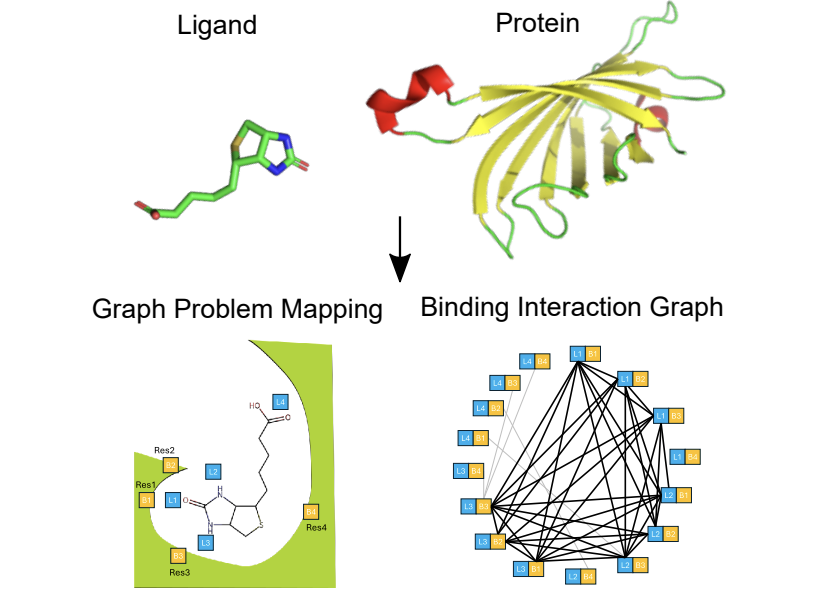
The team represented the docking problem as a network of possible contacts between a drug candidate and a protein.
The researchers first identified important chemical features on both molecules. These features included regions that can form hydrogen bonds, areas with electrical charges and parts of the molecules that tend to avoid water.
Each possible contact between the drug candidate and the protein became a point in a graph. Lines connected contacts that could occur together in the same binding arrangement.
The researchers then assigned a value to each contact based on the types of molecular features involved. The computer’s task was to find the highest-value group of contacts that could all exist at the same time.
A simple analogy would be choosing members for a team when some people work well together and others don’t. The goal is to build the strongest possible team while making sure every selected member is compatible with all the others.
In mathematics, this is known as a maximum vertex-weighted clique problem. The problem can become difficult because the computer must compare many possible combinations as the graph grows.
The researchers converted the graph into a form that could be divided between a quantum computer and a classical computer. The quantum computer represented possible solutions, while the classical computer calculated the quality of those solutions and adjusted the quantum circuit.
This combination of quantum and conventional computing is designed for the noisy intermediate-scale quantum, or NISQ, era. NISQ machines can run quantum circuits, but they don’t yet have the error correction needed for long and highly complex calculations.
Using Each Qubit More Efficiently
One of the study’s main contributions was a way to represent more information with fewer qubits.
In many quantum optimization methods, each choice in a problem is assigned to one qubit. A docking graph with 18 possible contacts could therefore require 18 qubits.
The researchers instead used three measurable properties of each qubit to represent as many as three separate choices, a method the team called full-basis encoding.
A qubit is often shown as a point on a sphere, known as the Bloch sphere. The sphere has three directions that describe the qubit’s state. The researchers used each of those directions to carry information about a different part of the docking problem.
This allowed them to represent an 18-variable problem with six qubits and a 14-variable problem with five qubits.
Reducing the qubit requirement could be useful because the number of high-quality qubits remains an important limit for current quantum computers. Larger circuits can also be more difficult to train and more exposed to errors.
The researchers provided a mathematical argument showing that the best solution to their version of the problem can be represented without requiring entanglement between the qubits. Entanglement connects quantum states in ways that have no direct classical equivalent, but creating and maintaining it can make circuits more demanding.
The finding allowed the researchers to use relatively shallow circuits, which are better suited to current quantum processors.
Tests on Molecular Examples
The researchers tested their method using two protein-ligand structures from the Protein Data Bank, a public collection of experimentally determined molecular structures.
A ligand is a molecule that attaches to another molecule, usually a protein. In drug research, the ligand may be a possible drug or a molecule used to study how a protein works.
The first test involved biotin and streptavidin. Biotin is a vitamin, while streptavidin is a protein known for binding to Biotin very strongly. Scientists have studied the pair extensively, making it a useful example for checking a new docking method.
The second test involved benzamidine and trypsin. Benzamidine can inhibit trypsin, an enzyme that breaks down proteins, by binding inside a pocket used by the enzyme to recognize its targets.
The team converted the biotin-streptavidin structure into a problem with 18 variables. The benzamidine-trypsin structure produced a problem with 14 variables.
The researchers also gave the calculations a “warm start.” This means the system began its search from a promising area rather than from a completely random position. The warm-start method helped the calculations reach the best solutions more quickly in the researchers’ simulations.
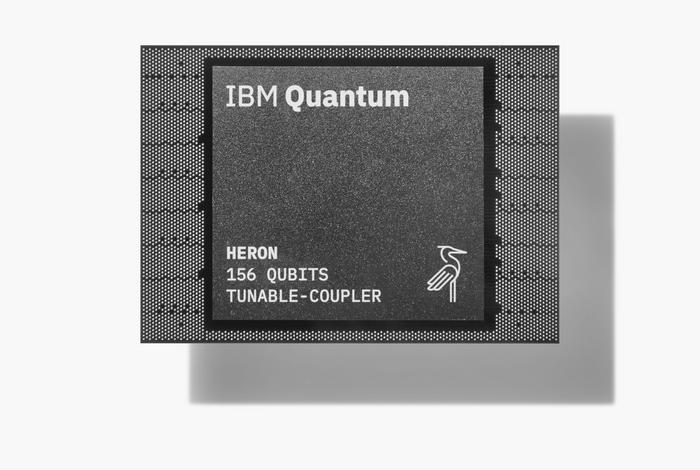
After training the circuits, the team ran them on IBM’s ibm_kingston quantum processor. The system is part of IBM’s Heron family of superconducting quantum computers.
For both molecular examples, the quantum hardware selected the same groups of compatible contacts as the classical calculations. The results suggest that the compressed method can continue to work despite the noise and measurement errors found in current quantum processors.
Comparing the Encoding Methods
The researchers compared the full-basis method with an earlier approach that uses two properties of each qubit instead of three.
The full-basis method required fewer qubits and produced the correct answer more often under the conditions used in the study.
For the 18-variable problem, the full-basis approach found the best solution in about 74% of 1,000 runs. The two-property method succeeded in about 66% of the runs.
For the 14-variable problem, the full-basis method succeeded in about 99% of the runs, compared with about 90% for the other approach.
The researchers cautioned that these results don’t prove the full-basis method will always perform better. The comparison used the same circuit depth and training budget for both approaches. The method using more qubits might improve with longer circuits or additional training.
The main advantage shown in the study was the ability to represent the same problem with fewer qubits while maintaining strong performance.
Limitations and Next Steps
The research remains an early demonstration and, as mentioned, it doesn’t establish a quantum advantage, which would require a quantum computer to outperform the best practical classical methods on a useful problem.
The two docking examples were small, and classical software could still calculate their correct solutions. They also involved well-understood molecular structures rather than unknown drug candidates.
The graph model simplified the molecules into selected chemical features and distance relationships. Real molecular binding can also depend on the movement of the protein, surrounding water molecules and subtle changes in energy. Those effects weren’t fully represented in the tests.
The method’s performance also depended on settings that controlled the circuit and the search. If the system applied too small a penalty to incompatible contacts, it could accept physically invalid combinations. If the penalty was too large, it could limit the search and miss better solutions.
Future work will need to test larger and more flexible molecules, more detailed models of chemical interactions and denser graphs containing many more possible contacts. The researchers also identified better circuit designs, automatic adjustment of search settings and methods that account for hardware noise as areas for further study.
Ultimately, the method could eventually serve as a quantum-assisted tool within a larger classical docking system. Conventional computers would prepare the molecular data and build the interaction graph, while a quantum processor would search for strong groups of compatible contacts.
The research team included Tianqi Chen, Jianguo Li, Chandra Verma and Sebastian Maurer-Stroh of A*STAR’s Bioinformatics Institute, and Adrian M. Mak and Jian Feng Kong of A*STAR’s Institute of Advanced Intelligence and Computing. Chen and Kong were also affiliated with the A*STAR Quantum Innovation Centre, while Chen, Verma and Maurer-Stroh held additional affiliations with the National University of Singapore and Verma was also affiliated with Nanyang Technological University.
For a deeper, more technical dive, please review the paper on arXiv. It’s important to note that arXiv is a pre-print server, which allows researchers to receive quick feedback on their work. However, it is not — nor is this article, itself — official peer-review publications. Peer-review is an important step in the scientific process to verify results.

Keep track of everything going on in the Quantum Technology Market. In one place.
Topics

Matt Swayne
With a several-decades long background in journalism and communications, Matt Swayne has worked as a science communicator for an R1 university for more than 12 years, specializing in translating high tech and deep tech for the general audience. He has served as a writer, editor and analyst at The Quantum Insider since its inception. In addition to his service as a science communicator, Matt also develops courses to improve the media and communications skills of scientists and has taught courses.
[email protected]

Stay Ahead of Quantum
Get the latest research, company news, and market intelligence every week.
MENTIONED IN THE ARTICLE

National University of Singapore
The National University of Singapore (NUS) is a prominent national public university and research institution in Singapore. Established in 1905 as the Straits Settlements and Federated Malay States Government Medical School, NUS holds the distinction of being the country's oldest independent university.
→

Nanyang Technological University
Nanyang Technological University (NTU) is a Singaporean national research university. Established in 1981, it holds the distinction of being the second-oldest autonomous university in the nation.
→

IBM
IBM is an iconic technology pioneer founded in 1911 as the Computing-Tabulating-Recording Company and officially renamed International Business Machines Corporation in 1924. Beyond foundational computing, IBM possesses a deep legacy in aerospace and defense from building the guidance computers and Instrument Unit for NASA's historic Apollo missions to partnering with Airbus on CIMON, the first AI assistant on the ISS.
→