

Insider Brief
- China is testing quantum sensing, secure communications and computing at the 220-kilovolt Houdian demonstration substation in Hefei to improve power-grid monitoring, security and analysis.
- The facility, commissioned in November 2024, has deployed 85 domestically developed quantum devices across 18 categories, including diamond-based sensors, quantum-dot sensors and quantum communications equipment.
- Several technologies demonstrated at Houdian have been deployed elsewhere in Anhui and are expanding to other regions, though independent evidence of their performance and commercial advantages remains limited.
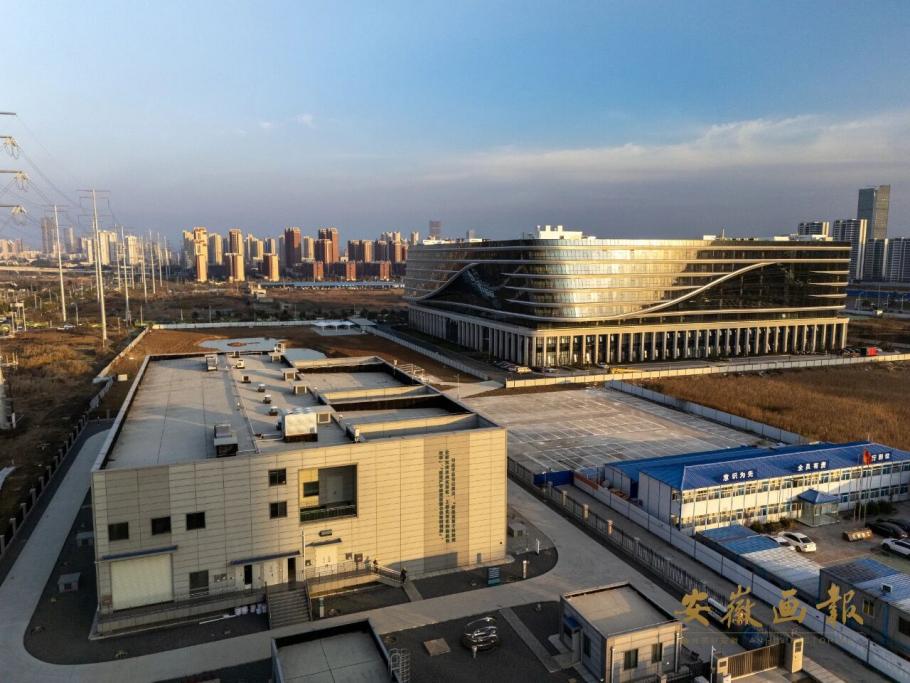
- Photo shows the 220-kilovolt Houdian Quantum Application Demonstration Substation in Hefei, east China’s Anhui province. (People’s Daily Online)
China is testing quantum sensors, secure communications and computing in a working power substation, examining how the emerging technology could be applied to the country’s electrical grid.
The 220-kilovolt Houdian Quantum Application Demonstration Substation in Hefei, in eastern China’s Anhui province, has deployed 85 domestically developed quantum devices across 18 categories, according to a report by People’s Daily Online.
Commissioned in November 2024, the facility is China’s first demonstration substation designed for the systematic use of quantum technologies, the report said. The equipment spans quantum sensing, communications and computing, with applications ranging from detecting electrical faults to protecting data and analyzing the flow of electricity through the grid.

People’s Daily Online is the website of People’s Daily, the official newspaper of the Central Committee of the Chinese Communist Party. Its account of the project should therefore be viewed as reporting from Chinese state media.
Quantum Sensors Move Into the Field
Much of the technology at Houdian is aimed at improving monitoring of electrical equipment, an area where quantum sensors could offer greater sensitivity than conventional devices.
Diamond-based quantum sensing materials are being used to monitor current fluctuations, while quantum-dot sensors — devices that use nanoscale semiconductor materials — monitor conditions inside switchgear and look for signs of partial electrical discharge, an early indicator of insulation problems and equipment failure.
“We have replaced many manual inspection tasks with high-precision quantum sensing equipment,” Tian Teng, an engineer at the digitalization institute of the electric power research institute under State Grid Anhui Electric Power Co., told People’s Daily Online. “The new system can identify and diagnose equipment defects much faster, reducing both inspection costs and operating expenses.”
Other equipment extends beyond the substation itself. A quantum lidar system monitors atmospheric particles and clouds within a 15-kilometer radius to identify weather risks. Quantum attitude sensors installed on transmission towers measure small changes in magnetic fields to track tower alignment.
The substation is designed to operate without regular on-site staffing, with automated systems replacing some manual inspections.
Communications and Computing
The project is also testing quantum technology as a way to protect grid communications. According to People’s Daily Online, the facility uses equipment supporting fiber-based quantum secure communications as well as a system combining 5G networks with quantum-based encryption.
Quantum communications can use properties of quantum physics to help distribute cryptographic keys and detect certain types of interception. The report, however, did not provide technical performance data for the communications systems or comparisons with conventional cybersecurity approaches.
Researchers have also tested quantum computing for power-flow analysis, the calculations grid operators use to determine how electricity moves through a network. The approach was validated using the structure of an actual power grid on Origin Wukong, a superconducting quantum computer developed in China, according to the article.
Important to note, the account did not say whether the quantum computer performed the analysis faster or more accurately than conventional computing systems. Today’s quantum computers remain limited and have not demonstrated an advantage over classical computers for most commercial tasks.
From Laboratory to Power Grid
The project is intended in part to address challenges created by increasingly complex grids carrying power from renewable energy sources and power-electronics equipment. Chinese researchers cited limitations in equipment monitoring, communications security and the ability to rapidly analyze increasingly complicated networks.
Moving quantum sensors from laboratories into an operating substation posed engineering problems, according to the article.
Zhao Long, head of the power quantum sensing laboratory at State Grid Anhui Electric Power’s research institute, said the team lacked domestic precedents, established standards and mature technical solutions. He also said overseas suppliers stopped providing high-quality diamond sensing materials, prompting the researchers to work with Chinese materials specialists to develop alternatives.
Engineers then had to deal with electromagnetic interference and package sensitive laboratory equipment for real-world operating conditions.
Project estimates provided by the People’s Daily Online indicate the quantum technologies could reduce annual electricity measurement errors at Houdian by more than 500,000 kilowatt-hours. The report did not provide independent verification of that estimate or enough information to determine how the figure was calculated.
Several technologies demonstrated at Houdian have since been deployed elsewhere in Anhui and are being introduced in other parts of China, according to the report.