QC Ware Demonstrates Hybrid Quantum-Classical Chemistry Workflow with IBM Quantum Hardware



Insider Brief
- QC Ware demonstrated a hybrid quantum-classical computational chemistry workflow combining its Promethium platform with IBM Quantum’s 156-qubit Heron superconducting quantum processor.
- The demonstration calculated electrostatic interaction energy for the nitric oxide reductase enzyme system using GPU-accelerated molecular modeling and quantum measurements.
- QC Ware said the work shows how classical and quantum computing methods can be combined for chemistry applications, while noting the workflow is not currently a fully integrated Promethium product capability.
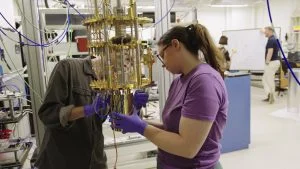
- Photo from Pexels by Marek Piwnicki.
Press release – QC Ware (“QC Ware” or the “Company”) today announced a technology demonstration of a hybrid quantum-classical computational chemistry workflow using Promethium® and IBM Quantum hardware.
The demonstration calculated electrostatic interaction energy for nitric oxide reductase by combining GPU-accelerated molecular modeling and classical chemistry methods with quantum measurements performed on IBM’s 156-qubit Heron superconducting quantum processor. The work highlights how Promethium can be used alongside quantum hardware in scientifically relevant workflows. This was a technology demonstration and is not currently a fully integrated Promethium product capability.
“This demonstration shows how classical and quantum computing can be combined to address meaningful computational chemistry problems,” said Dr. Kin-Joe Sham, Co-Founder and COO at QC Ware. “We believe Promethium delivers high-performance computational chemistry today while providing a foundation for exploring future hybrid workflows.”

Nitric oxide reductase is a chemically complex metalloenzyme system, making it a relevant benchmark for evaluating advanced computational methods. The workflow focused on electrostatic interaction energy, an important molecular property in drug discovery, catalysis, and materials science.
The demonstration builds on QC Ware‘s previously published research in hybrid quantum-classical chemistry and reflects the Company’s broader strategy of delivering practical, GPU-accelerated quantum chemistry today while advancing the use of artificial intelligence and quantum computing to address increasingly challenging scientific problems.
Available today, Promethium’s GPU-native architecture enables researchers to apply quantum chemistry across larger molecular systems and more compounds than has traditionally been practical. For selected workloads, Promethium runs demanding calculations up to 20× faster than the main conventional platforms, helping researchers generate molecular-level insights in hours instead of weeks and accelerating decision-making across drug discovery, catalysis, and materials science.

Keep track of everything going on in the Quantum Technology Market. In one place.
Topics

Mohib Ur Rehman
Covering quantum and emerging technologies, Mohib explores the intersection of technology, security, and society. His work also frequently examines surveillance infrastructure and the institutions shaping the digital world. In addition to his work at The Quantum Insider, he co-runs SK NEXUS, an independent technology publication that helps readers understand the technologies shaping their lives.

Stay Ahead of Quantum
Get the latest research, company news, and market intelligence every week.
MENTIONED IN THE ARTICLE