IonQ Raises 2026 Revenue Outlook After Record Quarter Fueled by Commercial Growth, SkyWater Acquisition


Insider Brief
- IonQ reported record second-quarter revenue of $80.1 million, up 287% year over year, and raised its full-year 2026 revenue guidance to $280 million to $290 million while reaffirming expectations for 100% organic revenue growth.
- The company completed its acquisition of SkyWater Technology, ended the quarter with $3.0 billion in cash, cash equivalents and investments, and said its updated guidance does not include any contribution from the acquisition.
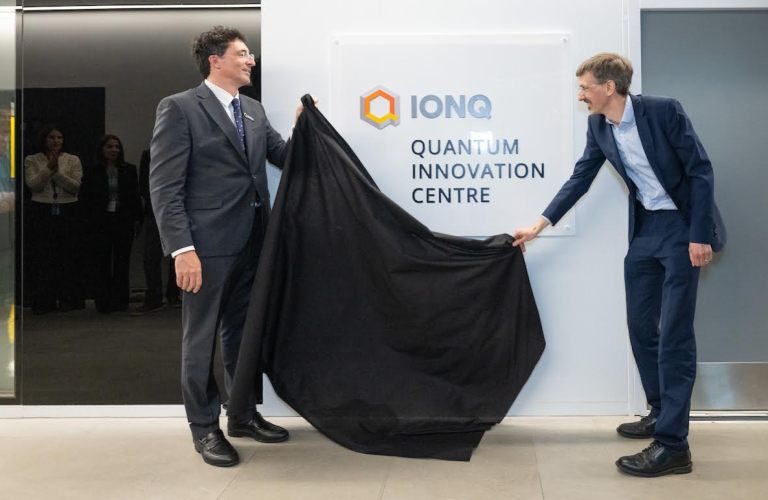
- During the quarter, IonQ expanded its quantum computing, networking and security businesses through new partnerships with Anduril and Sandia National Laboratories, the launch of a commercial quantum communications research center in Tennessee, and the acquisition of Nexus Photonics.
IonQ raised its full-year revenue guidance after reporting record second-quarter revenue, as the quantum computing company combined accelerating commercial growth with a series of acquisitions aimed at expanding beyond quantum hardware into a broader computing and networking platform.
In a statement on the earnings, the company announced its acquisition streak continued during the quarter with the addition of Nexus Photonics, which expands its integrated photonics capabilities, and culminated after quarter-end with the closing of its acquisition of SkyWater Technology, giving IonQ in-house semiconductor manufacturing and creating what it describes as the first vertically integrated, full-stack quantum platform.
The company reported second-quarter revenue of $80.1 million, up 287% from a year earlier and above the midpoint of its previous guidance. IonQ also increased its full-year 2026 revenue outlook to between $280 million and $290 million, while reaffirming expectations that its core quantum computing business will double organically this year.

“I am pleased to report that IonQ delivered its fifth consecutive quarter of record results and the strongest quarter in our company’s history,” Niccolo de Masi, Chairman and CEO said in the statement. “Second quarter revenue of $80.1 million again exceeded our guidance, reflecting continued customer demand across our expanding quantum platform.”
de Masi continued, “The successful close of our SkyWater and Nexus acquisitions extends IonQ’s full-stack quantum platform and merchant supplier leadership to the U.S. and allied ecosystem. We have also made powerful strides towards demonstrating our 256-qubit quantum computer and publishing results for our quantum error correction technology on our hardware. We enter the second half of the year confident in IonQ’s ability to execute our quantum platform roadmap, translate our technology leadership into durable commercial growth, and create long-term value for shareholders.”
“We also welcome the recent White House quantum executive orders which reinforce the strategic importance of quantum technologies for both the U.S. economy and national security. These executive orders send a strong signal that quantum sensing, quantum networking, quantum cybersecurity and quantum computing leadership are all now national priorities for the United States. We are more confident than ever that IonQ, with our unique quantum platform, is well positioned to support that effort.”
The results come days after IonQ officially completed its acquisition of semiconductor manufacturer SkyWater Technology, a transaction that gives the company in-house chip manufacturing capabilities and makes it one of the few quantum computing companies with direct control over much of its hardware development and production.
Despite the strong revenue growth, IonQ reported a GAAP net loss of $1.87 billion for the quarter, reflecting acquisition-related accounting charges and other expenses associated with its aggressive expansion strategy.
Commercial Momentum
IonQ said growth during the quarter was driven by deployments across its expanding portfolio of quantum computing, networking, security and space technologies.
International customers represented approximately half of quarterly revenue, while commercial customers accounted for roughly 60%. Products outside the company’s core quantum computing systems contributed about one-quarter of total revenue, illustrating how IonQ has diversified beyond selling quantum computing access alone.
The company said the results reinforce confidence in achieving approximately 100% organic revenue growth during 2026. Organic revenue excludes contributions from acquisitions completed after the end of 2024, allowing investors to distinguish growth generated by the company’s existing operations from revenue added through acquisitions.
IonQ also reported that remaining performance obligations, a measure of contracted future revenue that has not yet been recognized, increased 297% year over year. The company cited the expanding backlog as one factor supporting its decision to raise guidance.
The revised revenue outlook does not include any contribution from the recently completed SkyWater acquisition.
Reshaping Strategy?
The completion of the SkyWater acquisition marks a significant strategic moves in IonQ‘s history. Rather than relying entirely on outside semiconductor manufacturers, IonQ now owns a U.S.-based fabrication business capable of producing advanced chips used in quantum computing and other technologies.
This reflects a broader strategy of vertical integration that could allow the company greater control over hardware design, manufacturing, networking and software.
IonQ also disclosed its acquisition of Nexus Photonics, saying the transaction expands its integrated photonics capabilities to advance the miniaturization and mass manufacturing of quantum systems.
Taken together, the acquisitions position IonQ as a company seeking to build an integrated quantum technology platform rather than focusing solely on quantum computers.
The company ended the quarter with $3.0 billion in cash, cash equivalents and investments. After accounting for cash used to complete the SkyWater acquisition, pro forma cash totaled approximately $2.0 billion.
That balance sheet provides substantial capital to fund manufacturing expansion, acquisitions and continued research as the company competes in a quantum computing market that remains in its early commercial stages.
National Security and Networking
IonQ continued expanding its presence in government and national security markets during the quarter through several partnerships.
The company signed a memorandum of understanding with defense technology company Anduril Industries to explore quantum technologies for defense and national security applications while jointly pursuing future government and commercial contracts.
IonQ also announced a memorandum of understanding with Sandia National Laboratories focused on quantum co-design, an approach that develops quantum hardware and software together to improve system performance for specialized applications.
Beyond computing, the company continued investing in quantum networking, an emerging field that aims to connect quantum computers through secure communication links.
During the quarter, IonQ announced the Tennessee Quantum Communications Research Center with municipal utility EPB. The center includes what the company described as the world’s first commercial quantum memory unit installed on a live fiber-optic communications network. Quantum memories temporarily store fragile quantum information, making them a key component for future long-distance quantum networks.
IonQ also expanded its quantum cybersecurity portfolio by introducing ClavisXG Multiplex, a product designed to distribute encryption keys using the laws of physics rather than relying solely on mathematical algorithms.
Broader Technology Portfolio
The quarter also illustrated how IonQ‘s business now extends beyond quantum computing.
Through its space technology operations, the company launched a commercial interferometric synthetic aperture radar, or InSAR, capability that can detect millimeter-scale changes in Earth’s surface from orbit. Such systems are used for applications including infrastructure monitoring, environmental observation and disaster response.
IonQ also expanded its fleet of optical communications terminals operating in space to 84 units, supporting a U.S. government initiative.
The broader portfolio reflects the company’s strategy of combining quantum computing with quantum networking, secure communications, photonics and space-based technologies to create multiple sources of revenue as the quantum computing market matures.

Keep track of everything going on in the Quantum Technology Market. In one place.

Matt Swayne
With a several-decades long background in journalism and communications, Matt Swayne has worked as a science communicator for an R1 university for more than 12 years, specializing in translating high tech and deep tech for the general audience. He has served as a writer, editor and analyst at The Quantum Insider since its inception. In addition to his service as a science communicator, Matt also develops courses to improve the media and communications skills of scientists and has taught courses.
[email protected]

Stay Ahead of Quantum
Get the latest research, company news, and market intelligence every week.
MENTIONED IN THE ARTICLE

IonQ
IonQ is a developer in trapped ion quantum computing founded in 2015 that actively applies its technology to the aerospace and defense sectors. The company empowers satellite-based quantum networks and quantum enabled drones to improve positioning, navigation, and timing resilience in GPS denied environments, and collaborates with industry leaders like Airbus to optimize aircraft loading.
→
![SkyWater Technology Foundry [Acquired by IonQ]](https://s3.us-east-2.amazonaws.com/tqd.s3.bucket/images/7173d494-1510-4ea7-b481-e3ff43a8858d.jpg)
SkyWater Technology Foundry [Acquired by IonQ]
SkyWater is the only U.S.-owned and U.S.-based pure play semiconductor foundry and is a DOD-accredited Trusted supplier, specializing in custom technology development services and volume manufacturing for integrated circuits and micro devices.
→

Sandia National Laboratory
The Sandia National Laboratories is one of three National Nuclear Security Administration research and development laboratories in the United States, managed and operated by the National Technology and Engineering Solutions of Sandia.
→
![Nexus Photonics [Acquired by IonQ]](https://s3.us-east-2.amazonaws.com/tqd.s3.bucket/images/e9f7b9d9-ba40-441a-bc6c-9f99e0fbaf03.jpeg)
Nexus Photonics [Acquired by IonQ]
Nexus Photonics is a company that specializes in the development of integrated photonics, aiming to enhance performance across a wide spectrum of wavelengths. The company's work is focused on creating smaller, lighter, and more cost-effective solutions with better performance.
→

Electronic Power Board (EPB)
EPB, formerly known as the Electric Power Board of Chattanooga, is an American electric power distribution and telecommunications company owned by the city of Chattanooga, Tennessee.
→