Did IBM CEO’s Quantum Timeline Prompt Jim Cramer to Exit Bitcoin?


Insider Brief
- Jim Cramer said he plans to sell his bitcoin after discussing IBM CEO Arvind Krishna’s quantum computing timeline, highlighting how quantum security concerns are increasingly influencing mainstream investment discussions.
- Researchers broadly agree that sufficiently powerful fault-tolerant quantum computers could eventually threaten Bitcoin’s cryptography, but experts continue to debate when such systems will become practical.
- The episode underscores growing attention to post-quantum cryptography as companies including IBM advance quantum computing roadmaps while the cryptocurrency community explores quantum-resistant security upgrades.
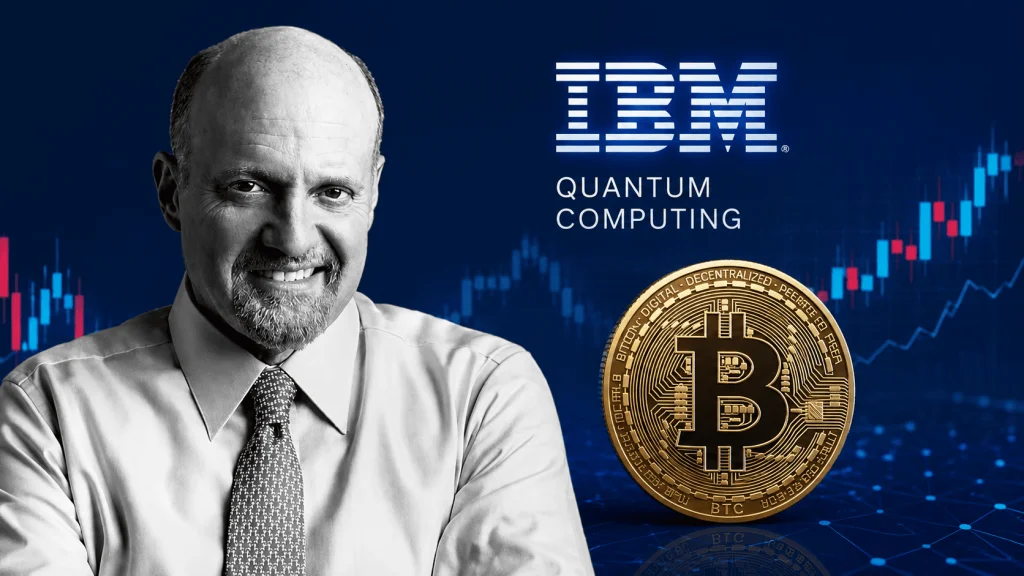
Jim Cramer said he plans to sell his bitcoin — perhaps not coincidentally — after IBM Chairman and CEO Arvind Krishna warned that investors should be “paranoid” about quantum computing’s eventual ability to challenge modern cryptography, Bitcoin.com reported.
The CNBC “Mad Money” host made the comments shortly after interviewing Krishna in late July. During the interview, Krishna said quantum computing could begin posing meaningful challenges to today’s encryption methods within three to four years, while emphasizing the importance of preparing for that transition through post-quantum cryptography.
Cramer later said he intended to exit his bitcoin position, indicating that advances in quantum computing could threaten the cryptocurrency’s underlying security on a similar timeline.

Although Cramer did not explicitly attribute his decision to Krishna’s comments, he referenced the same quantum computing timeline discussed during the interview, raising questions about whether IBM‘s public roadmap influenced his thinking.
For the quantum industry, the episode illustrates how quantum computing is increasingly entering mainstream discussions about financial markets, cybersecurity and digital assets as hardware continues to improve and commercial roadmaps become more concrete.
Bitcoin relies on the Elliptic Curve Digital Signature Algorithm (ECDSA) to verify ownership of coins. In theory, a sufficiently powerful fault-tolerant quantum computer running Shor’s algorithm could derive a private key from a publicly exposed key, allowing an attacker to control vulnerable bitcoin addresses.
Researchers broadly agree that the threat is real in principle. The central debate is not whether quantum computers could eventually break today’s public-key cryptography, but when they might become capable of doing so.
A cascade of research from leading quantum companies and research institutions have added fuel to the debate.
In March, researchers at Google Quantum AI estimated that breaking widely used elliptic curve cryptography could require fewer than 500,000 physical qubits—roughly 20 times fewer than previous estimates. While the study suggested the engineering challenge may be less daunting than once believed, today’s quantum computers remain far smaller, operating with hundreds to low thousands of physical qubits and only a limited number of logical qubits capable of supporting error-corrected computation.
IBM has also continued advancing its roadmap toward fault-tolerant quantum computing. Krishna has previously said he expects commercially meaningful quantum applications to emerge around 2028 or 2029, though he has also emphasized that organizations should begin migrating to quantum-safe cryptography well before large-scale quantum computers become available.
Security researchers have announced that not every bitcoin is equally exposed. Addresses whose public keys have never been revealed remain substantially better protected, while coins held in reused or legacy addresses face greater theoretical risk should cryptographically relevant quantum computers emerge. Estimates suggest millions of bitcoin reside in older addresses that have already exposed their public keys.
The cryptocurrency community has discussed quantum-resistant upgrades for years, and researchers continue developing post-quantum cryptographic techniques designed to withstand attacks from both classical and quantum computers. Many experts expect Bitcoin and other blockchain networks would have opportunities to adopt quantum-resistant signature schemes before quantum hardware reaches the scale needed to threaten the network broadly.
Cramer’s remarks also generated a familiar response from cryptocurrency traders. On social media, many users embraced the long-running “inverse Cramer” meme — the notion that the opposite of Cramer’s market predictions often proves correct — rather than reacting to the underlying discussion about quantum computing.

Keep track of everything going on in the Quantum Technology Market. In one place.
Topics

Matt Swayne
With a several-decades long background in journalism and communications, Matt Swayne has worked as a science communicator for an R1 university for more than 12 years, specializing in translating high tech and deep tech for the general audience. He has served as a writer, editor and analyst at The Quantum Insider since its inception. In addition to his service as a science communicator, Matt also develops courses to improve the media and communications skills of scientists and has taught courses.
[email protected]

Stay Ahead of Quantum
Get the latest research, company news, and market intelligence every week.
MENTIONED IN THE ARTICLE

IBM
IBM is an iconic technology pioneer founded in 1911 as the Computing-Tabulating-Recording Company and officially renamed International Business Machines Corporation in 1924. Beyond foundational computing, IBM possesses a deep legacy in aerospace and defense from building the guidance computers and Instrument Unit for NASA's historic Apollo missions to partnering with Airbus on CIMON, the first AI assistant on the ISS.
→

Google Quantum AI lab
Google aims to build quantum processors and develop novel quantum algorithms to dramatically accelerate computational tasks for machine learning.
→