



Insider Brief
- A coalition of researchers from leading universities, national laboratories and quantum technology companies has published an industry-wide roadmap outlining the scientific and engineering milestones needed to scale neutral-atom quantum computers toward practical applications.
- The roadmap identifies advances in larger qubit arrays, integrated photonics, quantum error correction, software, networking and standardized benchmarks as key priorities for achieving reliable, fault-tolerant neutral-atom quantum computing.
- The researchers argue that continued progress will require coordinated collaboration across the quantum ecosystem to develop systems capable of supporting tens of thousands of physical qubits and ultimately demonstrating practical quantum advantage on real-world problems.
Over the years, numerous quantum companies have released roadmaps proposing how they plan to move their technologies into the marketplace over the coming months and years.
Now, in what is an unprecedented move, a broad group of quantum scientists, engineers and entrepreneurs has outlined a path for neutral-atom computers to move from experimental machines to systems capable of solving useful problems beyond the reach of conventional computers.
The strategic plan, posted on the arXiv preprint server, brings together researchers from universities, national research organizations and quantum technology companies. The contributors include scientists affiliated with MIT, Harvard University, the University of Chicago, Yale University, Cornell University, Stanford University, the University of Wisconsin-Madison, NIST, QuEra Computing, PASQAL, planqc, Infleqtion and NanoQT, among others.

That range represents an industry-wide effort to identify the technical work required across the neutral-atom ecosystem. The plan covers hardware, optical control, error correction, software, algorithms and networking between quantum processors.
The researchers write that recent advances have created a credible path toward neutral-atom systems containing tens of thousands of physical qubits and hundreds of error-corrected logical qubits. A physical qubit is an individual quantum component, while a logical qubit combines several physical qubits to protect information from errors.
Reaching that scale, however, will require more than simply trapping additional atoms. The field must improve gate accuracy, continuously replace atoms lost during calculations, develop faster measurement systems and replace bulky optical equipment with more compact and scalable control technology, according to the study.
The researchers also call for stricter standards around claims of quantum advantage. They propose that a quantum computation should be considered practically advantageous only if it produces a correct result, performs a task beyond available classical hardware, has a scaling advantage over classical methods and addresses a problem that matters to people outside the group that built the machine.
That definition sets a particularly higher bar than demonstrations built mainly to show that a quantum device can outperform a classical computer on a specially designed test.
A Roadmap Across the Quantum Technology Stack
First, a quick definition of the neutral atom modality. Neutral-atom computers use individual atoms held in place by tightly focused laser beams known as optical tweezers. The atoms can be arranged in large, programmable patterns and moved during a calculation.
To perform operations, researchers often excite the atoms into high-energy Rydberg states. In these states, atoms interact strongly with one another, allowing them to become entangled and carry out quantum logic operations.
The platform has drawn interest because atoms of the same element are naturally identical. Unlike fabricated solid-state devices, they do not need to be manufactured one by one with exactly matching properties. Researchers can also rearrange the atoms, allowing qubits that began far apart to interact.
According to the study, neutral-atom systems have reached arrays containing thousands of atoms, while reported two-qubit gate fidelities have exceeded 99.5% in leading experiments. Fidelity measures how closely an operation matches its intended result.
Experiments have also demonstrated logical algorithms using as many as 48 logical qubits encoded in up to 280 physical qubits, according to the researchers. These results indicate that neutral-atom computing has begun moving into the era of error-corrected logical operations, although current systems remain far from machines that can run long, commercially useful calculations.
The neutral atom roadmap, which grew out of a National Science Foundation town hall on advancing quantum computing with neutral atoms held at MIT Endicott House in January 2025, organizes the field’s needs into several connected areas rather than treating hardware development as an isolated challenge.
The researchers also examine how to define and verify quantum advantage, scale neutral-atom processors, build integrated photonic controls, improve quantum error correction, compile programs for movable qubits and connect separate processors into larger distributed systems.
That systems-level approach reflects the idea that no single hardware improvement is likely to deliver practical quantum computing on its own.
Better atoms and gates will have limited value without control systems capable of directing thousands of laser channels. More accurate physical operations will not be enough without efficient error-correcting codes. Larger processors will remain difficult to use without compilers that decide where atoms should move and when operations should take place.
The paper estimates that the number of physical qubits in leading neutral-atom experiments has nearly doubled — increasing by roughly a factor of 1.8 — each year over the past decade. Over the same period, gate errors have fallen by a factor of about 0.6 annually, based on a fit to selected leading results.
The researchers caution that these trends are only rough measures. The largest systems do not necessarily have the most accurate gates, and the experiments included in the analysis used different architectures and ways of measuring performance.
Still, the researchers indicate that theoretical and experimental requirements are moving closer together. Newer error-correcting codes could reduce the number of physical qubits needed for each protected logical qubit, while hardware teams continue to increase atom counts and operation quality.
If progress continues at a similar pace, the study says neutral atoms could reach quantum utility within the next decade. The projection is conditional rather than a firm forecast because it depends on whether the field can scale processors into a range of roughly 100,000 to 1 million physical qubits while maintaining reliable control.
For demanding calculations such as using Shor’s algorithm to factor large numbers, the study cites estimates requiring at least thousands of logical qubits. More efficient quantum low-density parity-check, or qLDPC, codes could potentially allow such algorithms to run on about 10,000 to 100,000 neutral-atom physical qubits under certain assumptions.
Those estimates remain based largely on theoretical resource calculations rather than complete machine designs. Actual requirements will depend on gate errors, atom loss, measurement speed, code performance and the structure of the algorithm being run.
Defining Useful Quantum Advantage
The paper spends a lot of effort on defining what should count as meaningful quantum performance.
Current quantum advantage demonstrations have generally focused on narrow mathematical tasks chosen partly because they are difficult to simulate classically. Such experiments can provide evidence that a quantum processor is performing computations that strain the best conventional machines, but they do not necessarily solve useful industrial or scientific problems.
The researchers divide the path toward practical advantage into three broad stages.
The first is weak, unverifiable quantum advantage, involving relatively small numbers of quantum operations and tasks such as random-circuit sampling. These calculations can be hard for classical computers, but their outputs may also be difficult to verify directly.
The second is early practical advantage, which the study places in a range of about 1 million to 1 billion quantum operations. Possible applications include certifiable random-number generation and selected quantum simulations.
The third is broad practical advantage, requiring about 1 billion to 1 trillion quantum operations. The researchers associate this range with possible applications in chemistry, materials science, nuclear physics, cryptography and optimization.
The paper uses the term “quop” as a measure of the operations that can be performed within one error-correction cycle. The researchers use the measure to compare possible applications while accounting for some of the work hidden inside fault-tolerant operations.
The estimates show that proposed applications vary widely in their demands. Some proofs that a machine is genuinely quantum may need about 1,000 logical qubits and millions of operations. Simulations of certain material models may require hundreds of logical qubits and millions of operations. Factoring a 2,048-bit RSA number could require thousands of logical qubits and billions of more complex operations, depending on the method.
The study warns that useful algorithms remain a major limitation. Only a small number of known quantum algorithms offer a clear exponential advantage, and many of those require enormous fault-tolerant systems.
Hardware development may therefore outpace the ability of researchers to identify useful calculations for the machines. The team calls for more work on algorithms designed around the specific strengths of neutral atoms, including their flexible connectivity, parallel operations and ability to move qubits.
They also recommend closer co-design among hardware, software, error correction and algorithms. An algorithm that appears too expensive under a generic architecture might become practical if it is matched to a code and processor that can perform its most common operations efficiently.
The researchers propose establishing shared benchmark problems with long histories of classical study. Possible targets include molecular systems, reaction dynamics, transport in materials and the two-dimensional Fermi-Hubbard model, which is used to study strongly interacting electrons.
They suggest organizing competitions similar to the process used by NIST to evaluate post-quantum cryptography. Quantum and classical teams could attempt the same clearly defined problems at specified accuracy levels. Such contests could make advantage claims more credible by ensuring that quantum results are compared with strong classical methods rather than convenient or outdated baselines.
Verification remains difficult because a task that cannot be solved classically may also be hard to check classically. Factoring is an unusually clean example because multiplying the proposed factors quickly confirms whether the answer is correct. Results from chemistry or materials simulations may be harder to validate without comparing them against laboratory measurements or another quantum system.
The study also calls attention to the fact that classical algorithms also improve. A task that appears beyond conventional computers at one point can later become accessible after researchers develop a better method. Quantum advantage is therefore a moving target rather than a permanent label attached to a particular experiment.
Lasers, Lost Atoms and Networked Machines
The most immediate hardware challenge is scaling the optical systems that trap and control the atoms.
Current neutral-atom machines depend on lasers, spatial light modulators, optical deflectors and high-quality imaging systems. These components have allowed scientists to assemble defect-free arrays and direct operations at individual atoms, but extending the same approach to 100,000 qubits could create an impractical maze of optical equipment.
Laser power is a constraint with the study reporting that arrays containing more than 3,000 rubidium atoms have been produced using about 15 watts of light near a wavelength of 850 nanometers. Commercial systems with greater output are becoming available, and the researchers say coordinated work between industry and academia on kilowatt-scale laser systems could support arrays of as many as 100,000 atoms.
More power, however, could introduce new problems, including heat, damage to optical coatings and unwanted noise inside laser components.
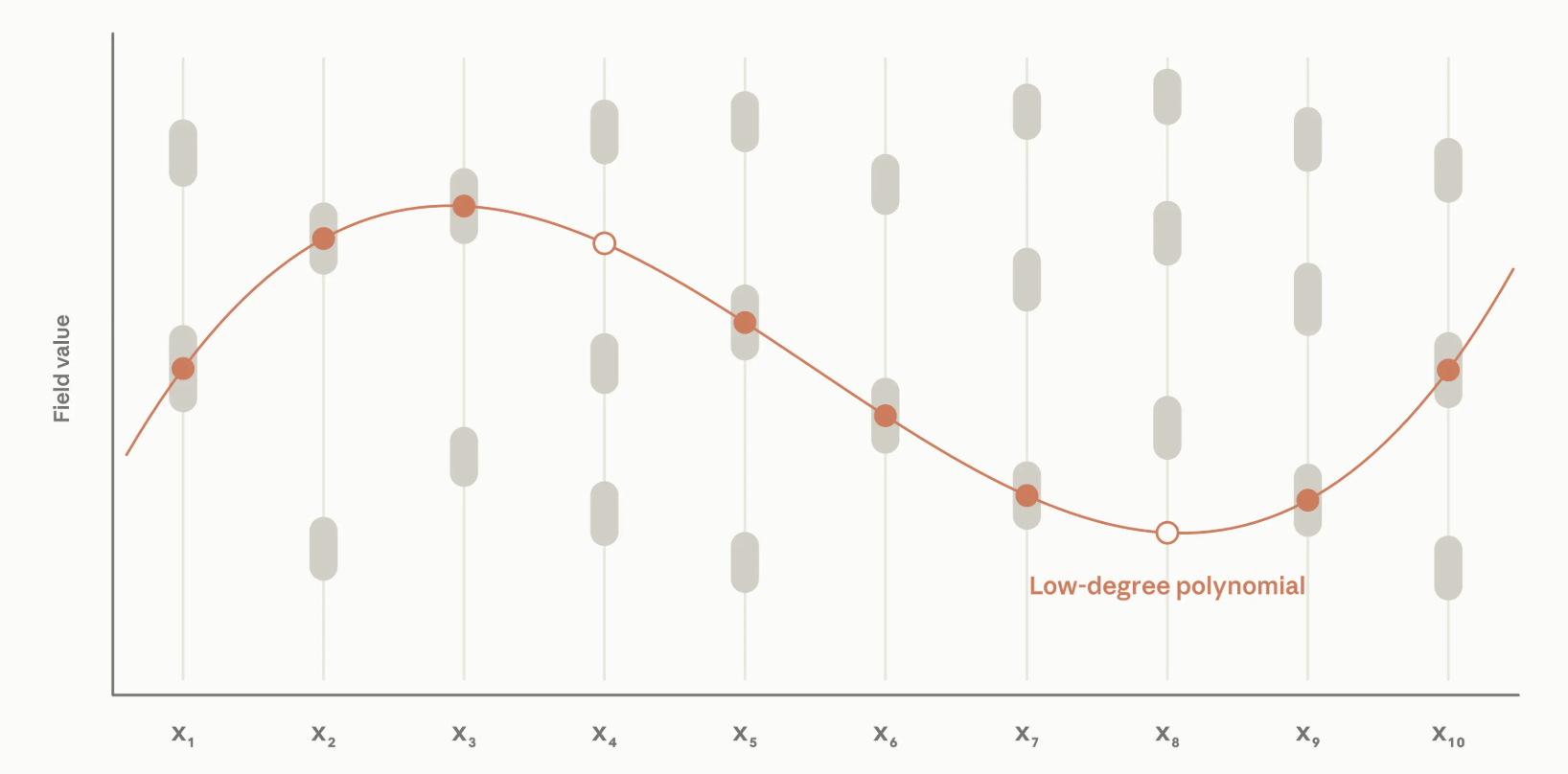
The study identifies integrated photonics as a possible route around the control bottleneck. Photonic chips can guide, switch and modulate light through small structures fabricated on a common platform. They could replace some large free-space optical setups with repeatable devices containing thousands of control channels.
The researchers write that future control systems must address between 10,000 and 100,000 qubits while supporting fast, local and parallel operations. Several photonic materials can operate at the visible and near-infrared wavelengths used to trap and control neutral atoms, although connecting these chips to full atomic processors remains an ongoing engineering task.
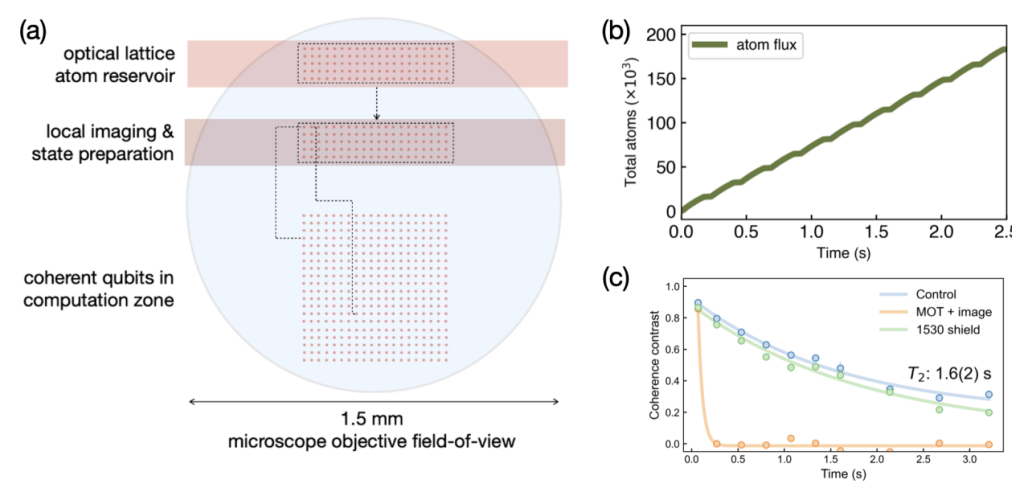
Atom loss presents another challenge. Atoms can disappear from the array because of imperfect gates, limits in the vacuum system or measurements performed during a calculation.
Loss may be manageable in short experiments, but becomes more serious when a fault-tolerant algorithm must run for millions or billions of operations. The roadmap therefore treats continuous reloading as a central requirement. Replacement atoms would need to be prepared and moved into empty locations without disrupting the calculation.
Readout also must become faster and less destructive. Conventional measurements can take much longer than quantum gates and may heat or remove atoms. Long fault-tolerant calculations will require frequent measurements so the system can detect errors and decide how to respond.
Software must operate on similar time scales, requiring compilers to schedule gates, atom movements, measurements and corrective actions while accounting for limits in the physical processor. Real-time controllers will need to react to atom loss and error information quickly enough to keep the calculation running.
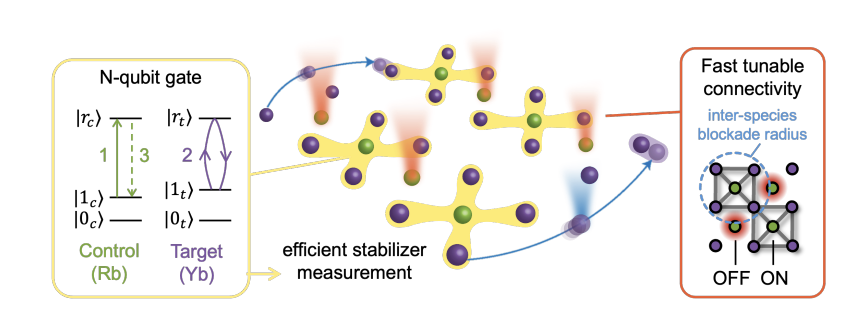
The roadmap also considers connecting multiple neutral-atom processors rather than placing every qubit in one machine. Quantum links could distribute entanglement between modules, allowing separate processors to operate as parts of a larger system.
Possible methods include converting atomic quantum information into photons that travel between devices or physically moving arrays of atoms between nearby processing zones. The study describes modular architectures in which transportable atom arrays carry quantum information between static sections within the same vacuum system.
Networking could ease some limits on the size and optical complexity of a single processor. It would also introduce new sources of loss and error. Remote entanglement must be generated quickly and with high fidelity, and the network must work with error-correcting codes and compiler systems.
Important to note that the study is a strategic plan rather than a report of one new experiment. It combines published results, theoretical resource estimates and proposed engineering directions. Many of its timelines depend on continued improvement in areas that have not yet been demonstrated together in a single machine.
The paper is also a preprint and had not undergone formal journal peer review when posted to arXiv.
The research team included scientists from: the Massachusetts Institute of Technology; Harvard University; the Joint Center for Quantum Information and Computer Science at NIST and the University of Maryland; the Weizmann Institute of Science; the University of California, Los Angeles; the University of Wisconsin-Madison; the University of California, Santa Barbara; Université Paris-Saclay, Institut d’Optique Graduate School and the CNRS Laboratoire Charles Fabry; the University of Waterloo’s Institute for Quantum Computing; the University of Massachusetts Boston; the University of Illinois Urbana-Champaign; the University of Chicago; PASQAL; Northeastern University; the University of Colorado Boulder; Nanofiber Quantum Technologies, or NanoQT; the Simons Institute for the Theory of Computing at the University of California, Berkeley; ETH Zurich; Cornell University; Yale University; the University of Washington; Infleqtion; QuEra Computing UK; Harvard’s John A. Paulson School of Engineering and Applied Sciences; Stanford University; Purdue University’s Elmore Family School of Electrical and Computer Engineering; Ludwig Maximilian University of Munich; the Max Planck Institute of Quantum Optics; and planqc. QuEra Computing was also represented through one researcher’s current affiliation.



.png)