

Insider Brief
- Google researchers demonstrated an AI system that continuously learns from quantum error-correction data to keep a quantum computer calibrated while it is running, reducing interruptions and improving reliability.
- The reinforcement learning approach reduced logical error rates by about 20% beyond conventional calibration and made performance 3.5 times more stable under artificially introduced hardware drift on Google’s Willow quantum processor.
- The researchers say the technique could help future fault-tolerant quantum computers operate autonomously for much longer periods by continuously adapting to changing hardware conditions.
A Google-led research team has demonstrated a quantum computer that continuously learns from its own errors while it is running, replacing one of the biggest operational bottlenecks in quantum computing with an artificial intelligence system that adapts as conditions change.
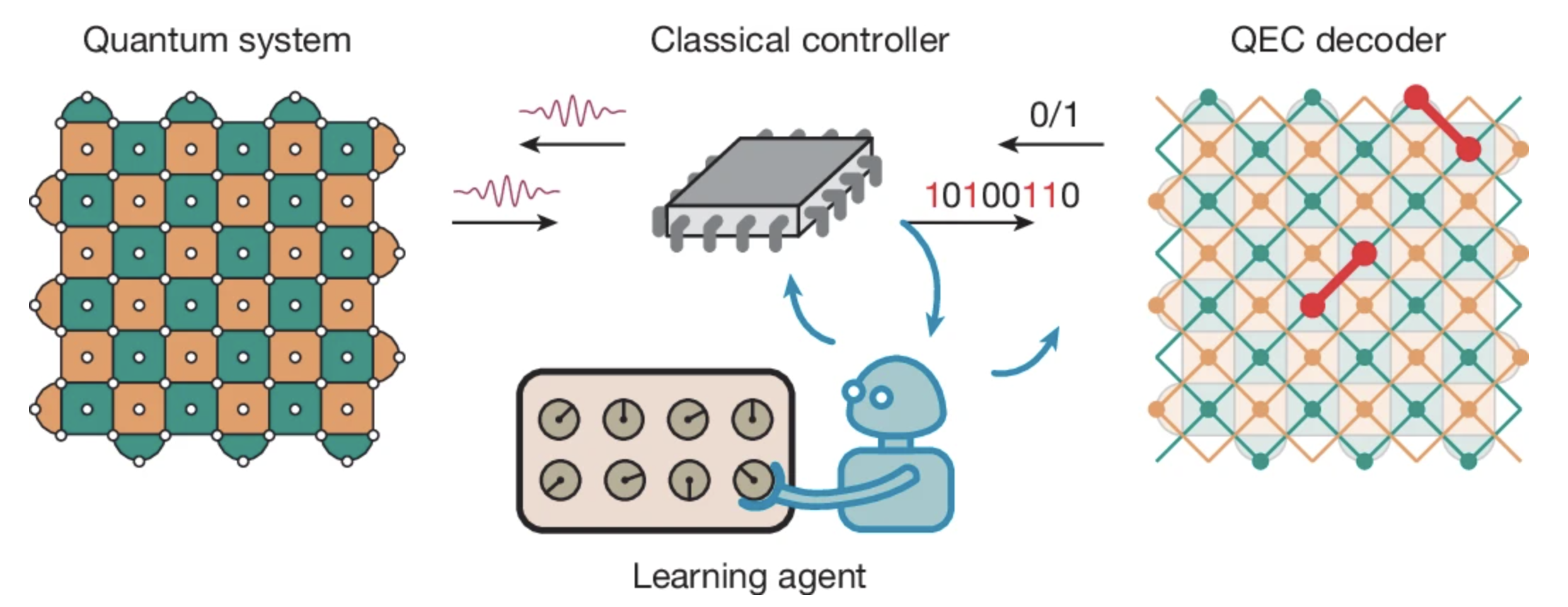
The study, published in Nature, describes a reinforcement learning system that uses the stream of error-correction data already generated during quantum computation to continually adjust the processor’s operating parameters. Rather than stopping a computation for periodic recalibration—a common requirement in today’s experimental quantum systems—the approach enables the processor to improve its own performance while continuing to execute quantum error correction.
The researchers demonstrated the technique on Google’s Willow superconducting quantum processor, where it made logical error rates 3.5 times more stable under artificially introduced hardware drift and cut them by about 20% beyond the performance achieved through conventional calibration and expert tuning. Lower logical error rates are important because they allow encoded quantum information to remain reliable for longer time periods.

According to the study, the work also establishes new benchmark performance for both surface-code and color-code quantum error correction on superconducting hardware.
The findings address one of the less visible but increasingly important engineering challenges facing large-scale quantum computers. Although much attention has focused on increasing qubit counts and reducing hardware errors, future fault-tolerant quantum computers will also need to remain precisely calibrated over computations that could last days or even months. Maintaining that stability without interrupting computation has remained an unsolved problem.
Replacing Periodic Calibration With Continuous Learning
Quantum computers rely on precise control of individual qubits using microwave pulses and other analog signals. Small environmental changes, fluctuations in electronics or materials, and gradual hardware drift can alter how those signals behave over time, increasing error rates.
Today’s systems typically address that problem by stopping quantum computations and recalibrating the processor before continuing. According to the researchers, that approach becomes impractical as useful quantum algorithms become longer and more complex.
Instead of separating calibration from computation, the new framework combines them.
The researchers repurposed the same error-detection events already produced during quantum error correction as feedback for a reinforcement learning agent. Reinforcement learning is a branch of artificial intelligence in which software learns through repeated interaction with an environment, improving its decisions based on feedback rather than explicit programming.
In this case, every detected quantum error becomes a lesson.
As the quantum computer performs error correction, the AI system analyzes patterns in those detection events and gradually adjusts more than 1,000 control parameters governing microwave pulse amplitudes, frequencies, coupling strengths and other hardware settings.
The result is a system that continuously adapts as operating conditions change rather than relying on fixed calibration settings established before a computation begins.
The researchers describe the concept as giving quantum error correction a dual role. In addition to protecting quantum information, the error signals themselves become the training data that teach the system how to improve its own operation.
That introduces what could be viewed as a limited form of self-improvement. The processor does not develop new algorithms or redesign itself, but it continually learns from its own performance and updates its controls without human intervention during computation.
Learning While Computing
The experiments were conducted on Google’s Willow superconducting processor using both distance-5 and distance-7 surface codes as well as a distance-5 color code, all of which are leading approaches for quantum error correction. Surface codes and color codes are two leading quantum error-correction designs, and a higher distance means stronger protection against errors using more qubits.
Quantum error correction works by encoding information across many physical qubits so that errors can be detected and corrected before they accumulate. Instead of measuring the quantum information directly—which would destroy it—the system repeatedly measures auxiliary qubits that reveal whether an error has occurred.
Those measurements create streams of binary error-detection events.
Traditionally, those signals have served only to allow software decoders to identify and correct likely errors in the encoded quantum information. The new work extracts additional value from the same data.
Rather than requiring separate calibration experiments, the reinforcement learning system continuously analyzes the error-detection statistics to determine whether small adjustments to hardware controls improve or worsen overall performance.
The researchers intentionally introduced tiny variations across thousands of control parameters while the quantum processor operated. By observing how those changes affected error-detection rates, the reinforcement learning system gradually identified better operating points.
The process resembles how recommendation systems or robotics algorithms improve through trial and feedback, although the optimization target here is the stability of a quantum processor rather than user preferences or physical movement.
Because the learning process operates during quantum error correction itself, calibration no longer requires interrupting the computation.
The study suggests that this distinction could become increasingly important as quantum computers transition from laboratory demonstrations toward practical fault-tolerant systems capable of running long scientific and industrial workloads.
Conventional quantum calibration relies heavily on carefully designed experiments targeting individual hardware parameters.
Engineers typically calibrate microwave frequencies, pulse amplitudes, gate timings and other settings separately using specialized measurements that exploit detailed physical models of the hardware.
That approach has enabled rapid improvements across the industry and underpins many recent advances in quantum computing. However, according to the researchers, increasingly complex processors may eventually exceed what model-based calibration alone can efficiently manage.
As physical error rates continue falling, remaining performance limitations are likely to arise from many small interacting effects that become difficult to isolate individually.
The reinforcement learning framework instead performs what the researchers describe as holistic optimization.
Rather than targeting one parameter at a time, it adjusts thousands simultaneously using overall system performance as guidance.
The study reports that even after exhaustive conventional calibration and expert tuning, reinforcement learning consistently reduced logical error rates by approximately 20%.
The researchers also tested a more demanding scenario by deliberately introducing artificial drift into several control parameters simultaneously.
Without adaptation, logical error rates steadily worsened as calibration became outdated. With reinforcement learning active, however, the system continuously tracked those changes and maintained substantially better performance.
The researchers report a 24% reduction in logical error rate under injected drift and a 2.4-fold improvement in logical stability. When decoder parameters were adapted alongside hardware controls, those figures improved further to a 31% reduction in logical error rate and a 3.5-fold improvement in stability.
The work also analyzed naturally occurring hardware drift arising from sources including material defects and temperature fluctuations within control electronics.
According to the study, reinforcement learning reduced low-frequency performance fluctuations caused by those effects as well.
Toward Autonomous Quantum Operation
Although the experiments focused on today’s processors, the researchers devoted considerable attention to future scalability.
Managing calibration becomes increasingly difficult as quantum computers grow. The Willow experiments involved more than 1,000 control parameters, however, future fault-tolerant processors may require tens of thousands or eventually millions of adjustable settings.
To address that challenge, the team performed numerical simulations extending to distance-15 surface codes involving roughly 40,000 control parameters.
According to the study, the reinforcement learning framework maintained optimization speed largely independent of overall system size because it exploits the local structure of quantum error correction. Individual hardware parameters primarily influence nearby error-detection events rather than the entire processor, allowing the optimization problem to remain manageable as systems expand.
The researchers also simulated quantum computations running continuously while reinforcement learning remained active.
Those simulations suggest the approach could balance exploration — trying new parameter settings — with maintaining reliable computation, provided hardware drift occurs slowly enough.
The researchers report that this eliminates the resource overhead associated with several previously proposed approaches for combining calibration and computation.
More broadly, the study points toward increasingly autonomous quantum hardware.
Today’s quantum processors require extensive engineering oversight, with researchers frequently recalibrating devices as conditions evolve. The reinforcement learning framework, then, shifts some of that responsibility from human operators to software that continually adapts in the background.
Although narrow in scope, the capability represents a form of machine learning embedded directly into the operation of the quantum computer itself. Rather than treating calibration as an external maintenance task, the processor effectively uses its own error-correction data to teach itself how to remain better calibrated over time.
Challenges and Future Work
The work does not eliminate quantum errors, nor does it demonstrate a fully fault-tolerant quantum computer capable of solving commercially important problems.
Instead, it addresses one enabling technology that could become essential as larger quantum computers emerge.
Practical fault-tolerant quantum computing depends not only on improving qubit quality but also on maintaining that quality throughout long computations. A processor that must stop frequently for recalibration could struggle to execute algorithms expected to run for extended periods. The reinforcement learning approach offers one possible solution.
The researchers also acknowledge important limitations.
The present implementation learns by deliberately exploring different hardware settings. During future single-shot quantum algorithms running continuously for long periods, that exploration must be balanced carefully so experimental adjustments do not themselves degrade computation.
Some forms of rapid hardware drift also occur faster than the learning system can currently respond, meaning improvements to the underlying hardware will remain necessary.
In addition, the study relies on proprietary Google software, although the authors provide a mathematical description of the learning framework intended to support independent replication.
The framework itself is also broadly applicable beyond Google’s superconducting hardware.
According to the researchers, the method requires only error-detection signals and adjustable control parameters. As a result, they indicate that it could be applied to other quantum computing modalities and quantum error-correction architectures as the field progresses toward larger fault-tolerant systems.
The researchers conclude that future improvements could incorporate more sophisticated neural networks capable of learning richer system models and discovering additional relationships within error-correction data. They also suggest that reinforcement learning could eventually perform much of the calibration process from the outset, reducing dependence on traditional calibration techniques and manual tuning.