

Insider Brief
- IBM and the U.S. Department of Commerce announced plans to launch Anderon, a standalone U.S.-based quantum chip foundry backed by up to $1 billion in CHIPS incentives and a matching $1 billion investment from IBM to expand domestic quantum manufacturing capacity.
- The proposed Albany, New York facility would operate as a 300-millimeter quantum wafer foundry serving multiple quantum hardware vendors, initially focusing on superconducting qubit wafers and related electronics before expanding into other quantum technologies.
- IBM said the initiative is intended to strengthen U.S. leadership in quantum computing, support national security and economic competitiveness, and accelerate development of scalable, fault-tolerant quantum systems targeted for commercial deployment by 2029.
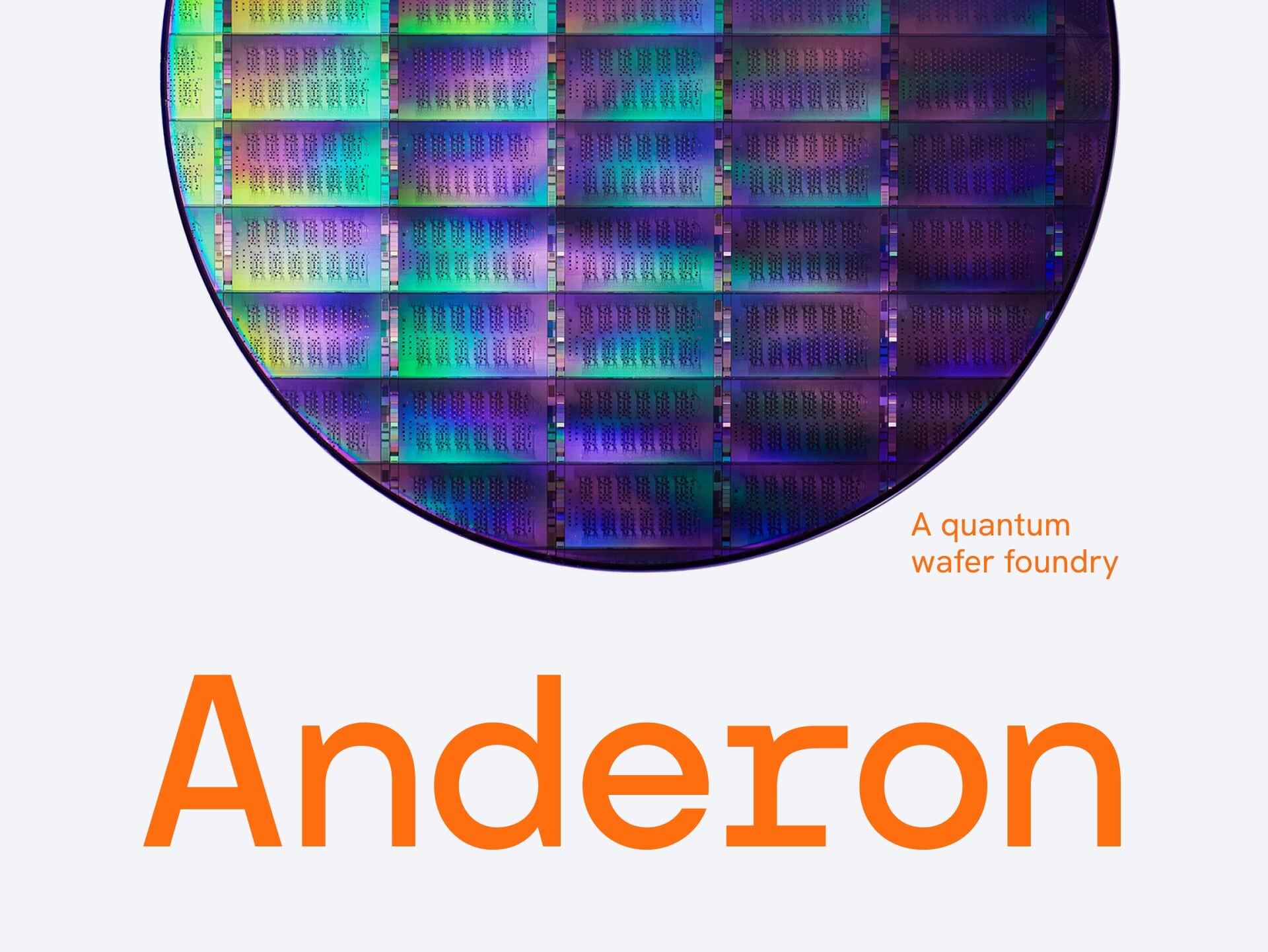
- The logo of Anderon, a new standalone IBM company, and quantum wafer. (IBM)
PRESS RELEASE — Today, IBM (NYSE: IBM) and the U.S. Department of Commerce (DoC) announced a Letter of Intent (LOI) to build an American quantum chip foundry, securing the nation’s global quantum leadership and fueling the country’s growing quantum ecosystem. The CHIPS incentive from the DoC will support the research and development efforts of a new IBM company: Anderon, which will be America’s first pure-play quantum foundry. This initiative represents one of the most significant commitments by the U.S. Government to date in quantum R&D to position the United States to manufacture most of the world’s quantum wafers.
In addition to the $1 billion in CHIPS incentives provided by the DoC, IBM will contribute $1 billion of cash into Anderon, along with IBM investing significant intellectual property, assets, and a skilled workforce, with additional investors expected as Anderon grows. Headquartered in Albany, New York as a standalone company, Anderon will operate as a state-of-the-art 300-millimeter quantum wafer foundry. It will help the nation solidify its leadership at the center of a thriving new quantum industry that is estimated to generate up to $850 billion in economic value by 2040(1) and spur American economic growth while also bolstering national security.
IBM’s mission to bring market-leading quantum computing to the world remains unchanged. The LOI with the DoC reflects IBM’s global leadership in quantum computing and world-class wafer fabrication expertise. IBM has already developed and tested scalable quantum wafer technology, offering a clear pathway to commercialization. As a pure-play quantum foundry, Anderon plans to tap IBM’s strength in building and deploying quantum computers to offer wafer fabrication for multiple quantum technology vendors across the world.

“With today’s CHIPS Research and Development investments in quantum computing, the Trump administration is leading the world into a new era of American innovation,” said Secretary of Commerce Howard Lutnick. “These strategic quantum technology investments will build on our domestic industry, creating thousands of high-paying American jobs while advancing American quantum capabilities.”
“The Department of Commerce’s incentives strengthen and accelerate U.S. quantum leadership and technological resilience,” said Bill Frauenhofer, Executive Director of Semiconductor Investment and Innovation. “Quantum computing has significant implications for national defense, advanced materials and biopharmaceutical discovery, financial modeling and energy systems.”
“IBM has pioneered quantum computing for decades. Our work in silicon wafer fabrication has been a key to IBM’s success and will be critical to enable a broader quantum technology landscape that will reshape global innovation and economic competitiveness,” said Arvind Krishna, Chairman and CEO of IBM. “With the support of the U.S. Department of Commerce, Anderon will be well-positioned to fuel America’s fast-growing quantum technology industry.”
IBM plans to use its expertise in fabrication tools and specialized talent to help Anderon build a secure, U.S.-based supply of quantum wafers for multiple hardware vendors. Anderon will first support wafer fabrication for superconducting qubit and supporting electronics wafers, with the goal to expand into other quantum modalities.
From the start, Anderon will be prepared to serve as the anchor for a national ecosystem for quantum wafer manufacturing, ensuring IBM and other quantum companies have the ability to catalyze the production of scalable quantum technologies within the United States.
Anderon’s forthcoming leading-edge 300mm wafer processes expect to offer the most advanced quantum wafer technologies, including superconducting wiring, through-silicon vias and bumps, and is backed by established production capabilities such as dedicated process design kits, in-line wafer testing and characterization, and established baseline routes that enable rapid iteration and reliable scalability.
Betting Big on America’s Quantum Future
Quantum computing is a completely new paradigm of computing, poised to solve complex problems far beyond the reach of today’s classical supercomputers and enable breakthroughs in materials science, chemistry, optimization, and cybersecurity, among others.
Fueled by IBM, the United States leads the development of this technology. It remains critical to accelerate this momentum and set the pace for quantum hardware development in order to meet the needs of a thriving ecosystem and to maintain global economic competitiveness and national security for decades to come.
To date, IBM has deployed over 90 quantum systems, including more quantum computers than reported by all other industry players across the globe combined. The company has built a global client and partner ecosystem spanning more than 325 Fortune 500 companies, startups, universities, and government agencies already using IBM’s global fleet of quantum computers to tackle scientific challenges across chemistry, biology, materials science, and more.
IBM has collaborated for decades with federal agencies, including NIST, DARPA, and U.S. Department of Energy laboratories, positioning the company at the center of operationalizing a secure U.S. quantum manufacturing capability and to lead the push to deliver the world’s first large-scale, fault-tolerant quantum computer by 2029 for commercial clients.
The launch of Anderon is subject to the negotiation and execution of definitive documents by IBM and U.S. Department of Commerce in accordance with the letter of intent agreed among the parties as of the date hereof.
For more information, visit www.anderon.com.





.png)