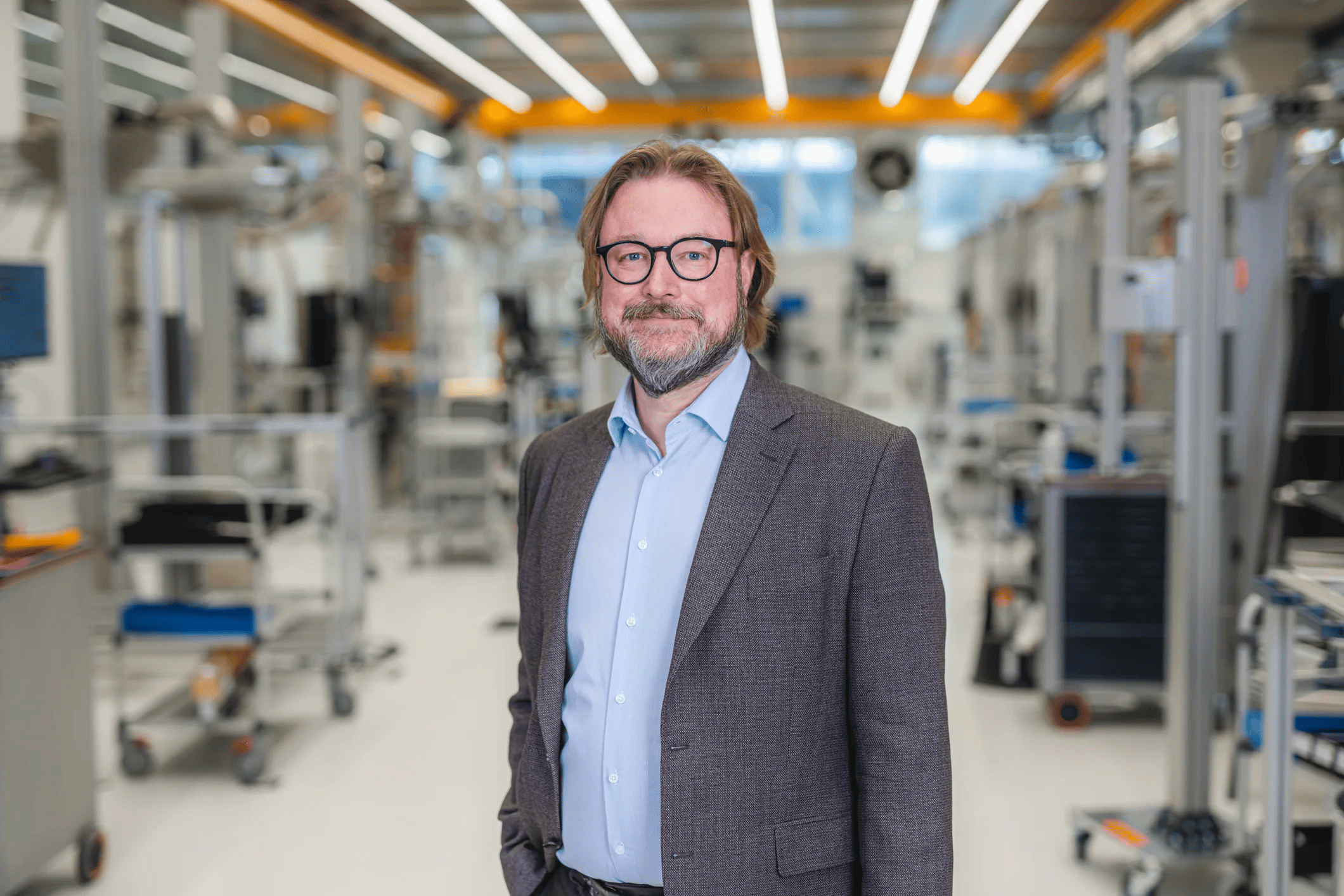


Guest Post by Dr. David Gunnarsson
After more than four decades of development, quantum computing is on the brink of its public and business breakthrough. We also see an increase in public interest, with quantum computing discussed across society. While many call for scale in manufacturing and progress in innovation, there is one big obstacle to rapid quantum development: it needs clear business cases. Today, technical feasibility has been largely demonstrated, and companies are steadily scaling their systems, needed cryogenics can handle demand, and the supply chains are in a solid place. Yet the field is missing one critical trigger: a clearly defined, commercially viable use case: “quantum’s ChatGPT moment”, a single, unignorable demonstration of business value that forces everyone to pay attention. When this happens, the technology won’t need years to catch up, it will be ready from day one.
Over the past forty years, quantum computing has evolved from theory to the deployment of several hundred systems worldwide. The underlying hardware, once experimental, is now technically more robust. Cryogenic systems, which are essential for cooling most quantum modalities, can already support systems with thousands of qubits. Production lines are active. Supply chains are stable. I know from experience that the building blocks are in place. In practice, the infrastructure is no longer waiting for the science.
What’s eye-opening is that this situation mirrors the state of artificial intelligence just before its public explosion. For years, AI researchers had the models, the hardware, and the data, but no application that resonated “beyond the lab”. Then came ChatGPT, a moment so grand and visible that it reframed an entire field overnight. Quantum computing is waiting for the same kind of revelatory moment.

Quantum ecosystem is ready to scale when the business cases call.
Within the quantum community, the conversation too often centres on qubit numbers, coherence times, or price per qubit. These are essential metrics for scientists and engineers, but the other side of the equation is the business value per computation. This equation has yet to be resolved in quantum computing’s favour, and it is the missing piece for large quantum investments to happen.
Many quantum computing players are making serious efforts to develop algorithms and business use cases, using their hardware to test and shape real-world applications for users. HSBC has used quantum techniques to predict bond values 34 percent more accurately. Monte Carlo integration, which are vital for financial, economic, and risk modeling, are potentially running faster on quantum systems. These results are meaningful, but still not yet transformational. They haven’t yet shifted quantum computing from a future investment to an absolute operational necessity.
So while the technical community debates logical versus physical qubits, or argues whether 1,000 qubits equal one logical qubit, the bigger fact still remains: the hardware, supply chains and ecosystems are ready to grow faster than the business case demands. And the shift is underway: from building the technology to actively testing and shaping applications with end users.
Cryogenics isn’t one of the bottlenecks for quantum breakthroughs
In many ways, cryogenics illustrates just how far ahead the enabling technologies already are. Despite certain industry perceptions, cryogenics is not currently limiting quantum’s expansion. They can sustain massive system loads, maintain stability at millikelvin temperatures, and integrate with increasingly complex quantum payloads. Even as the number of qubits rises, cost baselines remain stable after inflation adjustments. Cryogenics, the ultra-low-temperature technology that enables many quantum systems, is already scaling beyond current market demand. In fact, capacity is underused, with suppliers ready to scale production. The technical challenges that remain, for example, signal conditioning, heat management, and integration, are now questions of optimization and incremental improvement, not feasibility. The cryogenics field has even begun tailoring systems to specific quantum modalities, creating custom interfaces that align with unique qubit architectures. That level of flexibility shows that the bottleneck isn’t technical or physical.
While the availability of helium-3, non-abundant on earth and critical for the development and operation of quantum computers, has raised discussions about potential future supply constraints, the cryogenics industry is already adapting through innovation. Ongoing cryogenics developments, such as efficient helium-3 recycling and sourcing helium-3 from the moon, are ensuring that supply will not become a limiting factor for the growth of quantum computing. This is an area where many quantum providers are now focusing: advancing applications together with potential users and ensuring that cryogenics can scale alongside quantum technologies.
If there’s a slowdown ahead, it won’t be caused by cryogenics or manufacturing limits: the ecosystem is already prepared to meet high-volume demand.
Competing quantum technologies keep innovation going
Part of the delay comes from the diversity of the technology field itself. Different quantum modalities offer different advantages. Neutral atom systems, for instance, can scale easily into thousands of qubits, but their operation speeds are roughly a thousand times slower than superconducting systems. Superconducting and spin qubits, on the other hand, offer faster operation but require more complex cryogenics and tighter error correction. Each of these modalities serves a different vision of what quantum is for, and that diversity, while scientifically productive, slows the emergence of a unified business cases.
But this is not a weakness; it’s an inevitable phase in any emerging industry. Competing technologies keep innovation going. But it also means that, from an outside perspective, quantum still looks like a field in search of a “when.” AI only took off like a rocket when the public could see it in action.
Quantum’s “big moment” will be economic, not technical
As said, quantum’s big moment, where the world suddenly recognises its economic and societal value, has yet to happen. Quantum’s ChatGPT moment won’t come from the next qubit milestone number. The next chapter of quantum won’t be led by labs: it will be led by bold businesses focusing on concrete business breakthroughs. Whether that will be a financial institution cutting risk forecasting time from days to seconds, a pharmaceutical company reducing drug discovery cycles radically, or a logistics network optimizing in real time beyond classical computing limits. The next major breakthrough won’t just be technical, it will be business-centric. When that happens, scaling will follow instantly, and the good news is that the technology and ecosystem is ready.
Dr. David Gunnarsson
Chief Business Development Officer, Bluefors