



Insider Brief
- AQT announced that its LYNX quantum computer achieved a Quantum Volume of 32768, the highest reported benchmark in Europe.
- The trapped-ion system improves on AQT’s earlier IBEX architecture with enhanced gate implementation and all-to-all qubit connectivity.
- The benchmark reflects improvements in qubit quality, connectivity, and circuit execution performance on commercially available hardware.
PRESS RELEASE — The Quantum Volume (QV) test is an internationally applied benchmark originally proposed by IBM. The benchmark rigorously assesses and describes the computational power of a quantum computer with a single number. The QV metric describes how many “good” qubits a quantum information processor contains. In the procedure, random quantum circuits (according to the QV test protocol) are executed on an increasing number of qubits until the result is close to the ideally expected outcome. If the success probability of at least 100 different random circuits exceeds a certain threshold, the QV test is passed.
Since the circuit size increases with the qubit number, the quality of the quantum operations also needs to increase in order to successfully pass the test. Hence, the higher the QV benchmark value, the more powerful the computer. The number is sensitive to many important aspects of a quantum computer, such as the number of qubits, the connectivity of the qubits, the quality of the quantum state preparation and measurement operations and the quality of the quantum gates. Because the Quantum Volume Test is agnostic of the underlying hardware and it tests hardware capabilities that is required for the successful implementation of a large class of quantum circuits, it can provide a strong statement about the computational power of any quantum information processor.
AQT’s Next Generation Quantum Computer LYNX
The AQT LYNX system is a new prototype of AQT’s quantum computers and it is an evolution of the successful AQT IBEX series. Building on several improvements in operation and patented quantum gate implementation, the achieved QV on the new system is increased by a factor 256x. As of today, the AQT LYNX system holds a record quantum volume of 2^15=32768 within Europe. Increasing performance on commercially available systems is critical for development and research, as well as for realizing the pathway towards large quantum computing systems and quantum advantage. This achievement marks a new milestone in the European quantum computing technologies, building on the previous record that was also held by AQT.

To the best of our knowledge, AQT is now the company with second highest QV benchmarking result worldwide. Furthermore, the AQT LYNX architecture offers a virtually infinite range qubit interaction and thus an arbitrary all-to-all qubit connectivity. There is no need for time-consuming reconfiguration or SWAP operations, which leads to unprecedented execution times of complex quantum circuits.
This achievement further reinforces our alignment with the European Quantum Technology roadmap and demonstrates the innovative potential of European deep-tech ecosystem. Supported by the European Commission’s Quantum Technology Flagship, the European Innovation Council, and Austrian FFG and AWS, AQT is making this system available to provide tangible value for its customers and partners.
Details on the Quantum Volume Test
We run 305 random quantum volume test circuits with 100 shots each on the AQT LYNX system. The test resulted in a mean Heavy Output Probability (HOP) of 0.678 with a 2σ lower limit of 0.670 that was estimated via bootstrapping. Thus, the measured HOP is above the required threshold of HOP=0.678>2/3 with a 99.5% confidence level. The tests are performed using a 15 qubit register and the total execution time for the 305 circuits with 100 shots each, including classical control overhead and overhead induced by auto-calibration routines during the execution time was around 173 minutes. This results in a clock speed of QVCPS(15)~2.9 (Quantum Volume Circuits Per Second using 15 qubits). The implemented circuits were generated using IBM Qiskit (https://qiskit.org/). The random circuits were further optimized using methods described in a publication by Quantinuum (https://quantum-journal.org/papers/q-2022-05-09-707), which include block combination, block approximation, mirroring and arbitrary angles for entangling gates.
Figure 1: Measured Heavy Output Probabilities
For the Quantum Volume Test to be successful, the Heavy Output Probability (HOP) must be above the specified threshold of 2/3. The data shows that the mean HOP is above this threshold and the associated uncertainty decreases as the number of random circuits increases. The HOP exceeds the threshold by more than two standard deviations (2 sigma), which achieves a Quantum Volume of QV=2 ^15=32768.
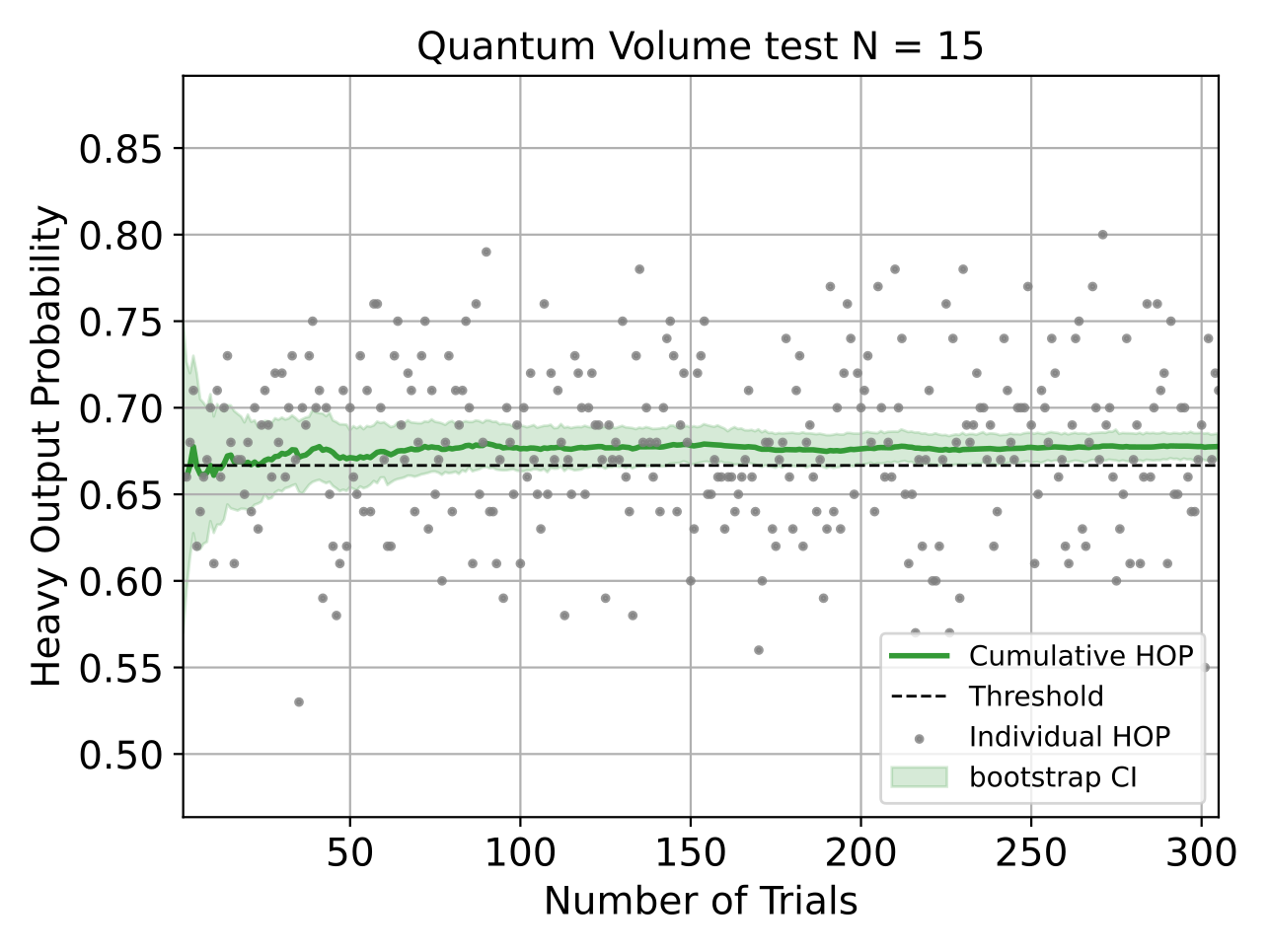
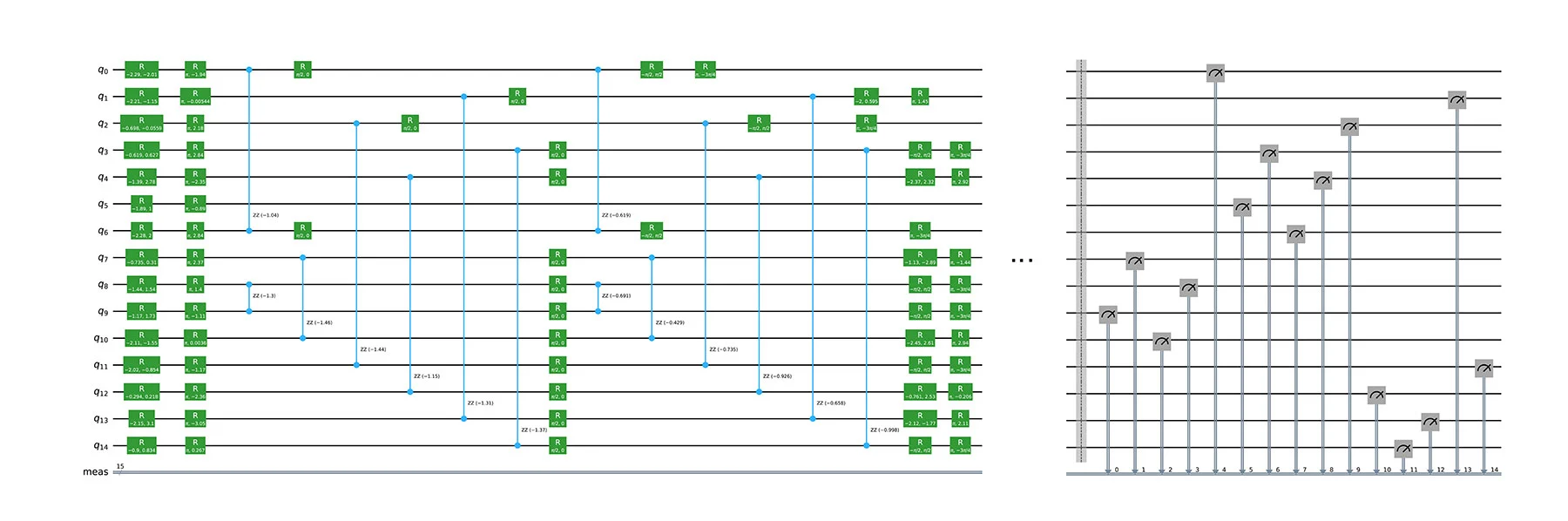
Figure 2: Random Circuit Example
The Quantum Volume Test consists of a series of random quantum circuits. An example of such circuit is depicted here. A random circuit starts with the preparation of the qubits, followed by the implementation of several local single-qubit gates and interleaving two-qubit gates. Finally, the state of the qubits is measured and the result is obtained in the form of a classical bit string. The number of qubits (vertical extent) corresponds to the circuit width and the number of gate realizations (horizontal extent) describes the circuit depth.