

Insider Brief
- Scientists from Cleveland Clinic, RIKEN, and IBM used a quantum-centric supercomputing approach to simulate protein complexes of up to 12,635 atoms, marking the largest biologically relevant molecular simulations performed with quantum hardware to date.
- The team achieved a roughly 40-fold increase in simulation size and up to 210-fold improvement in accuracy within six months by combining quantum processors with classical supercomputers and a new hybrid algorithm.
- The results demonstrate early practical value for quantum computing in drug discovery by improving the ability to model protein–drug interactions, a key challenge in reducing the cost and timeline of developing new medicines.
PRESS RELEASE — Scientists at Cleveland Clinic, RIKEN, and IBM (NYSE: IBM) have used IBM quantum computers and two of the world’s most powerful supercomputers to simulate protein complexes spanning up to 12,635 atoms. These are the largest-known simulations of biologically meaningful molecules performed with quantum hardware yet, and signal that quantum computers are maturing into useful scientific tools which can help solve fundamental problems in biology, chemistry, and life sciences.
The results were achieved in part by an innovative algorithm that optimizes how quantum and classical computers can work together, a framework known as quantum-centric supercomputing. Using this approach, the team captured the behavior of two biochemically relevant proteins that are roughly 40 times larger than what this same method could initially achieve just six months ago. Additionally, the accuracy of the simulations in a key step of the workflow improved by up to 210 times over this same period.
The decision to explore if quantum computers could offer value in the simulation of protein complexes was motivated by challenges faced today by researchers when studying how a drug candidate could bind to a protein. This can be one of the most difficult and expensive problems in life sciences research, and one that today’s existing computational methods have struggled to exactly solve as molecules increase in size. Doing so accurately and early in the discovery process could meaningfully shorten drug development timelines that currently can stretch over a decade and require substantial investment to produce a single medicine.

“This work marks an important advance and underscores quantum computing’s emerging role on systems of relevance to drug discovery,” said Kenneth Merz, Ph.D., lead author of the study and staff scientist in Cleveland Clinic’s Computational Life Sciences Department. “By crossing the 12,000-atom barrier, we have significantly expanded the scale of biologically meaningful molecular simulations possible with quantum computing and demonstrated a framework for applying these methods to scientifically relevant problems at a larger scale.”
“For years, quantum computing has been a promise. Now, quantum computers are producing results that matter to science,” said Jay Gambetta, Director of IBM Research and IBM Fellow. “The systems we simulated here are the kind of molecules that biologists and chemists work with in the real world. Quantum computers are no longer proving they are viable tools — they are proving they can contribute meaningful results in quantum-centric supercomputing architectures.”
The breakthrough research, reported in a pre-print study [LINK], builds on a series of milestones from the three institutions. This includes work on the cover of Science Advances that introduced techniques to model electronic states in molecules, first demonstrated on iron sulfides, and more recently, the 303-atom benchmark molecule called Trp-cage – the first-known full quantum-centric simulation made of 20 amino acids.
Quantum and Classical Computers, Working in Tandem
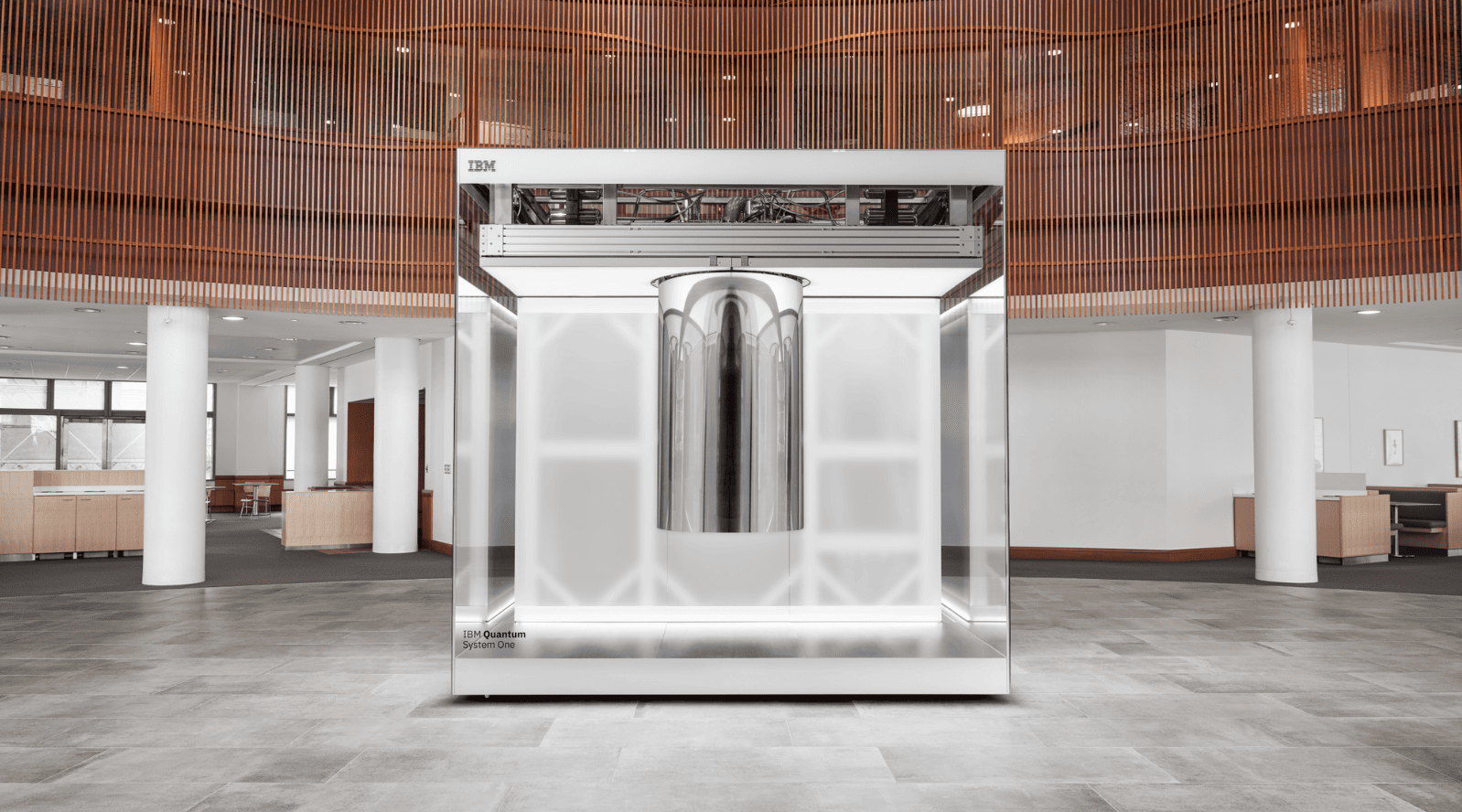
This approach — what IBM calls quantum-centric supercomputing — pairs quantum processors with classical computers so each computational tool can solve the parts of a problem where it excels. In this work, classical computers deconstructed the protein-ligand complexes into computable fragments. IBM’s 156-qubit IBM Quantum Heron processors, running within the IBM quantum computers at both Cleveland Clinic in the United States and RIKEN in Japan, calculated the quantum-mechanical behavior of those pieces in tandem with two of the most powerful classical supercomputers — Fugaku at RIKEN and Miyabi-G, operated by the University of Tokyo and the University of Tsukuba. The strength of IBM’s quantum hardware was essential to the accuracy and success of the computation, which required up to 94 qubits running nearly 6,000 quantum operations within certain parts of the simulation. Results were reassembled on classical computers to obtain a complete representation of the molecule.
As published on arXiv [LINK], the jump in scale was made possible by both algorithmic innovation and access to cutting-edge computing infrastructure. The novel quantum-classical hybrid algorithm, coined EWF-TrimSQD, dramatically reduced computational overhead and accelerated the ability to directly represent the chemistry of these molecular systems on quantum hardware. As a result, the frontier for what is possible with quantum-centric supercomputing has been pushed forward to previously inaccessible molecule sizes, and there is a clear path to further increase the size and accuracy of such calculations.
A Step Towards Drug Discovery
The team views this work as a starting point. Looking ahead, the ability to scale simulations of molecular systems with accuracy is a step towards helping researchers better predict how medicines may interact with protein targets. Computational improvements in drug discovery rest on two fundamental capabilities: first, modeling the movement of atoms as biological processes unfold; and second, accurately computing their energies, for which these results provide evidence that quantum-centric supercomputing can support.
As quantum computers advance, integrating them into computational workflows could offer higher accuracy in energy calculations at larger scales, and potentially open the door to simulating enzyme catalysts, drug mechanisms, and other molecular behaviors that today can only be studied through experimentation.
More broadly, this breakthrough marks a shift in what quantum computing means to science. For most of its history, the field of quantum computation has measured progress in qubits, gates, and error rates. Now, its capabilities can also be measured by the size and significance of the problems it can help to solve.
For more information on this milestone, visit: https://www.ibm.com/quantum/blog/cleveland-clinic-riken-chemistry
Research Support
This research is supported by NEDO (New Energy and Industrial Technology Development Organization), an organization under the jurisdiction of Japan’s Ministry of Economy, Trade and Industry (METI)’s “Research and Development of Quantum-Supercomputers Hybrid Platform for Exploration of Uncharted Computable Capabilities” (Project Leader: Mitsuhisa Sato) as part of the “Project for Research and Development of Enhanced Infrastructures for Post 5G Information and Communications Systems (JPNP20017).”