


Insider Brief
- IBM’s decision in 2016 to put a quantum computer on the cloud expanded access to real hardware and helped turn quantum computing into a global research and early-stage commercial ecosystem.
- Cloud access enabled students, startups, and enterprises to run experiments on real quantum systems, accelerating innovation and supporting the emergence of a quantum software and applications layer.
- Over the past decade, IBM’s systems have scaled from five-qubit devices to machines with more than 100 qubits, alongside advances in error rates, software tools, and a growing base of experienced users.
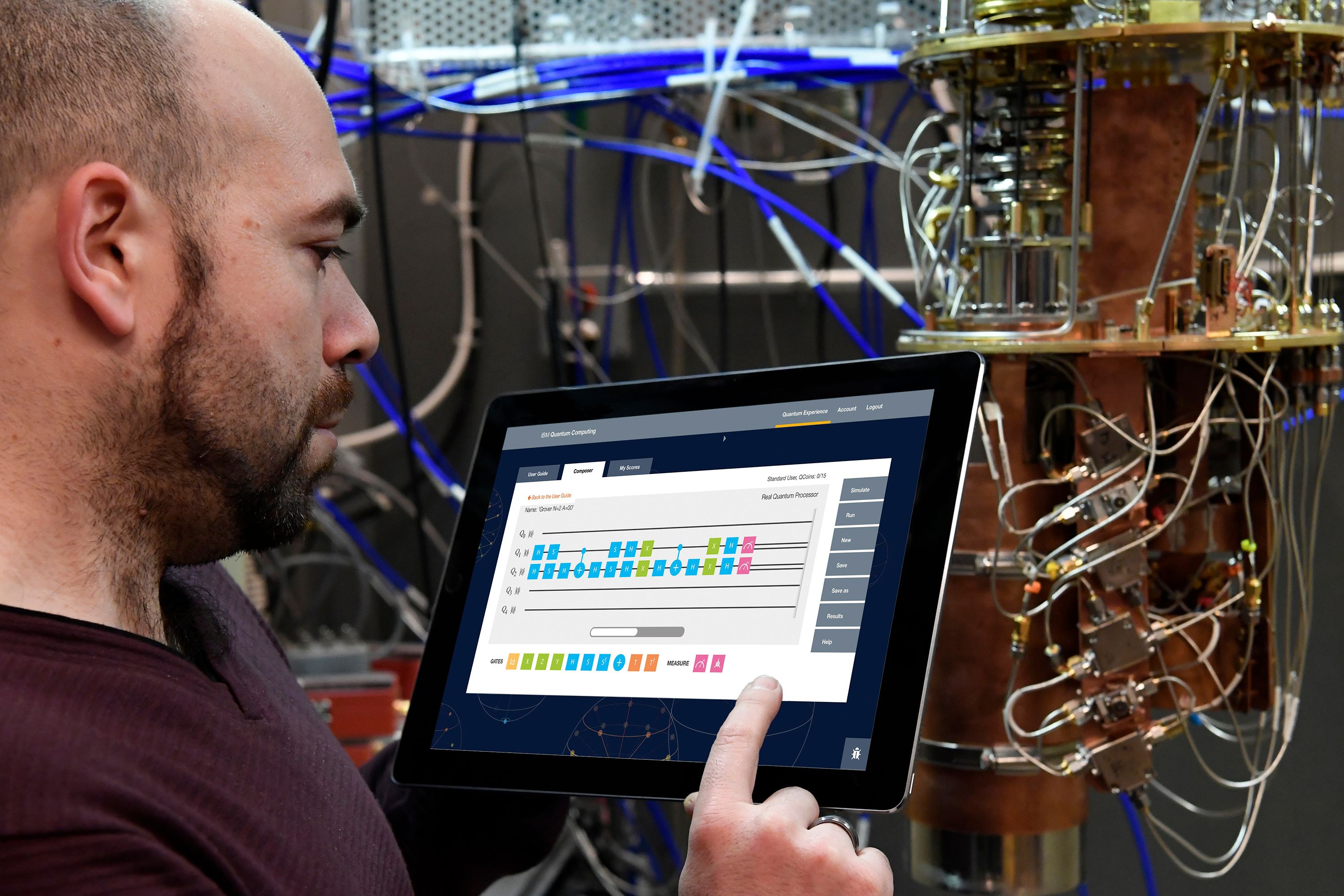
- Image: IBM Head of Quantum + HPC and Principal Research Scientist Antonio Corcoles uses the newly debuted IBM Quantum Experience on a tablet in the IBM Quantum Lab while standing next to a dilution refrigerator, 2016. (Jon Simon/Feature Photo Service for IBM)
IBM’s decision to put a quantum computer on the cloud 10 years ago helped transform a niche research field into a globally accessible computing platform with growing industrial use.
On May 4, 2016, IBM made its first quantum processor available over the internet, allowing users to run experiments on real quantum hardware for the first time. A decade later, that move is widely viewed by researchers and industry participants as a turning point that expanded access, accelerated development, and helped establish the foundations of today’s quantum computing ecosystem, according to a company blog post on the anniversary.
The anniversary comes as IBM opens its annual Think conference, where clients and partners are reflecting on how early cloud access shaped the field’s trajectory. At the time, quantum computers were largely confined to specialized labs. Making one available online lowered barriers to entry and enabled students, startups and corporations to test algorithms on physical machines rather than simulations.

Aarly IBM Quantum users include Dr. Álvaro Nodar, Advocate for the Basque Quantum (BasQ) initiative and Quantum Technical Lead at Global Data Quantum, who said his mind was blown using the service.
“The first time I accessed a real quantum device through the cloud was in 2016, during my master’s,” said Nodar. “I remember my professors telling us about its release, and that same afternoon I started running the circuits I had been working on in exercises, projects and exams. It was mind-blowing to take all those pen-and-paper circuits and test them on a real device.”
Democratizing Access
Researchers say the most immediate impact of IBM’s cloud launch was access. Quantum systems, which use qubits instead of classical bits to process information, are expensive and difficult to maintain. Before 2016, only a small number of institutions could work directly with them.
Travis Humble, director of the Quantum Science Center at Oak Ridge National Laboratory, said in the post: “Cloud-based quantum computing established a new paradigm in accessibility for quantum information science experiments. The impact of broad access to real quantum computers on the morale of the community cannot be overstated.”
Over time, access changed expectations, according to IBM. What began as an experiment evolved into a standard tool for research and development, with cloud-based quantum computing becoming a baseline assumption for many in the field.
Helping to Build an Industry
The ripple effects extended beyond academia. Startups and enterprise users began incorporating quantum systems into their workflows, using cloud access to prototype applications and test performance against classical computers.
Executives from companies including Kipu Quantum and Q-CTRL said access to real hardware accelerated innovation and enabled the emergence of a new segment of quantum software businesses.
“Cloud accessible quantum computing has made it possible for a whole new class of software businesses to innovate at speed and help drive the quantum industry forward,” said Michael Biercuk, CEO and Founder of Q‑CTRL, according to the post. “Where previously machine access was only available to machine builders, IBM’s pioneering efforts helped spawn an entirely new segment of the quantum industry.”
Large corporations also expanded their efforts. Boeing, for example, has used quantum systems to run demonstrations and explore potential applications, according to company representatives.
“As advances from IBM and others have pushed the frontier of science and technology, Boeing has been able to mature our capabilities in step,” said Marna Kagele, Technical Fellow and Program Manager at the Boeing Company. “Over the past seven years we’ve run demonstrations that surface new techniques and applications each year. Those demonstrations let us focus on high value use cases with real business impact.”
These developments helped shift quantum computing from a research discipline toward an early-stage industry, with cloud platforms acting as the primary interface between hardware providers and users.
Advancing the Hardware
The underlying technology has advanced significantly over the past decade. IBM’s first cloud-accessible processor had five qubits. The company initially projected systems with up to 100 qubits by 2026.
That benchmark has already been surpassed. Current IBM quantum systems exceed 100 qubits, with the Heron r3 processor reaching 156 qubits and demonstrating lower error rates than earlier devices. IBM has also reported experimental chips with more than 1,100 qubits.
Error rates remain a central challenge. Quantum computations are sensitive to noise, and reducing errors is essential for scaling systems to solve practical problems. Improvements in both hardware and software have contributed to more reliable performance.
Industry participants say progress has not been limited to hardware. Software tools, programming environments, and user interfaces have matured alongside the machines.
Early systems relied on simple graphical tools. Today, developers write code to control quantum circuits, supported by documentation, libraries, and training materials.
Scott Crowder, vice president of adoption at IBM Quantum, said the shift reflects a broader transition from experimentation to structured development.
“What’s changed in a dramatic way is the maturity of the software stack,” said Scott Crowder, Vice President of Adoption at IBM Quantum. “Ten years ago, you dragged and dropped a circuit and hit run. Now, you’re truly programming quantum computers with a few lines of code.”
The result is a more complete technology stack, combining hardware, software, and services into a platform designed for both research and early commercial use.
The Human Dimension
Perhaps the most lasting impact is human capital. Many of the students and researchers who first accessed quantum computers through the cloud have since become founders, engineers, and technical leaders.
That cohort is now shaping the direction of the industry, building companies, developing applications, and contributing to standards and best practices.
The decision to put quantum computing on the cloud did more than launch a platform. It created a global user base and helped define how the technology would be developed and deployed.
“For me, this anniversary is more about the impact on people than on institutions,” Crowder said. “You’ve got organizations like the Unitary Foundation running annual open-source quantum developer surveys. There was no such thing as a quantum developer 10 years ago.”