

Insider Brief
- A new study finds that most quantum catalyst approaches fail under realistic noise, but a “catalytic channel” method can maintain stability and enable reliable operation.
- Researchers show that conventional quantum catalysts degrade even with minimal environmental noise due to unrealistic assumptions about perfect input conditions, limiting their practical use.
- The work also establishes limits on what noise-resilient catalysts can achieve, while identifying thermodynamic scenarios where stable catalytic effects could still support real-world quantum applications.
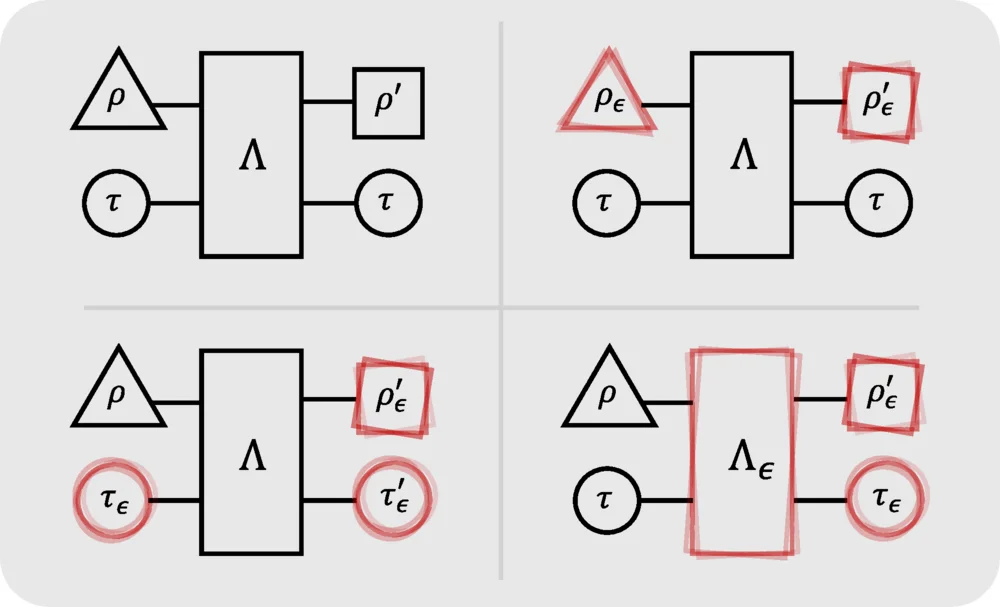
- Image: Illustrations of noisy catalysis (UNIST)
PRESS RELEASE — Quantum catalysts are specialized resources that enable quantum state transformations previously thought impossible, holding promise for advancements in quantum computing and thermodynamics. A recent international study has identified the conditions under which these catalysts can operate reliably even amid environmental noise, marking a significant step toward practical quantum technologies.
Professor Seok Hyung Lie and his research team in the Department of Physics at UNIST, in collaboration with researchers from Nanyang Technological University (NTU) in Singapore, have mathematically demonstrated that most existing quantum catalyst schemes are highly sensitive to even minimal noise, leading to gradual degradation and limiting their reusability. In contrast, they showed that the catalytic channel approach uniquely maintains catalyst stability in real-world, noisy environments.
Quantum catalysts facilitate transformations between states that are otherwise impossible, akin to chemical catalysts that enable reactions without being consumed. They are expected to improve the efficiency of quantum operations and are central to developments in quantum computing and thermodynamics.

However, the study reveals that many theoretical models assume idealized conditions—precise preparation of input states—that are unrealistic outside laboratory settings. Under such assumptions, catalysts tend to deteriorate even with tiny amounts of noise, undermining their potential for repeated use.
To address this challenge, the team proposed the concept of catalytic channels—a quantum operation designed to restore the catalyst to its original state regardless of the input. Unlike conventional catalysts that require perfect state preparation, catalytic channels are inherently robust against small errors, making them more suitable for practical, noisy environments.
Their findings also demonstrated a fundamental no-go result for achieving additional benefits through catalytic channels in the presence of environmental noise. Specifically, they established that for key quantum resources—such as entanglement and coherence—even catalytic channels cannot generate new advantages under noisy conditions. This clearly defines the limits of what noise-resilient catalysis can achieve. Conversely, under certain thermodynamic conditions, stable catalytic effects remain feasible, opening promising avenues for practical applications.
“This work offers a realistic perspective on what quantum catalysts can accomplish in noisy settings,” explains Professor Lie. “It emphasizes the importance of designing structures that are inherently resilient to environmental disturbances—crucial for optimizing quantum circuits and developing microscopic heat engines, such as quantum heat engines, at atomic scales.”
Published in the 2026 February issue of Physical Review Letters, this study was conducted in collaboration with Dr. Nelly H. Y. Ng and Dr. Jeongrak Son at NTU, along with researchers from Aix-Marseille University, France, and Nagoya University, Japan. It was supported by the National Research Foundation of Korea (NRF) and the Institute for Information & Communications Technology Planning & Evaluation (IITP).
Journal Reference
Jeongrak Son, Ray Ganardi, Shintaro Minagawa, et al., “Catalytic Channels Are the Only Noise-Robust Catalytic Processes,” Phys. Rev. Lett., (2026).