

Insider Brief
- QCentroid’s QuantumOps framework integrates with NVIDIA CUDA-Q to provide enterprise teams with GPU-accelerated quantum simulation, experiment lifecycle management, and structured benchmarking capabilities through its Launchpad cloud development environment.
- The platform enables hybrid quantum-classical workflows such as Variational Quantum Eigensolver to be developed on GPU-backed instances with automatic capture of execution metadata, versioned artifacts, and backend-agnostic execution across simulators and physical QPUs.
- The combined approach addresses enterprise adoption bottlenecks including infrastructure provisioning friction, experiment reproducibility, and cross-backend performance comparison for applications such as molecular simulation and materials discovery.
PRESS RELEASE — Hybrid quantum-classical algorithms such as the Variational Quantum Eigensolver (VQE) are fundamentally iterative. A parameterized quantum state is prepared, expectation values are measured, and a classical optimizer updates parameters. This loop continues until convergence. At research scale, this can be executed in a notebook. At enterprise scale, it needs to be a structured experimentation pipeline.
NVIDIA CUDA-Q provides a unified hybrid programming model where quantum kernels and classical optimization routines co-execute within a single program. Through its MLIR → LLVM → QIR compilation stack and backend abstraction layer, CUDA-Q enables developers to write a VQE workflow once and execute it interchangeably on GPU-accelerated simulators or physical QPUs. The hybrid loop is expressed as a coherent computational construct rather than stitched together across disparate SDKs.
In enterprise environments, execution is only one dimension. Access to scalable infrastructure during development is equally critical. Large parameter sweeps, ansatz exploration, and convergence studies require substantial compute resources. Provisioning and configuring GPU infrastructure often becomes a bottleneck before the algorithm itself is optimized.

This is where a QuantumOps framework complements the NVIDIA stack.
Frictionless Development with CUDA-Q and Launchpad
Using QCentroid Launchpad, our cloud-hosted Jupyter development environment, teams can start hybrid quantum development with immediate access to CPU, RAM, and NVIDIA GPU resources. There is no local infrastructure setup, no driver configuration, and no manual environment management. Developers can begin experimenting with CUDA-Q on GPU-backed instances in minutes.
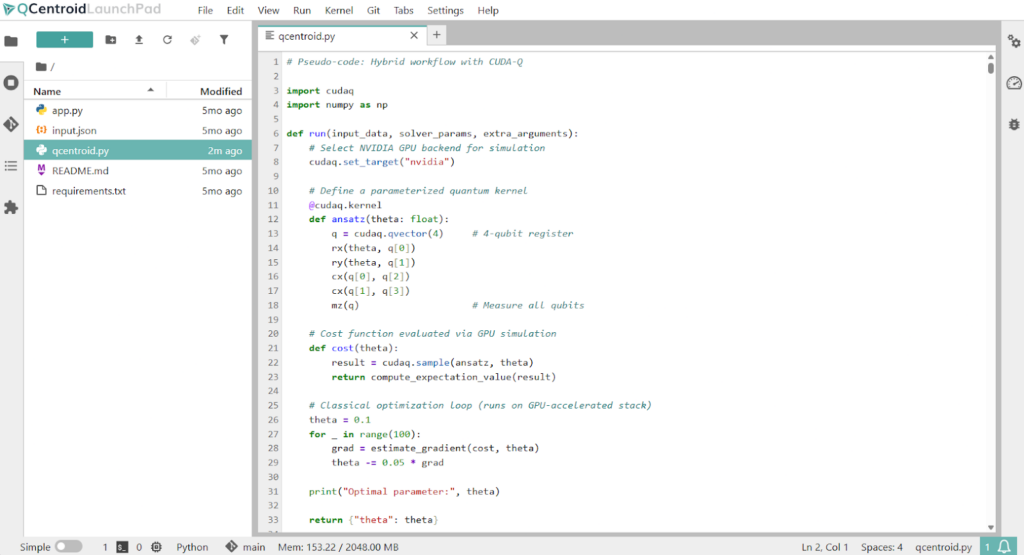
In a simplified hybrid quantum-classical workflow implemented with NVIDIA CUDA-Q, enterprise teams design parameterized quantum circuits, execute them on NVIDIA GPUs for large-scale simulation, and iteratively optimize them using classical routines. The same code structure can later be executed against real QPUs without redesigning the algorithm.
The figure below illustrates how a parameterized circuit is defined, simulated on NVIDIA GPUs, and embedded in a classical optimization loop – the foundational pattern behind most near-term quantum applications such as optimization, chemistry simulation, and machine learning.
More importantly, workloads can be deployed on different NVIDIA GPU configurations with minimal friction. Teams can test how simulation performance scales across GPU models, evaluate memory requirements for larger qubit counts, and determine which hardware configuration is sufficient for their use case. This flexibility directly impacts cost efficiency: instead of overprovisioning infrastructure, enterprises can calibrate resources based on measured performance.
Systematizing the Workflow -The QuantumOps Framework
To make this concrete, consider electrolyte design for industrial batteries. From a computational perspective, the task reduces to estimating electronic structure properties of candidate molecules. A Hamiltonian is constructed and mapped to qubits. An ansatz is defined. A classical optimizer iteratively updates parameters to minimize the expected energy.
In practice, this workflow requires repeated experimentation. Ansatz depth must be varied. Optimizers must be compared. Noise models must be evaluated. Simulation results must eventually be validated on real hardware. Each variation expands the experimental search space.
Enterprise VQE workflows require repeatability, governance, and structured experimentation.
In our example, when screening multiple electrolyte candidates, hundreds or thousands of experiments may be executed. Hamiltonians evolve as molecular models are refined. Optimizer configurations change. Backend selections shift between GPU simulators and QPUs. Without operational discipline, results become fragmented and difficult to reproduce.
A QuantumOps framework layers experiment lifecycle management on top of CUDA-Q’s hybrid runtime. Experiments are defined declaratively. Hamiltonians, ansätze, and optimizer configurations are versioned as artifacts. Backend selection, shot configuration, and execution metadata are captured automatically. Convergence trajectories are stored and indexed for comparison.
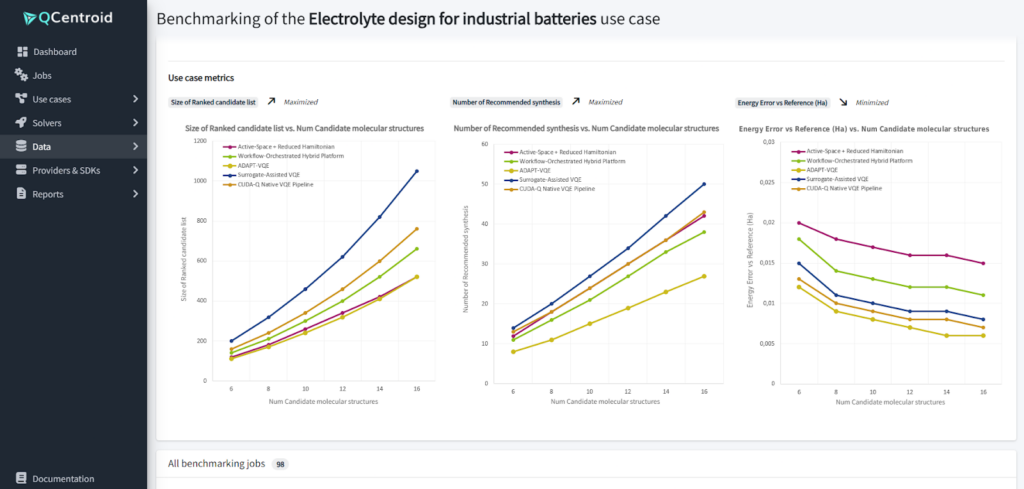
Benchmarking & Comparative Analysis
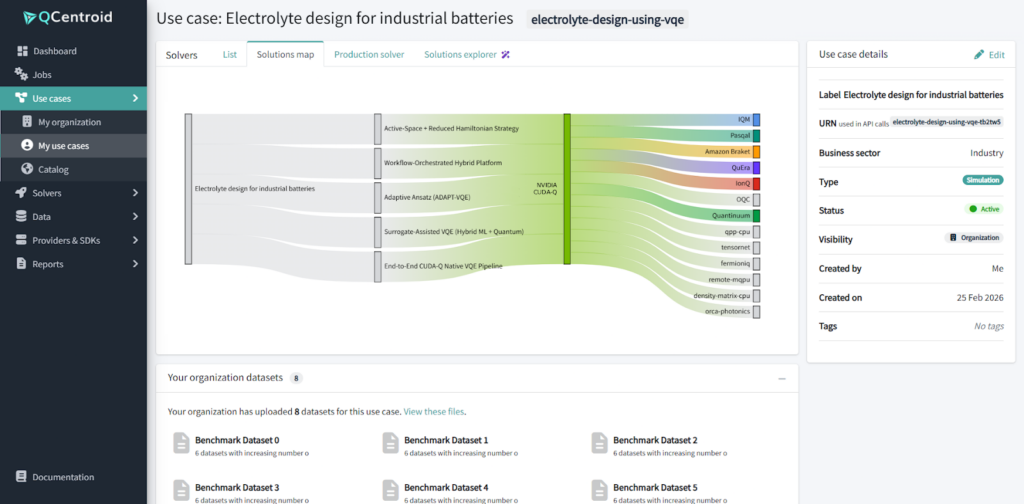
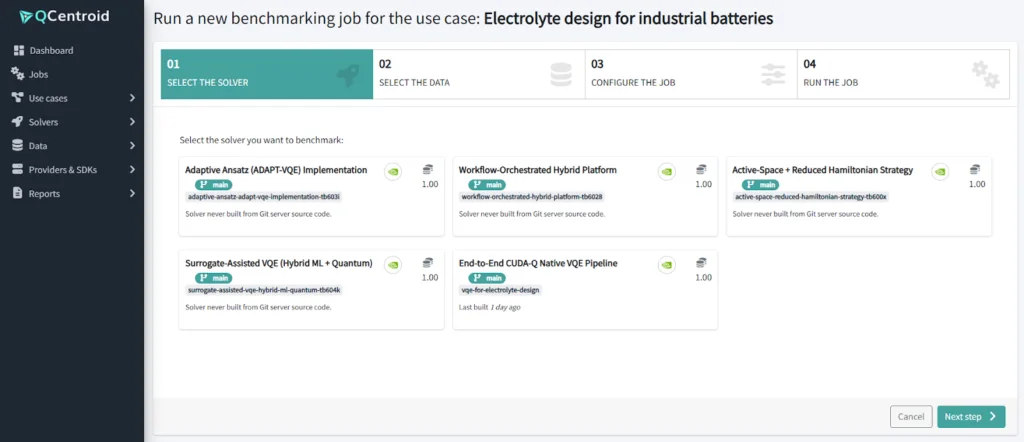
By capturing the metadata of each execution, the QuantumOps platform facilitates rapid comparative analysis across different solvers, infrastructure backends, and datasets.
From Fragmented to Operationalized
CUDA-Q accelerates hybrid execution. QuantumOps systematizes hybrid experimentation. The combined impact creates a structured, evidence-based adoption pathway, summarized below:
| Workflow Step | Fragmented Stack | NVIDIA CUDA-Q + QuantumOps Framework | Primary Benefits (Impact) |
| Hybrid algorithm implementation | Quantum circuits and classical optimizers integrated manually across separate SDKs. | Unified hybrid kernel model in CUDA-Q with structured experiment definitions. | Reduced integration complexity. (Development time) |
| Simulation performance & scaling | CPU-based simulation limits qubit count and slows parameter sweeps. | GPU-accelerated simulation on NVIDIA GPUs with managed sweep orchestration. | Higher throughput. (Time-to-insight, scalability) |
| Infrastructure availability during development | Local setup or custom cloud provisioning required. | Instant access to CPU and NVIDIA GPU resources via QCentroid Launchpad. | Faster onboarding. (Infrastructure friction, deployment time) |
| Hardware portability (Sim QPU) | Backend-specific APIs; hardware changes require refactoring. | QPU-agnostic execution compatible with leading quantum hardware providers. | Reduced vendor lock-in. (Vendor lock-in, validation cycles) |
| Experiment lifecycle management | Script-driven runs with manual tracking of configurations. | Declarative, versioned experiment definitions with captured metadata. | Deterministic reproducibility. (Reproducibility, technical risk) |
| Parameter sweeps & benchmarking | Manual aggregation and comparison of results. | Indexed sweeps with normalized cross-backend benchmarking. | Structured performance comparison. (Optimization cycles, decision confidence) |
| Resource & cost visibility | Fragmented tracking across vendors. | Per-experiment visibility across GPU and QPU execution. | Better hardware allocation. (Cost control) |
| Collaboration & knowledge retention | Results dispersed across repositories and individuals. | Persistent experiment registry with searchable history. | Institutional continuity. |
Conclusion
Although electrolyte design provides a concrete example, the architecture is domain-agnostic. Any enterprise VQE workload – whether in materials science, energy systems, or optimization requires scalable simulation, backend portability, reproducibility, and cost-aware infrastructure allocation.
The combination of NVIDIA GPUs and NVIDIA CUDA-Q creates a versatile development substrate. GPU-accelerated state vector and tensor network simulators allow simulation of larger qubit systems than CPU-bound approaches. At the same time, resource allocation can be adapted dynamically to match problem scale and budget constraints. As quantum hardware evolves, the same CUDA-Q code remains compatible with leading QPU providers thanks to its qubit-agnostic backend abstraction. Simulation and hardware validation are not separate development tracks, they are part of a continuous workflow.
When layered with a Quantum Ops framework, this stack transforms VQE from an experimental algorithm into an operational research system. In industrial electrolyte discovery and across enterprise quantum computing—the true acceleration vector lies not only in faster computation, but in the convergence of scalable GPU infrastructure, portable hybrid execution, and structured experimentation.