

Insider Brief
- A $750,000 NASA EPSCoR grant will fund Montana State University research through 2028 to reduce atmospheric turbulence effects in quantum laser links between ground stations and space terminals.
- The project will develop compact, low-power adaptive optical equalizers using programmable photonic integrated circuits to mitigate photon loss and signal fading in quantum free-space optical communications.
- The effort builds on prior U.S. Air Force Research Lab work and will support four graduate researchers while expanding MSU’s role in NASA’s emerging quantum space network.
PRESS RELEASE — A new $750,000 EPSCoR grant from NASA will help researchers at Montana State University work to limit the impact of atmospheric turbulence in quantum laser communications links between ground stations and space terminals. The project, titled “Programmable Photonics for Quantum Space Networks,” is funded through September 2028.
The project builds on optical communications technologies developed by John Roudas, professor of electrical and computer engineering and principal investigator on the NASA EPSCoR grant, during two previous projects with the U.S. Air Force Research Lab. This NASA project is synergistic to MSU’s growing quantum research activities while creating a new direction toward quantum space communications. MSU’s current quantum infrastructure includes the Applied Quantum Core, or QCORE, the MonArk NSF Quantum Foundry and the Montana Microfabrication Facility.
“Quantum networks will enable the transmission of quantum bits, or qubits, among physically separated quantum processors and sensors, both for terrestrial and space applications,” Roudas said. “This new project will enable MSU to participate in the development of NASA’s quantum space network.”

When a satellite orbiting the earth sends data by using a laser beam aimed toward a ground station, he said, light on the earth appears to flicker – an effect called scintillation – due to Earth’s turbulent atmosphere. This is why city lights appear to flicker when viewed from a hill and why stars appear to twinkle. For classical laser-based communication methods, photon loss causes signal-to-noise ratio variations and signal fading at the receiver. For quantum free-space optical communications, however, where information is encoded using single photons or pairs of entangled photons, photon loss can lead to complete erasures of data.
The challenge for space optical communications is to develop compact, real-time adaptive optical equalizers that correct quickly turbulence-induced distortions, Roudas said.
“Conventional adaptive optics constitute a major obstacle to the widespread adoption of optical communications for space missions,” the MSU team wrote in the grant application’s abstract. “To overcome scintillation and fading, adaptive optical systems based on photonic integrated circuits can be used instead.”
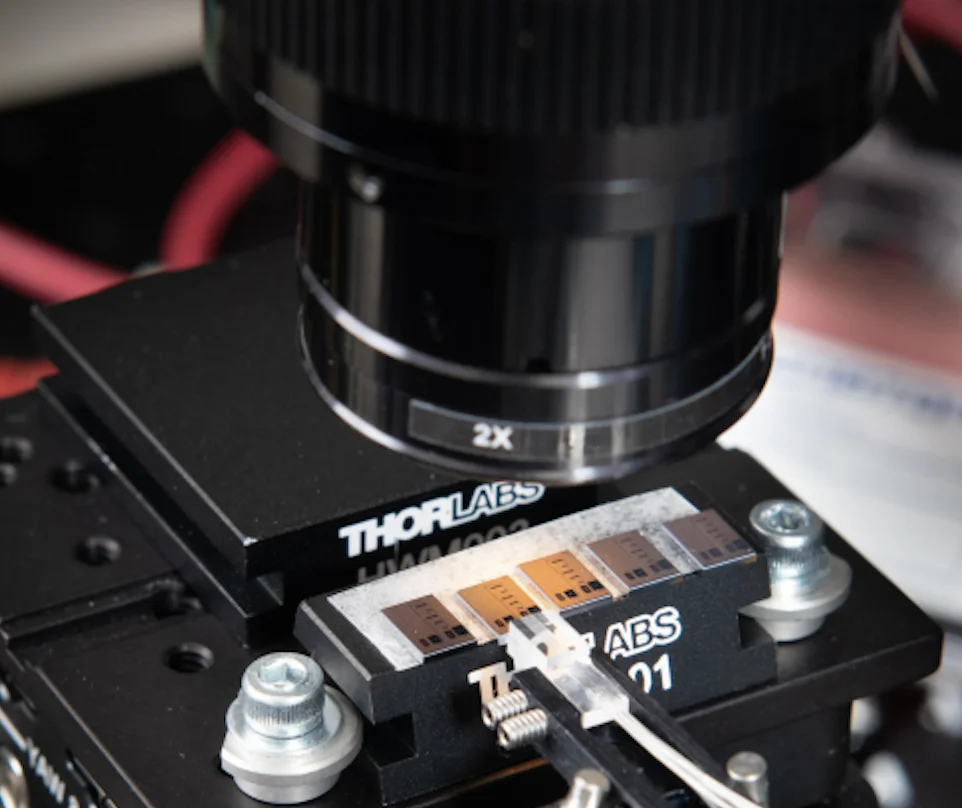
MSU researchers are working to develop compact, lightweight real-time adaptive optical equalizers that consume little energy to correct quickly turbulence-induced distortions, Roudas said. Programmable photonic integrated circuits, or PICS, can dynamically compensate for signal fading due to atmospheric turbulence at a fraction of the cost of alternative technologies. PICs are similar to the computer chips routinely used on electronic circuit boards, except they use light instead of electricity to process information. Programmable PICs are mainly intended for modern, high-speed computing systems to accelerate computations and save energy. Their use for space applications is one of the novelties of MSU’s proposal.
“Programmable PICs can be reconfigured to perform different functions,” said Roudas, who is also the Gilhousen Telecommunications Chair in the Department of Electrical and Computer Engineering, which is housed in MSU’s Norm Asbjornson College of Engineering. “A multidisciplinary team at MSU will design, simulate and experimentally characterize programmable PIC architectures for optical signal processing in future quantum space networks.”
The other MSU faculty members participating in this project are Brock LaMeres and Kevin Repasky, both professors of electrical and computer engineering; and Matt Jaffe, professor of physics in MSU’s College of Letters and Science. The program will support four graduate research assistants for three years.
“NASA is making a good investment in MSU’s interdisciplinary team working on photonic integrated circuits,” said Alison Harmon, MSU’s vice president for research and development. “This is an area where our faculty have particular strength. They will have an opportunity through this and other work to make a significant contribution to quantum space communications. MSU researchers continue to advance and diversify quantum work at this university.”
According to NASA’s website, EPSCoR grants, or Established Program to Stimulate Competitive Research grants, are designed “to enhance the research competitiveness of targeted jurisdictions by strengthening science, technology, engineering and mathematics – or STEM – capacity and capability through a diverse portfolio of investments from talent development to local infrastructure.”
Five federal agencies, including NASA, conduct EPSCoR programs.