

Insider Brief
- Microsoft is shifting its quantum strategy toward software and developer tools, upgrading its Quantum Development Kit with AI-assisted features to support the move from error-prone physical qubits to more stable logical qubits.
- The open-source QDK is positioned as a full development environment that runs on standard laptops, integrates with Visual Studio Code and GitHub Copilot, and supports multiple languages and frameworks to lower barriers for quantum application development.
- Microsoft is extending the toolkit with domain-specific libraries for chemistry and error correction, aiming to accelerate near-term experimentation while preparing researchers and software stacks for fault-tolerant quantum systems that remain years away.
The push to make quantum computing useful is shifting from raw hardware toward the software and tools that can turn fragile machines into reliable systems, and Microsoft is upgrading its tools for quantum developers, even adding AI-assisted development to the mix.
In a recent blog post outlining updates to its quantum software stack, Microsoft said the field has moved beyond the earliest era of error-prone physical qubits and into one focused on logical qubits — which are collections of qubits that can be stabilized through error correction.
Matthias Troyer, technical fellow and corporate vice president of quantum at Microsoft, writes in the post that reaching fault-tolerant quantum machines will require advances not only in hardware, but also in the software that lets researchers design, test and run applications on today’s limited devices while preparing for larger systems in the future.

At the center of that effort is the Microsoft Quantum Development Kit, or QDK, an open-source toolkit that the company positions as a full development environment for quantum computing. The kit is designed to run on a standard laptop, integrate with familiar programming tools, and increasingly rely on AI assistance to lower the barrier to entry for scientists and developers who are not specialists in quantum theory.
Microsoft said its goal is to meet researchers where they already work, rather than forcing them to adopt entirely new workflows. That strategy is strengthened by the tight integration of the QDK with Visual Studio Code and GitHub Copilot, which together provide code completion, debugging, visualization and job submission for quantum programs written in languages such as Q#, Python and OpenQASM.
The company indicates this can help accelerate experimentation on existing quantum hardware while building the skills and software foundations needed for fault-tolerant systems that remain years away.
The Microsoft Quantum Development Kit bundles simulators, compilers, libraries and tools into a single environment aimed at making quantum programming feel more like conventional software development. Microsoft said the QDK can be installed locally and used without immediate access to quantum hardware, allowing developers to write and test code using simulators before submitting workloads to cloud-connected devices.
The kit supports interoperability with widely used quantum frameworks, including Qiskit and Cirq, alongside Microsoft’s own Q# language. Domain-specific libraries are included for areas where quantum computing is expected to have early impact, notably error correction and quantum chemistry.
Microsoft said these libraries are intended to reduce the amount of specialized expertise required to explore advanced topics such as logical qubits or molecular simulations. In practice, that means providing prebuilt workflows, templates and tools that handle much of the mathematical and engineering complexity that typically sits between a scientific problem and a runnable quantum circuit.
The company also emphasized reproducibility and portability, particularly for scientific research. The chemistry components of the QDK support Windows Subsystem for Linux and Docker, allowing researchers to package workflows so they can be rerun or shared across different systems.
AI-assisted Quantum Programming
The most distinctive element of Microsoft’s approach is the deep integration of AI into the quantum development workflow. Through its connection with Visual Studio Code and GitHub Copilot, the QDK uses large language models to assist with tasks such as writing code, generating tests, configuring experiments and submitting jobs to simulators or hardware.
Microsoft said this AI helper can guide developers through unfamiliar quantum concepts, suggest code patterns and automate routine steps that would otherwise slow experimentation. The intent is not to replace human understanding, but to reduce friction in a field where even small mistakes can invalidate results.
Within the development environment, Copilot works alongside features such as IntelliSense, breakpoint debugging, circuit rendering and resource estimation. Together, these tools are meant to provide immediate feedback on how a quantum program behaves, how many resources it consumes and whether it is likely to fit within the constraints of a given device.
By embedding these capabilities directly into a mainstream code editor, Microsoft is effectively treating quantum programming as an extension of modern software engineering rather than a separate, niche activity.
Chemistry as a Near-Term Test Case
Quantum chemistry is considered one of the most promising applications for early quantum computers, but it also illustrates the gap between theoretical potential and practical limitations. Realistic chemical problems must be simplified and optimized to fit within the small number of qubits and limited coherence times available today.
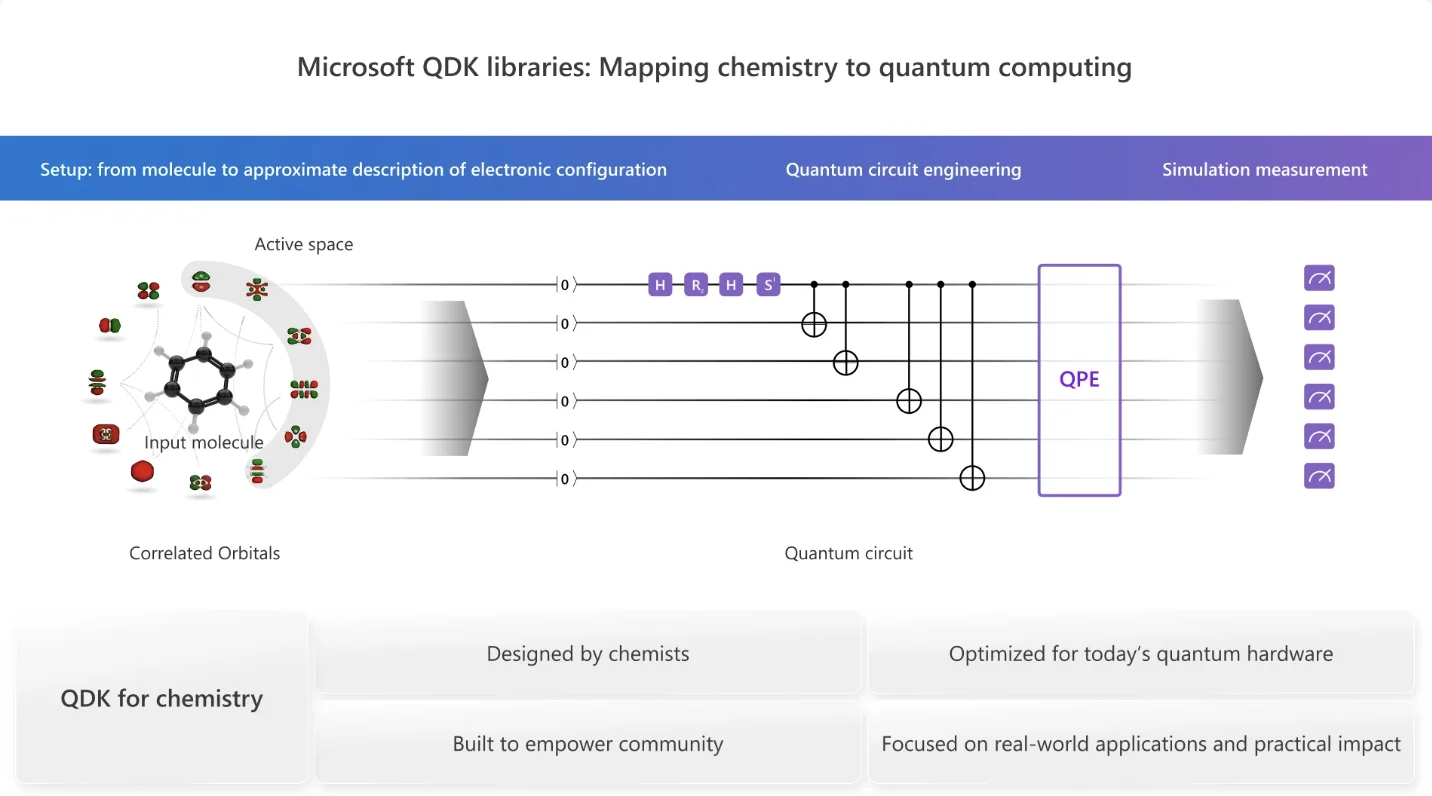
Microsoft’s QDK for chemistry is designed to bridge that gap by combining classical and quantum methods into an end-to-end workflow. The toolkit helps researchers define molecular problems, select relevant electronic states, map those problems onto qubits, optimize circuits and analyze results after execution.
The company said a key focus is reducing circuit depth — the number of operations a quantum computer must perform — because deep circuits are more susceptible to errors. By using chemistry-aware algorithms and efficient classical preprocessing, Microsoft claims certain problems can be reduced from circuits requiring thousands of quantum gates to ones that use only a handful, while preserving chemical accuracy.
The chemistry toolkit was developed with input from academic and industrial partners that can, for example, build quantum algorithms for life sciences. Microsoft said collaborations helped shape a modular design intended to scale as hardware improves and new algorithms emerge.
Within VS Code, the chemistry tools provide visualization of molecules, molecular orbitals and quantum circuits, allowing researchers to inspect and refine their models in real time. Workloads can be run on local simulators or submitted to quantum hardware through the same interface, streamlining the path from theory to experiment.
Tools For Error Correction Research
Beyond applications, Microsoft is also opening up internal tools it has used in its own quantum error correction research. Error correction is central to the creation of logical qubits, which encode information across many physical qubits to detect and correct mistakes.
The QDK for error correction includes open-source modules for characterizing and debugging encoded quantum programs, along with customizable strategies for encoding and decoding data in ways that align with different hardware targets. Microsoft said these tools are meant to support common research workflows, from validating new codes to testing how they perform under realistic noise conditions.
Notebook-based examples are included to help researchers get started, and additional tooling packages are expected to be released over time, with full availability planned for later in 2026. By making these capabilities broadly available, Microsoft is positioning the QDK as a shared platform for the community working on one of quantum computing’s hardest problems.
The Quantum Development Kit sits within a broader Microsoft Quantum platform that combines software, AI, high-performance computing and cloud infrastructure. Through Azure, the platform connects developers to quantum processing units from multiple hardware providers while handling scheduling, monitoring and integration with classical resources.
Microsoft said its platform relies on a qubit-virtualization system and a quantum operating system that manages devices and orchestrates error correction. A quantum engine coordinates workloads across hardware and software layers, with the aim of presenting logical qubits to applications even when the underlying machines remain noisy.
The company is designing the platform to be hardware-agnostic, supporting multiple qubit technologies. As an example, Microsoft is working with Atom Computing on a neutral-atom system known as Magne, which the companies describe as a step toward large-scale quantum computing. Details of Magne are expected to be unveiled by QuNorth at an event in Copenhagen later this month.
Alongside hardware development, Microsoft said it is investing in training and skills development to ensure that researchers can use these systems effectively. In the Nordic region, the company is partnering with qBraid and academic and industry groups to provide training tailored to application engineers and error-correction researchers.