

Insider Brief
- A Europe-wide pilot project called Photonics for Quantum (P4Q) will launch in 2026 to improve the reliability, scalability, and manufacturability of photonic chips for quantum sensing, computing, and secure communications.
- The initiative targets the transition from lab prototypes to repeatable industrial production by developing standards, design kits, and production techniques that reduce optical loss, ensure stability at cryogenic temperatures, and enable system-level integration.
- Backed by €25 million in EU funding matched by national governments across 12 countries, the 29-partner consortium aims to bring multiple quantum photonic platforms to TRL-8/MRL-8 readiness through shared test and manufacturing infrastructure.
PRESS RELEASE — Across a dozen European countries, a new European pilot will be started in 2026: Photonics for Quantum (P4Q). In this project, a large consortium is working on ways to make photonic chips for quantum applications more reliable and scalable.
The coordinator of P4Q, Pepijn Pinkse (University of Twente, NL): “Ideas that currently remain in the lab can grow into really useful devices more quickly.”
As the global race for quantum technology accelerates, Europe wants to strengthen its knowledge and manufacturing capacity. It is precisely at the intersection of photonics and quantum that there is a strategic opportunity there. P4Q therefore focuses on standards and production techniques that are needed to make quantum chips work properly not once, but time and time again. That is a crucial step from research to application.

From sensors to computing and ultra-secure communication
In practice, these are very tangible improvements. Less loss of light in chips and glass fibers. Components that remain stable at extremely low temperatures. And photonic circuits that are suitable for integration into larger systems, such as full stack quantum computers, quantum sensors or secure communication networks.
Imagine sensors that can detect minute traces of contamination in water pipes. Or a compact device in a hospital lab that measures extremely weak signals, with a precision that classic technology does not achieve. Such applications require reliable photonic chips that work not only in the lab, but also outside it.
The same chips also play a role in large-scale quantum computers and in ultra-secure quantum communication, for example through the exchange of entangled photons. It sounds futuristic. But P4Q is working on the step that is needed to bring these types of technologies to use in companies and research facilities.
Large consortium, shared infrastructure
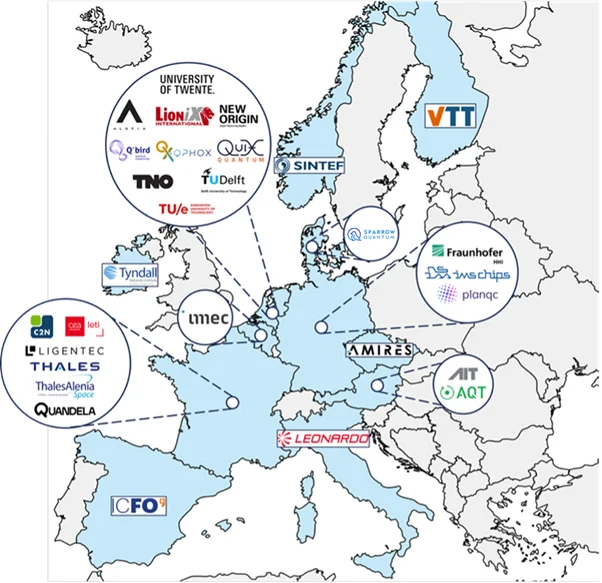
P4Q brings together 29 partners: universities, research and technology organisations (RTOs) and industrial foundries. Within the project, Process Design Kits and Assembly Design Kits are being developed, among other things, so that design and production are better aligned. Various photonic platforms are also receiving attention, such as silicon nitride (SiN), thin-film lithium niobate (TFLN) and alumina (AlOx).
An important part is scaling up test and production facilities. This increases quality and at the same time lowers the threshold for start-ups and smaller companies to get started with quantum photonics. Europe is investing 25M€ in this project. The same amount comes from national governments in 12 European countries.
The project is organised into eight work packages and includes small commercial partners, foundries, universities, research institutes, as well as the multinationals. P4Q focuses on technologies that grow into TRL-8 and MRL-8: ready for large-scale demonstration and further industrialisation.
Partners in this project are:
AIT, Aluvia, AMIRES, AQT, C2N, CEA-Leti, Delft Networks, ICFO, IMEC, IMS CHIPS, Leonardo, Ligentec, LioniX International, New Origin, PlanQC GmbH, Q*bird, QphoX, QuiX Quantum, Sintef, Sparrow Quantum, Thales Alenia Space, Thales R&T, TNO, TU Delft, TU Eindhoven, Tyndall National Institute, University of Twente (coordinator), VTT, Quandela
In the Netherlands, P4Q is supported by Oost NL and financially made possible by Quantum Delta NL, Nanolab NL and the Ministry of Economic Affairs.