Argonne and Intel Deploy 12-Qubit Quantum Dot Device


Insider Brief
- Argonne National Laboratory and Intel have deployed a 12-qubit quantum dot device in a collaboration led by the DOE National Quantum Information Science Research Center, Q-NEXT.
- Quantum dots confine electrons to discrete energy levels, enabling their use as qubits, and Argonne is testing the behavior of the 12-dot system to inform scaling efforts.
- Intel provides fabrication and manufacturing capabilities while Argonne contributes expertise in materials, qubit characterization, and experimental testing, according to statements cited by Argonne.
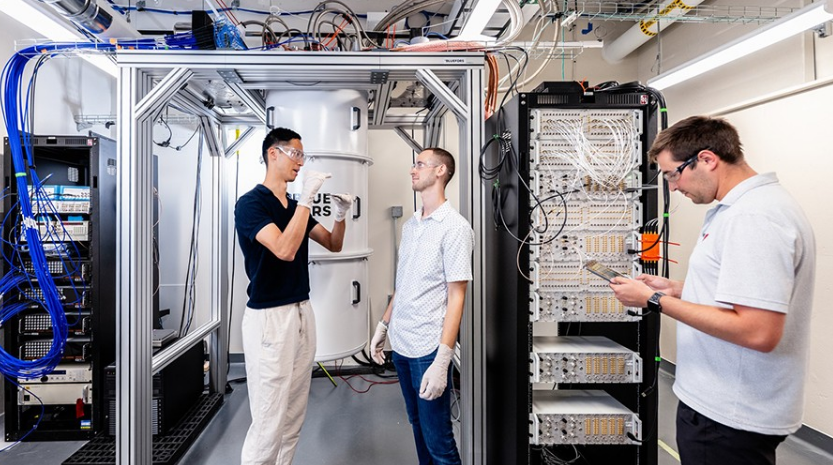
- Image by Argonne National Laboratory.
In a joint project led by Q-NEXT, a DOE National Quantum Information Science Research Center hosted at Argonne National Laboratory, researchers have deployed a 12-qubit quantum dot device built by Intel, according to Argonne and Intel. Qubits are the carriers of quantum information, and the first collaborative results were published in Nature Communications, Argonne reports.
Jonathan Marcks, a scientist at Argonne National Laboratory leading the effort, said, “You can draw a very direct line from the first transistor to a quantum dot,” in a statement cited by Argonne. He added, “What if we do at a single-electron level what transistors already do? What if we make quantum technology out of the same building blocks that we already make classical technology out of?”
Q-NEXT Inaugural Director David Awschalom said in a statement cited by Argonne, “This collaboration between Argonne and Intel is a cornerstone of Q-NEXT. It shows the impact of a national quantum research center: Only at this scale can industry and discovery-driven organizations like the national laboratories combine their strengths to build such a complex system. Together, we accomplish advances that would be challenging for a single investigator, or even a single institution, to achieve alone.”

According to Argonne, quantum dots confine particles such as electrons to a space smaller than their wavelength, forcing them into discrete, tunable energy levels. By adjusting the dots’ size and composition, scientists can control these energy levels.
Marcks told Argonne, “It can be difficult to build even a few quantum dot qubits. But with Intel, the prospect of making a ton of qubits on a practical device using quantum dots suddenly seems a lot more realistic.” Intel provides capabilities for building and manufacturing the devices, while Argonne contributes expertise to test and characterize the qubits, according to Marcks in a statement cited by Argonne.
Nathan Bishop, quantum systems technology director at Intel, said, “Intel’s design, fabrication and test teams make it possible to scale up quantum processors based on silicon quantum dot qubits. By working with scientists at Argonne, we enable cutting-edge science and benefit from DOE’s world-class capability for materials and qubit characterization,” Argonne reports.
Argonne is investigating how the 12-dot system behaves as more qubits are added, including how material properties affect operations and how the qubits interact. Marcks said, “How these qubits behave together requires a lot of physics research and insight, so we’re conducting experiments to see what’s possible,” as cited by Argonne.
Marcks also stated, “As a company, Intel is invested in engineering fully integrated quantum processors that we can study in the lab, and everyone benefits from more research into these systems. You need both partners to ultimately build something useful,” Argonne reports.
This research is supported by the DOE Office of Science National Quantum Information Science Research Centers as part of the Q-NEXT center, Argonne confirms.
Source — Argonne launches silicon quantum processor collaboration with Intel

Keep track of everything going on in the Quantum Technology Market. In one place.

Mohib Ur Rehman
Covering quantum and emerging technologies, Mohib explores the intersection of technology, security, and society. His work also frequently examines surveillance infrastructure and the institutions shaping the digital world. In addition to his work at The Quantum Insider, he co-runs SK NEXUS, an independent technology publication that helps readers understand the technologies shaping their lives.

Stay Ahead of Quantum
Get the latest research, company news, and market intelligence every week.
MENTIONED IN THE ARTICLE

Argonne National Laboratory
Argonne National Laboratory, one of the U.S. Department of Energy's national laboratories for science and engineering research, employs 3,400 employees, including 1,400 scientists and engineers, three-quarters of whom hold doctoral degrees. Argonne's annual operating budget of around $1 billion supports upwards of 200 research projects. Since 1990, Argonne has worked with more than 600 companies and numerous federal agencies and other organizations. The Lab has successfully launched its own Quantum Foundry to accelerate quantum information research.
→

Intel
Intel's mission is to drive the future of technology to contribute to a better world. By advancing in areas such as AI, analytics, and cloud-to-edge technology, Intel is central to many innovations.
→

U.S. Department of Energy (DOE)
The mission of the Department of Energy is to ensure America's security and prosperity by addressing its energy, environmental, and nuclear challenges through transformative science and technology solutions. In September, 2022, Research supported by ASCR demonstrated that classical machine learning algorithms can accurately predict ground state properties and classify quantum phases of matter using data generated from quantum experiments. In November, 2022, Research supported by Q-NEXT revealed that the performance of a sensor network is constrained by the intrinsic noise associated with the quantum states used in the network. In March, 2023, Research funded by DOE SC NP achieved the first experimental observation of entanglement between dissimilar particles, specifically positive and negative pions. In August, 2023, Research funded by DOE SC BER demonstrated strong preservation of entanglement in a two-photon absorption process involving organic molecules, offering a new approach for developing quantum light-based spectroscopy and microscopy.
→