


Insider Brief
- Chinese researchers used the Zuchongzhi 2 quantum processor to create a non-equilibrium higher-order topological phase that traps quantum effects at the corners of a system.
- The experiment, reported by SCMP and Science, showed that time-driven Floquet circuits can stabilize quantum information in ways that conventional equilibrium materials cannot.
- The work demonstrates a potential path toward error-resistant quantum computing by exploring forms of quantum order that do not occur in nature.
Chinese researchers have demonstrated a new form of quantum matter that stays intact even when disturbed, a result that could reshape how future quantum computers protect information and perform large-scale calculations.
The work, reported by the South China Morning Post and published in Science, represents the first experimental creation of a non-equilibrium higher-order topological phase, which is an exotic state in which quantum effects collect at the corners of a system rather than across its edges.
The study centers on a property that SCMP describes as a “quantum Lego block” that refuses to fall apart when shaken. Led by Pan Jianwei, a physicist at the University of Science and Technology of China, the team used a programmable superconducting quantum processor called Zuchongzhi 2 to simulate a form of matter that does not occur naturally. According to Science, the experiment created corner states that were protected by topological rules — deep mathematical constraints that keep certain properties stable even when the system is stretched, bent, or exposed to noise.

These corner states act like fortified pockets of information. Because qubits — the basic units of quantum computing — are highly sensitive to their environment, much of the field’s progress has been held back by errors that accumulate during calculations. The researchers showed that information encoded in these topological corner modes can remain stable even as the system evolves, according to SCMP. By demonstrating both equilibrium and non-equilibrium versions of these phases, the team provided a new strategy for error-resistant quantum computing.
“Our study also presents an intriguing possibility of leveraging presently accessible noisy intermediate-scale quantum processors to universally explore custom-built topological materials, both in the presence and absence of interactions and in and out of equilibrium,” the team wrote in their study, as reported by SCMP
Building Quantum Matter That Nature Never Made
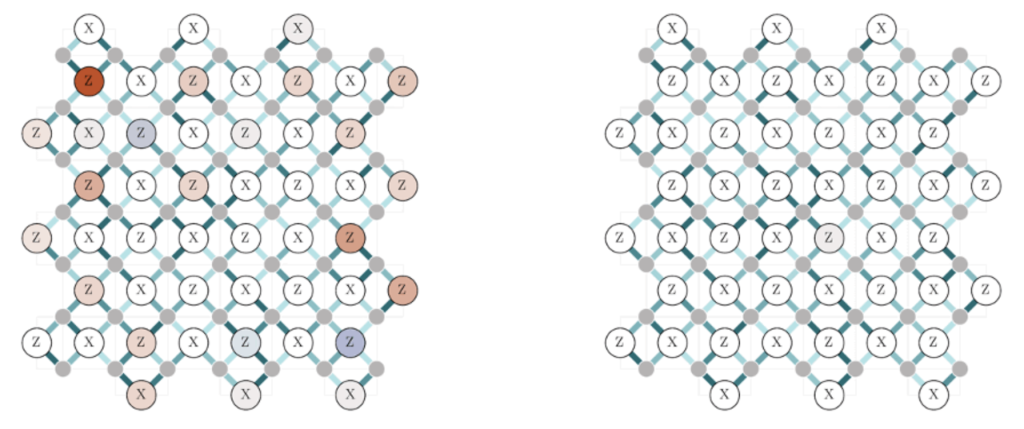
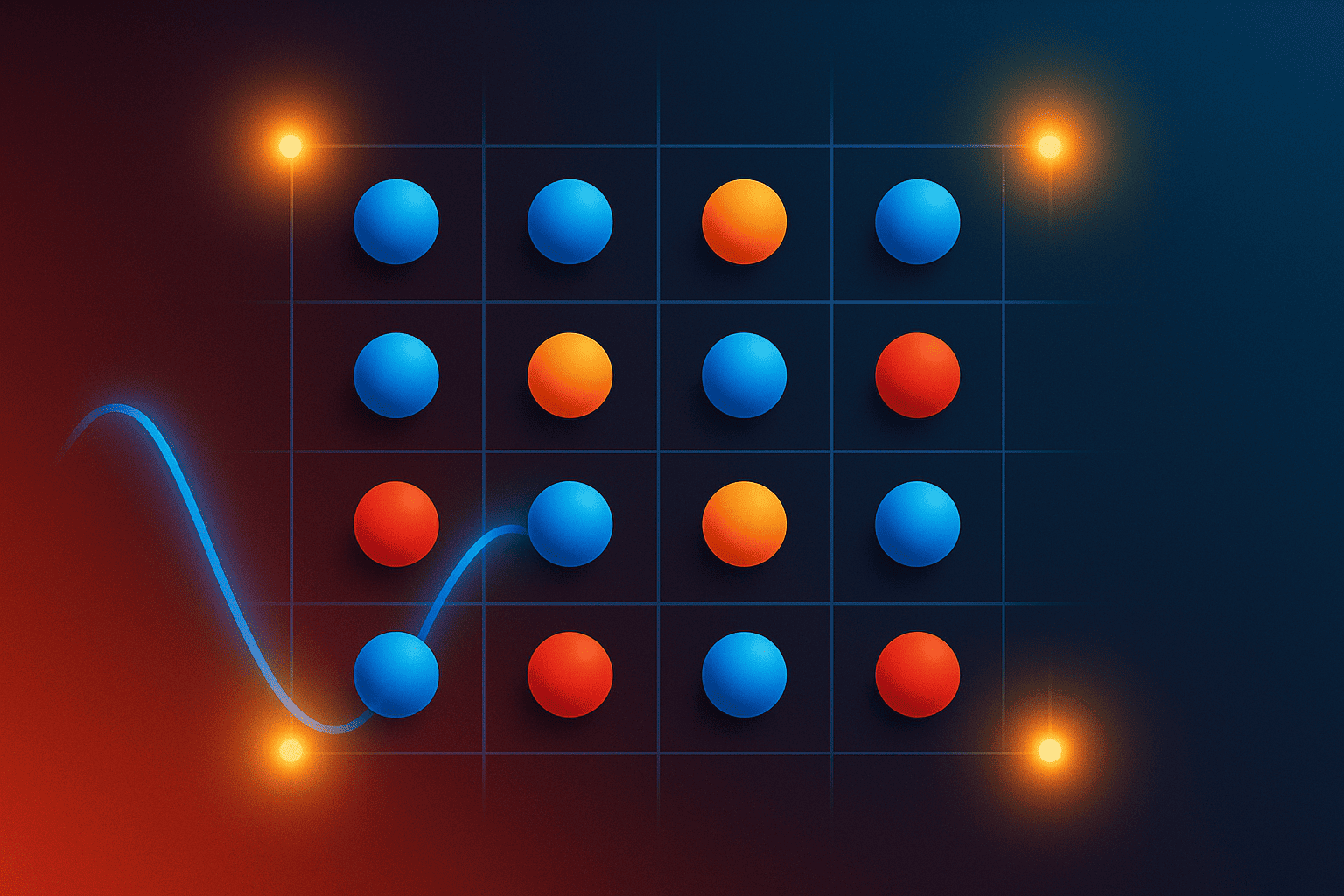
Pan’s group, which includes researchers from USTC and Shanxi University, engineered these unusual phases on a six-by-six array of qubits inside the Zuchongzhi 2 processor.
In the Science journal, the team reported that researchers constructed circuits with more than 50 cycles of a special type of time-dependent operation known as a Floquet operator. This allowed them to drive the system into a non-equilibrium regime.
Unlike traditional phases of matter that sit quietly in stable forms — such as solids, liquids, or gases — non-equilibrium phases are constantly changing and are influenced by outside forces like electric fields or lasers. The researchers pursued this regime because certain forms of quantum order, including the corner-locked behavior they sought to test, appear only when a system is pushed away from equilibrium. By repeatedly driving the qubits in time, the team could reveal topological features that do not arise naturally in resting materials and may offer stronger protection for quantum information.
According to SCMP, the team developed a way to detect these higher-order phases by measuring how “chiral density” — a property that tracks directional behavior — changes over time. That method helped reveal the signatures expected in corner-mode systems, confirming predictions that had remained out of reach for years.
Topology, the mathematical framework that forms the basis of this research, concerns properties that remain unchanged even when an object is stretched or deformed.
As reported in SCMP, a sphere can be turned into a cube without altering its topology because both shapes have no holes, but it cannot be reshaped into a doughnut without tearing. A doughnut and a coffee mug, meanwhile, share a topology because each has one hole — one through the center of the doughnut, and one through the mug’s handle.
In quantum physics, these ideas have given rise to “topological phases” in which certain features — often located at the edges of materials — stay robust even in the presence of disturbance. Higher-order topological phases go further by confining these protected features to even smaller regions, such as corners.
Science reports that Pan’s team achieved a second-order version of this behavior in both equilibrium and driven, non-equilibrium conditions.
A Step Toward Fault-Tolerant Machines
The work arrives as China accelerates its efforts to build a practical, fault-tolerant quantum computer, a goal that SCMP mentions as part of a high-stakes race with the United States. Pan, sometimes referred to as the “father of quantum” in China, has led several of the country’s most visible projects, including earlier experiments on quantum communication and quantum advantage.
If higher-order topological phases can be harnessed in future processors, they could reduce the burden of error correction — one of the major cost drivers in today’s designs. That could make machines more reliable and open the door to industrial-scale applications in drug discovery, artificial intelligence, and environmental modeling, according to SCMP.
Programmable quantum processors like Zuchongzhi 2, which can be reconfigured for different tasks, are essential for exploring these ideas. Science notes that the platform’s flexibility allowed the team to create a range of simulated environments, making it possible to test several theoretical models in the same device.