Supercomputing Centers to Integrate Quantum Processors Using NVIDIA’s NVQLink



Insider Brief
- NVIDIA’s NVQLink will be adopted by more than a dozen leading supercomputing centers to connect quantum processors with accelerated computing systems.
- The interconnect provides microsecond-level latency and high-throughput links that enable large-scale hybrid quantum-classical workflows through CUDA-Q.
- Quantinuum used NVQLink with its Helios processor to demonstrate real-time decoding for quantum error correction, exceeding performance requirements by a wide margin.
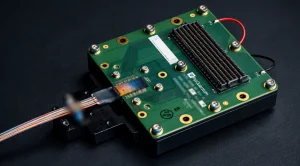
NVIDIA today announced that the world’s leading scientific computing centers are adopting NVIDIA® NVQLink™, a first-of-its-kind, universal interconnect for linking quantum processors with state-of-the-art accelerated computing.
Tapping the low-latency, high-throughput interconnect, more than a dozen supercomputing centers and national research institutions across Asia and Europe are joining U.S. facilities in advancing their ability to research, develop and harness the integration of quantum and classical hardware.
“In the future, supercomputers will be quantum-GPU systems — combining the unique strengths of each: the quantum computer’s ability to simulate nature and the GPU’s programmability and massive parallelism,” said Jensen Huang, founder and CEO of NVIDIA. “NVQLink with CUDA-Q is the gateway to that future — uniting quantum and GPU computing into a single, coherent system to push the frontier of what’s computable and unlocking new scientific discoveries.”

By uniting quantum processors with NVIDIA accelerated computing, NVQLink’s open system architecture overcomes control and error-correction challenges and enables the development of hybrid quantum-classical applications. It delivers 40 petaflops of AI performance at FP4 precision with a GPU-QPU throughput of 400 Gb/s and a latency of less than four microseconds.
NVQLink allows the coupling of quantum processors and GPUs via tight integration with quantum control systems and GPU supercomputing within the NVIDIA CUDA-Q™ software platform. NVQLink was designed in collaboration with quantum processor and controller builders, as well as supercomputing centers across the world, including in Asia, such as:
- Japan’s Global Research and Development Center for Business by Quantum-AI technology (G-QuAT) at the National Institute of Advanced Industrial Science and Technology (AIST)
- Korea Institute of Science and Technology Information (KISTI)
- Taiwan’s National Center for High-Performance Computing (NCHC)
- Singapore’s National Quantum Computing Hub (including A*STAR IHPC, CQT and NSCC Singapore centers)
- Australia’s Pawsey Supercomputing Research Centre
Europe and the Middle East are also embracing quantum computing research with supercomputing and quantum technology centers supporting NVQLink, including:
- CINECA, Italy
- DCAI, operator of Denmark’s AI Supercomputer
- The Czech Republic’s IT4Innovations National Supercomputing Center (IT4I)
- Germany’s Jülich Supercomputing Centre (JSC)
- Poland’s Poznań Supercomputing and Networking Center (PCSS)
- Technology Innovation Institute (TII), UAE
- Saudi Arabia’s King Abdullah University of Science and Technology (KAUST)
They join the U.S. national laboratories that recently announced integration with NVQLink technology for cutting-edge research, including:
- Brookhaven National Laboratory
- Fermi National Accelerator Laboratory
- Lawrence Berkeley National Laboratory
- Los Alamos National Laboratory
- MIT Lincoln Laboratory
- National Energy Research Scientific Computing Center
- Oak Ridge National Laboratory
- Pacific Northwest National Laboratory
- Sandia National Laboratories
Real-World Hybrid Quantum-Classical Applications
Quantinuum recently announced that its latest Helios QPU, and future generations of its quantum processors, will be integrated with NVIDIA GPUs through NVQLink and will draw on the power of NVIDIA CUDA-Q to orchestrate quantum error correction.
NVQLink and CUDA-Q allowed the deployment of quantum error-correction techniques to successfully protect the delicate quantum information within the Helios QPU from noise, or unwanted disturbances that cause errors in quantum systems.
This demonstration is the world’s first real-time use of a scalable decoder for a class of quantum error-correction codes known as qLDPC codes. The Quantinuum team demonstrated active error correction and decoding with a decoder implementation that achieved a reaction time of 67 microseconds, exceeding Helios’ two-millisecond requirement by 32x. Key to achieving this result was NVQLink’s ability to provide a flexible and configurable decoder capable of massive parallelism.
The microsecond latencies and extremely high throughput provided by NVQLink are made accessible to developers through real-time application programming interfaces in NVIDIA CUDA-Q. This lets scientists and developers easily build and test approaches to quantum error correction and quantum-GPU applications within a single programming environment.
In addition, NVQLink’s use of Ethernet allows researchers to easily scale the classical compute they draw on as quantum processors and applications expand.

Keep track of everything going on in the Quantum Technology Market. In one place.
Topics

Matt Swayne
With a several-decades long background in journalism and communications, Matt Swayne has worked as a science communicator for an R1 university for more than 12 years, specializing in translating high tech and deep tech for the general audience. He has served as a writer, editor and analyst at The Quantum Insider since its inception. In addition to his service as a science communicator, Matt also develops courses to improve the media and communications skills of scientists and has taught courses.
[email protected]

Stay Ahead of Quantum
Get the latest research, company news, and market intelligence every week.
MENTIONED IN THE ARTICLE

NVIDIA
NVIDIA Corporation is an American multinational technology company and a global player in accelerated computing and Artificial Intelligence (AI). Founded in 1993, the company pushes the aerospace frontier with the Space-1 Vera Rubin Module, a platform for orbital data centers that delivers massive AI-compute Space Computing. This NVIDIA technology enables satellites and autonomous spacecraft to process and fuse sensor data rapidly Space Computing.
→

Quantinuum
Quantinuum builds full-stack quantum computing solutions for practical deployment. Leveraging proprietary enhancements to trapped-ion QCCD architecture, the company has launched multiple commercial hardware generations that deliver leading two-qubit gate fidelity and industry-topping accuracy.
→

G-QuAT
G-QuAT is a research centre operated by National Institute of Advanced Industrial Science and Technology (AIST) in Japan specialising in hybrid quantum-AI and convergence computation technologies. It focuses on developing advanced quantum-classical hybrid infrastructures, creating industrial use cases, and promoting standardisation and ecosystem building. G-QuAT currently houses three types of quantum computers. There are plans to expand its capacity to host startups and SMEs from eight to more than 40 over the next three years. Developed at a cost of ¥62 billion JPY (about $430 million USD)
→
Korea Institute of Science and Technology
The Korea Institute of Science and Technology, situated in Seoul, South Korea, serves as a diverse research institution. Established in 1966, it holds the distinction of being Korea's initial multi-disciplinary scientific research institute. The institute played a crucial role in the nation's economic progress, particularly during the rapid growth experienced in the 1970s and 1980s.
→

Jülich Supercomputing Centre (JSC)
The Jülich Supercomputing Centre (JSC) is a research center located in Jülich, Germany, that provides leading-edge supercomputer resources, IT tools, methods, and know-how. The center has approximately 250 experts working on all aspects of supercomputing and simulation. The JSC is part of the John von Neumann Institute for Computing (NIC) and the Gauss Centre for Supercomputing (GCS). The JSC is also home to the Jülich Unified Infrastructure for Quantum Computing (JUNIQ), which is a uniform quantum computing Platform as a Service (QC-PaaS) that offers European users support and access to quantum computer emulators and quantum computing technologies of different types and levels of technological maturity. JUNIQ will integrate quantum computers in the form of quantum-classical hybrid computing systems into the modular HPC environment of the Jülich Supercomputing Centre. They operate a quantum annealer with more than 5,000 qubits as part of JUNIQ, making them the first site in Europe to operate a latest-generation system by the Canadian manufacturer D-Wave. The JSC collaborates with renowned hardware and software vendors like IBM, Intel, NVIDIA, and ParTec to meet the challenges that arise from the development of exaflop.
→

Brookhaven National Laboratory (BNL)
Brookhaven National Laboratory is executing a cross-disciplinary strategy to harness quantum effects in physics for advanced computing, communications, and fundamental science. The laboratory is applying its expertise in quantum technologies to overcome the current limitations of scientific experiments and measurements, integrating new quantum capabilities and instruments into its existing facilities. Some of the projects include the Quantum Material Press, quantum telescopes and astrometry, quantum LIDAR, and a quantum-enhanced microscope. Brookhaven Lab and Stony Brook University are working together to bring the vision of a quantum internet into reality, enabling completely secure communications online. The team has built the Nation’s longest quantum network, which spans 98 miles and connects the institutions’ two campuses. Researchers at Brookhaven are also developing a quantum repeater prototype to ultimately connect the Lab to New York City. The Computational Science Initiative (CSI) at Brookhaven Lab has a Quantum Computing Group (QCG) that addresses Quantum Information Science research challenges. The Brookhaven National Laboratory Quantum Network Facility is an experimental facility open to the user community, and experimental opportunities are focused on the development of foundational quantum devices, including entanglement. Brookhaven National Laboratory leads the Co-design Center for Quantum Advantage (C2QA), which is building the tools necessary to create scalable, distributed, and fault-tolerant quantum computer systems. The center is working toward quantum advantage in computations for high-energy and nuclear physics, chemistry, materials science, condensed matter physics, and other fields. The C2QA Quantum Computing Summer School is a virtual six-week tutorial program introducing college students to the Co-design Center for Quantum Advantage. .
→

Fermi National Accelerator Laboratory
Fermi National Accelerator Laboratory, located just outside Batavia, Illinois, near Chicago, is a United States Department of Energy national laboratory specializing in high-energy particle physics. Fermilab's QICK box, an integrated system for quantum control, simplifies and enhances quantum research by consolidating hardware like FPGA boards, amplifiers, and filters into a compact, modular package. Building on the original Quantum Instrumentation Control Kit, the QICK box improves signal-to-noise ratios and qubit control, offering scalability and adaptability for evolving experiments. Developed with collaborators like Yale and the University of Chicago, it has become a widely adopted tool with over 350 users, aiding scientists in advancing quantum information science.
→

Lawrence Berkeley National Laboratory
Lawrence Berkeley National Laboratory, operating under the U.S. Department of Energy, spearheads unclassified scientific research pivotal to climate technology. Their innovative work includes developing advanced energy-efficient technologies, renewable energy solutions, and cutting-edge climate modeling tools. These efforts are crucial in mitigating climate change, enhancing energy sustainability, and informing policy decisions to foster a resilient, low-carbon future.
→