

Insider Brief:
- Maybell Quantum has signed a commercial agreement to purchase thousands of liters of helium-3 from Interlune for use in its dilution refrigerators, with deliveries scheduled from 2029 to 2035.
- Helium-3 is essential for operating dilution refrigerators that cool quantum processors to millikelvin temperatures, enabling the stable operation of qubits.
- Interlune is developing technologies to harvest helium-3 both from lunar regolith and Earth-based helium sources, supported by funding from the U.S. Department of Energy, NASA, and the NSF.
PRESS RELEASE — Interlune, a natural resources company, today announced its first commercial customer. Maybell Quantum, the quantum infrastructure company, has agreed to purchase thousands of liters of helium-3 for yearly delivery from 2029 to 2035. The helium-3 will be used in Maybell’s state-of-the-art dilution refrigerators, which cool quantum devices to near-absolute zero temperatures. Interlune also announced a purchase agreement with the U.S. Department of Energy Isotope Program.
“Helium-3 will fuel a fundamental transformation in computing,” said Corban Tillemann-Dick, founder and CEO of Maybell Quantum. “In the coming years, we’ll go from a few hundred quantum computers worldwide to thousands, then tens of thousands, and they all need to get cold. To get cold, they need dilution refrigeration running on helium-3.”
Quantum Computing Advancements Accelerating
With recent and continued advancements in hardware, error correction, and applications, quantum computing is transitioning from research to practical breakthroughs across multiple industries. To create, maintain, and manipulate the fragile quantum states necessary for quantum computing, ‘qubits,’ the fundamental unit of information in a quantum computer, must be cooled to temperatures hundreds of times colder than outer space. Current dilution refrigerators each use a few dozen liters of helium-3 for their operation. As quantum computing systems scale, individual systems will grow, needing hundreds or even thousands of liters of helium-3.

Maybell Innovation
“Maybell’s innovation in cryogenic refrigeration is ahead of its time, making it possible for its quantum computing customers to innovate in turn,” said Rob Meyerson, Interlune co-founder and CEO. “We are thrilled and honored to book our first commercial order with a company delivering real-world breakthroughs on the ground every day while simultaneously planning for a radically expanded quantum future that’s right around the corner.”
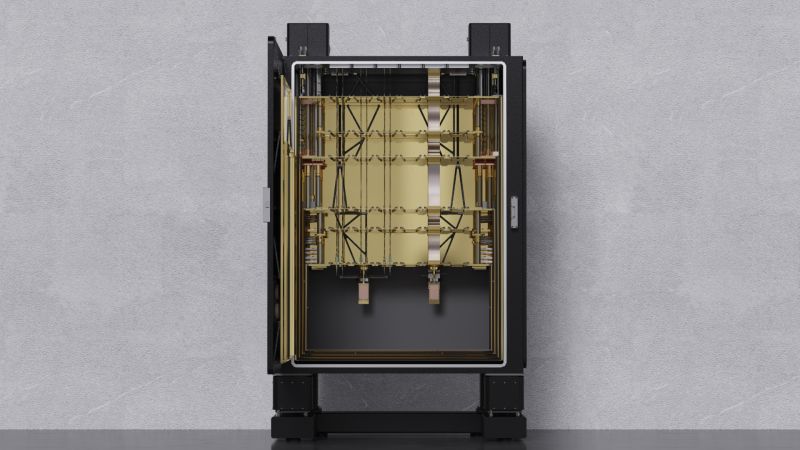
Maybell Quantum refrigeration systems revolutionized quantum cryogenics by supporting three times the qubits in one-tenth of the space compared to competing systems, making it easier for quantum computing companies to scale. Maybell dilution refrigerators increase computing performance, experimentation capacity, and reliability by reaching temperatures below 10 millikelvins (mK).
The Interlune Harvesting System
Interlune is pioneering new approaches to separate helium-3 from helium supplies on Earth and to harvest helium-3 on the Moon. The Interlune harvesting system includes novel technologies for excavating, sorting, extracting, and separating lunar soil or regolith to produce industrial quantities of helium-3 and other resources. Its harvester is smaller, lighter, and requires less power than other industry concepts, making it less expensive to transport to the Moon and operate once it’s there. The company is also developing novel technologies to separate helium-3 from domestic helium supplies using extremely cold temperatures, funded in part by a research grant from the Department of Energy Isotope Program (DOE IP).
The company has raised $18 million in venture capital seed funding. In addition to the DOE IP research grant, Interlune has received a NASA TechFlights grant and a National Science Foundation (NSF) Small Business Innovation Research (SBIR) Phase I award. The company is planning several missions to the Moon this decade.
SOURCE: Interlune