


Hawking Et Al
The University of Cambridge, like its bitter rival Oxford some sixty-miles to the south-west — if we’re talking in a straight line, avoiding the A421 by all means — is universally lauded for its intellectual achievements over the centuries. Its alumni include poet John Milton, Charles Darwin, Ludwig Wittgenstein, Alan Turing, Stephen Hawking, and, God help us, Ali G. Anyway, the people that have graduated have been some of the most esteemed in history, etching their imprint on our lives in more ways than one, even if we’re clueless to their contributions for the most part.
We’re in the era of quantum information science. Time for bits to move aside for qubits, smaller particles but with a whole lot more power for their size.
The University of Cambridge has a history in this respect, going back at least a hundred years. For one, the Cavendish Laboratory, established by William Cavendish, 7th Duke of Devonshire in the mid-19 century. James Clerk Maxwell, arguably the best physicist of that century, was up next. Since Maxwell’s time, a plethora of scientists has passed through. The greatest, in many people’s books, has been Ernest Rutherford, ‘the father of nuclear physics’. Professors Brian Pippard and Richard Friend, too, have followed in his footsteps, adding their own flavour to this storied history.
Moving into the new century, things changed. Quantum technology gathered pace. The 2000s and 2010s have been unprecedented in history when we talk about technological innovation.

The University of Cambridge has realized this. The UK is full of bright, innovative people with the will and an idea to make breakthroughs for our future in QC. Part of Cambridge’s strategy here in supporting this is its incubator program: Cambridge Enterprise, established to ‘support academics, researchers, staff and students in achieving knowledge transfer and research impact’.
Nu Quantum
One of the results of this has been the QC startup Nu Quantum, founded in 2018 and run by an ambitious group of academics and entrepreneurs that wants to:
Develop end-to-end quantum cryptography systems, securing communications within and between cities through urban and satellite free-space optical links
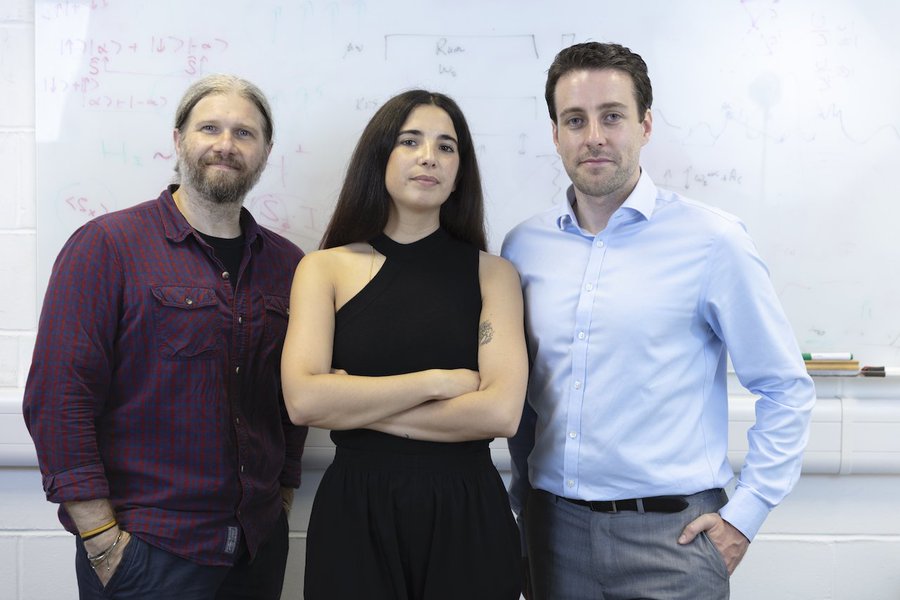
With a team of four scientists who all bring their unique perspective to the startup, Nu Quantum can certainly boast a brilliant central command as they embark on the QC journey.
CEO Carmen Palacios-Berraquero is an award-winning physicist who is a former president of the Women’s Society at the Cavendish while also being a past laureate of the Jocelyn Bell Burnell IoP Medal award back in 2018. She gained a Ph.D. from Cambridge in quantum information. If that wasn’t impressive enough, she used to be a researcher at the Quantum Optical Materials and Systems (QuOMS) group at Cambridge, too.
The startup’s CTO, Matthew Applegate, is a mathematician and computer scientist by training whose multidisciplinary knowledge of the space will be invaluable to the team’s strategy. He gained his Ph.D. from the University of Cambridge, and his research was focussed on the ‘implementation of a quantum random number generator based on photon number detection’.
Mete Atatüre, a professor of physics at the Cavendish Laboratory, obtained his Ph.D. at the Quantum Imaging Laboratory at Boston University in the early 2000s. From there, he became a postdoctoral fellow in the Quantum Photonics Group at ETH Zurich before joining Cambridge as a lecturer in 2007. In 2015, he became a professor. Currently, Atatürespecializes in ‘optical control of single and multiple quantum-dot spins, high-resolution spectroscopy of diamond-based emitters, solid-state cavity-QED and nanoplasmonics’.
‘Nu Quantum is developing high-performance quantum photonics hardware that works at the single photon-level, at room temperature. These quantum components are the necessary building blocks for any quantum architecture.’
— Nu Quantum CEO Carmen Palacios-Berraquero
Backing up all this academic scope is Yuri Andersson, Nu Quantum’s CBO. An entrepreneur whose first startup came into being some two decades ago, he has also founded technology innovation advisory and investment firm NablaVentures, co-founded QLM Technology Ltd, a startup ‘applying the latest quantum technologies to environmental monitoring of greenhouse gases’ and Andersson’s most recent incarnation, Angoka, a startup which focusses its business on network security. With a degree in applied physics/electrical engineering, he was also a Ph.D. candidate in astronomy at the University of Cape Town. He also holds an Executive MBA from the London Business School.
Quips, Quotes, Quanta, Cash
Nu Quantum produces quantum machines that can emit, as well as detect, single-photons. Unlike other approaches out there, the team sees that the application of single photons will enable the startup to ‘arrive at a new era of communications, simulation, computing, sensing and metrology’.
All this is all well and good, but to achieve this will take funding.
Ernest Rutherford once said: ‘We’ve got no money, so we’ve got to think (at least that’s the case from the book Quips, Quotes, and Quanta: An Anecdotal History of Physics, written by Anton Z. Capri, a former professor of physics at the University of Alberta, which I’ve recently read).
Luckily that’s not the case here.
In October of last year, in a Pre-Seed round, Nu Quantum raised £650,000. The investment itself was led by venture capital firm Amadeus Capital Partners. IQ Capital, Ahren Capital, Cambridge Enterprise and Martlet Capital were also involved as minor investors.
On the investment, general partner of early-stage investment at Amadeus Capital Partners, Alex van Someren — who will also join the Nu Quantum team as a member of the board — had this to say: ‘Nu Quantum is poised to unlock the potential of quantum communication. Using this investment by Amadeus, Nu Quantum will address the challenge of cryptography first. Based on its single-photon sources and detectors, Nu Quantum aims to deliver high-rate.’
Over the last few weeks, as most of the planet is under lockdown and the world’s stock markets plummet to new-found depths, the startup scene — like all others — has been of little importance. When we get out of the medical quagmire, we can only hope startups like Nu Quantum have the tenacity of spirit to come out rosy on the other side.